
What Makes Albuquerque Different From Other Southwest Cities?
The Southwest contains a specific category of American city: large, sun-drenched, sprawling, growing. Phoenix, Las Vegas, Tucson, El Paso, Albuquerque — they share a climate category, a population trajectory, and a broad regional character. Ask someone who has not been to any of them what they are like, and you get a reasonable general description of all of them.
Spend a week in Albuquerque and you stop applying the general description. The city has too many characteristics that are not shared — not distributed across the Southwest category, but specific to this place in ways that compound into a character that no other Southwest city produces.
This guide identifies what those characteristics are and why they matter — not as a promotional exercise, but as an honest accounting of the specific things about Albuquerque that genuinely have no equivalent in any other Southwest city.
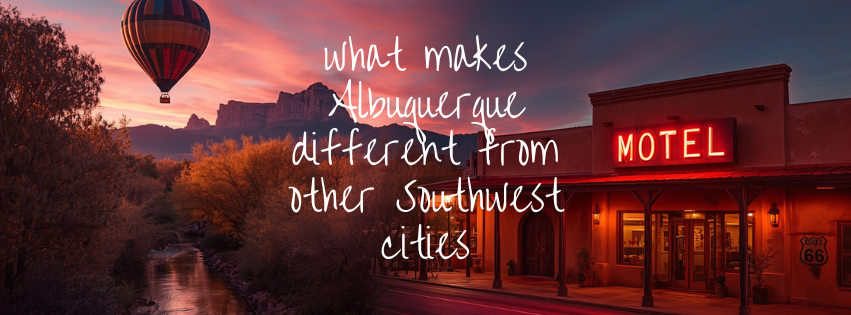
The Mountain Is Inside the City — Not Beside It
Most Southwest cities have mountains. Phoenix has the McDowell Mountains, the South Mountain range, the Superstitions. Tucson has the Rincon Mountains, the Santa Catalinas. Las Vegas has Red Rock Canyon. The pattern: mountains are accessible from the city, visible from the city, and reachable within 30 to 60 minutes of the city.
Albuquerque's relationship to the Sandia Mountains is different in degree to the point of being different in kind. The Sandia Mountains rise 5,000 feet above the valley floor — the equivalent of stacking the Empire State Building six times — from within the city's residential boundaries. The Tramway base station that launches the aerial car to 10,678 feet is in the Northeast Heights, minutes from residential streets. Hikers in the Sandia foothills are accessible from residential streets in the Northeast Heights on foot, without a drive.
This is not a scenic backdrop. It is a vertical mile of hiking, cycling, skiing, hang gliding, and rock climbing integrated into the city's daily life rather than positioned as a day trip destination. The consequence: Albuquerque residents have an outdoor lifestyle that is in practice, not just proximity — more active per capita than any comparable Southwest city, because the mountain is reachable on a Tuesday morning before work.
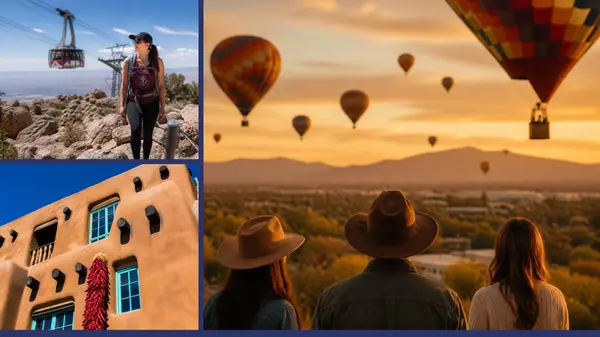
The Sandia Peak Aerial Tramway — at 3.5 miles the longest aerial tramway in North America — ascends 4,500 feet from the city to the crest in 15 minutes. Standing at the 10,678-foot summit, you can see the city 5,000 feet below you and 11,000 square miles of New Mexico in every direction. No other Southwest city offers this combination of urban base and mountain summit as a daily option.
New Mexican Cuisine Is Not Southwestern Cuisine — It Is Its Own Thing
"For nearly 500 years, cooks here have been blending Native American foods — like blue corn and squash — with chile peppers, wheat flour, pork and other ingredients that the Spanish settlers brought with them from Europe and Mexico," confirmed the Visit Albuquerque official cuisine guide. That 500-year timeline is not a metaphor. It is the literal culinary history that produces something that cannot be obtained in Phoenix, Las Vegas, or Denver.
Phoenix has good Mexican food — Sonoran style, influenced by Sonora, Mexico. Tucson has excellent Sonoran food and a Sonoran hot dog culture that is specific and excellent. But neither Sonoran nor Tex-Mex nor Californian Mexican food is New Mexican food. The distinction matters:
- The chile: Hatch green chile — grown in the Hatch Valley 90 miles south of Albuquerque — is a specific agricultural variety that produces a flavor, heat, and character that cannot be replicated with any other chile. The September chile roasting season, when the smell of roasting Hatch chile drifts across the city from grocery store parking lots, is a sensory experience that exists only here.
- The question: "Red or green?" is New Mexico's official state question, encoded in the legislature. Nowhere else in America is a food preference a political act. Nowhere else does the server's question determine your entire culinary experience in a way that is simultaneously casual and freighted with centuries of local meaning.
- Blue corn: A variety of corn specific to the Pueblo agricultural tradition, with a nuttier flavor and a slightly different nutritional profile than yellow or white corn. Blue corn tortillas, blue corn pancakes, and blue corn tamales are specific to New Mexico and reflect a culinary heritage that predates European contact.
- Sopapillas: The fried hollow pastry that arrives with honey as dessert or filled with meat and chile as an entree. Not a Mexican tradition, not a Tex-Mex tradition — a New Mexican tradition.
- The biscochito: New Mexico's official state cookie — an anise-flavored lard-based shortbread in star or fleur-de-lis shapes. The only state in the union to have adopted an official cookie. Found at New Mexico family holiday tables, not in any restaurant east of the Colorado border.
The James Beard recognition: Albuquerque's contemporary restaurant community has received national recognition through Char's 2024 James Beard Best Chef Southwest finalist designation. This is not a regional footnote — it is a national culinary institution recognizing that what Albuquerque is doing with New Mexican ingredients and technique is worth the country's attention.
The Native American Culture Is Living, Not Historical
"Albuquerque is recognized as one of the most culturally diverse cities in the country. Its ethnic tapestry is reflected in its architecture, art, cultural centers and cuisine. Countless customs and traditions that have been passed down over generations are a vibrant part of daily life in the city," confirmed the Visit Albuquerque official culture and heritage guide. More than 70 different ethnicities call Albuquerque home.
The critical distinction from every other Southwest city: the Native American cultural presence in Albuquerque is not a historical artifact. The 19 Pueblos of New Mexico — the sovereign nations whose ancestors built the civilization whose ruins are visible at Coronado Historic Site, at Kuaua Pueblo, at thousands of petroglyph sites on the Albuquerque West Mesa — are active, contemporary participants in the city's cultural life.
- The Indian Pueblo Cultural Center: Owned and operated by the 19 Pueblos. Not a museum about Native American culture, but a living institution controlled by its subjects. The Pueblo Harvest Café serves traditional feast day foods. The gallery shows contemporary Pueblo artists. The courtyard hosts traditional dances. This is the distinction that no other Southwest city's "arts district" or "cultural center" can replicate — the institution is governed by the culture it represents.
- The Gathering of Nations Pow Wow — Final Year 2026: North America's largest Pow Wow has been held in Albuquerque at Tingley Coliseum for 43 years, bringing thousands of dancers, singers, and artists from across North America. In 2026, the Gathering of Nations holds its final celebration — after 43 years, the event that has defined Albuquerque as North America's most significant annual gathering of Native American culture will close. Being present for the final year is being present for the conclusion of a 43-year cultural institution. No comparable event exists in Phoenix, Las Vegas, or Tucson.
- Petroglyph National Monument: 20,000+ images carved into volcanic basalt within the city limits by Pueblo people and their ancestors over 700 years. The most accessible urban-scale ancient art site in America — trail access from residential streets in the northwest side, free at Rinconada Canyon, $1-$2 parking at Boca Negra. Phoenix has no equivalent. Las Vegas has no equivalent. Tucson has Saguaro National Park, not ancient urban rock art.
The depth of Native American cultural presence in Albuquerque is not ornamental. It is structural — embedded in the place names, the architecture, the food, the agricultural traditions visible in the South Valley's acequia-irrigated farms, and the contemporary art market where Pueblo and Diné artists work in international-quality galleries accessible from Albuquerque's Old Town and Nob Hill corridors.
Route 66 at 100 — The Longest Urban Stretch in America
Route 66 was commissioned in 1926, making 2026 its centennial year. Albuquerque is celebrating the anniversary throughout the year with events on Central Avenue — Route 66's longest continuous urban stretch remaining in America.
What Central Avenue as Route 66 actually means: the original alignment of Route 66 runs through the center of Albuquerque as Central Avenue — the main street of the city, the commercial spine of Nob Hill, the corridor of the University of New Mexico, the road that the 66 Diner has been serving travelers on since 1987. The neon signs, the motor courts, the diner culture, and the specific roadside American aesthetic of Route 66 are present in Albuquerque not as theme park recreation but as the actual original infrastructure of the road.
No other Southwest city can say this. Las Vegas is not on Route 66. Phoenix is not on Route 66. Tucson is not on Route 66. Albuquerque is Route 66's largest surviving urban section, and the 2026 centennial has produced the largest Route 66-specific cultural programming the city has hosted — events throughout the year honoring the road's specific relationship to American mobility, American culture, and Albuquerque's character as a crossroads city.
The Balloon Fiesta — The Largest Hot Air Balloon Event on Earth
The Albuquerque International Balloon Fiesta is the largest hot air balloon festival in the world — 700+ balloons, October, nine days, the specific combination of Albuquerque's unique wind pattern (called the "Albuquerque Box") and its high-desert clear skies that makes the city the most technically favorable balloon flying location in the world.
The Albuquerque Box is the specific atmospheric phenomenon that makes Balloon Fiesta possible in the form it takes. Wind conditions in the Rio Grande valley create a layered airflow system where balloons can be flown at different altitudes in different directions simultaneously — allowing pilots to navigate back to the launch field without propulsion. No other city in the world has this specific atmospheric characteristic at the scale that makes mass ascensions of 700+ balloons logistically possible.
The Mass Ascension — when hundreds of balloons launch simultaneously from the field at dawn — is annually one of the most photographed events in the world. The specific visual of hundreds of colorful spheres lifting into the clear October sky with the Sandia Mountains as backdrop is the image that represents Albuquerque in every national and international publication. No comparable visual exists for Phoenix, Las Vegas, or any other Southwest city.
The free viewing opportunity from the bosque and surrounding neighborhoods — available without a ticket — is covered in our lifestyle guides and is the specific detail that distinguishes Albuquerque's Balloon Fiesta from other festivals. The event is not experienced only by those who buy tickets. It fills the sky for the surrounding neighborhoods and the entire north valley for nine October mornings.
The Light — Georgia O'Keeffe Came for It and Never Left
New Mexico's light has been noted by artists, filmmakers, and photographers for more than a century — not as a subjective preference but as a specific atmospheric quality that produces visual results unavailable elsewhere. The combination of high altitude (5,280 feet), low humidity, clear air, and the specific color-rendering properties of the desert's geology and vegetation creates light that is categorically different from what lenses capture in lower, wetter, or less geologically varied environments.
Georgia O'Keeffe came to New Mexico in 1929 and spent the rest of her career here — not because the abstract expressionist movement was happening here (it was not), but because the light and the landscape produced the visual experience that her work required. The Albuquerque photographers, filmmakers, and painters who cite the light as the reason they specifically came here and specifically stayed are in a tradition that Georgia O'Keeffe established.
The practical consequence: Albuquerque has attracted a creative community — painters, photographers, filmmakers, writers — whose presence is disproportionate to the city's size because of the specific quality of the working environment the light provides. This creative community contributes to the Nob Hill arts corridor, the First Friday ARTScrawl, the gallery concentration, and the James Beard-recognized restaurant scene. The light is infrastructure as much as the mountain.
Albuquerque has hosted more than 800 film and television productions — Breaking Bad, Better Call Saul, Young Guns, No Country for Old Men, The Avengers, and hundreds of others — specifically because of the light, the landscape, and the production infrastructure that follows a location-based industry. The city's relationship to film and television production is not incidental. It is a consequence of the same atmospheric quality that brought O'Keeffe.
Three Geological Eras Visible Simultaneously — The Most Dramatic Urban Landscape in the Southwest
From the Balloon Fiesta field or from the Paseo del Bosque Trail, Albuquerque's full geological biography is visible in a single gaze. Looking west: the five extinct volcanic cinder cones of the Petroglyph National Monument area, formed 150,000 to 190,000 years ago, whose lava flow created the black basalt escarpment that holds the petroglyphs. Looking at your feet: the ancient Rio Grande floodplain, a river-valley geology 10,000+ years in formation. Looking east: the Sandia Mountains — 1.4 billion-year-old granite, some of the oldest exposed granite in the world, thrust upward along the Sandia fault to 10,678 feet.
Three geological eras — Precambrian granite, Pleistocene volcanic flow, Holocene river valley — visible from the same urban viewpoint. The geological drama of Albuquerque's landscape is not a marketing phrase. It is the literal stratigraphic biography of a landscape that was in formation for 1.4 billion years and is now a city.
No other Southwest city has this. Phoenix sits in a basin ringed by mountain ranges but does not have the active geological conversation that Albuquerque's landscape produces. Tucson is beautiful but its mountains are older and more eroded, its city less dramatically positioned at the interface of valley and mountain. Las Vegas is in a basin with no mountain within the city boundary. Albuquerque is the city that the geology built for the specific visual experience it produces.
Albuquerque vs. Other Southwest Cities — The Direct Comparison
vs. Phoenix — The Most Common Comparison
Phoenix is larger, hotter, flatter, and more generic. The McDowell Mountains and South Mountain are accessible but not within the city's neighborhood fabric in the way the Sandia Mountains are in Albuquerque. Phoenix's food scene is excellent and diverse — but it does not have New Mexican cuisine because New Mexican cuisine does not exist in Phoenix. The Sonoran hot dog is Phoenix's specific food identity, which is genuinely excellent and genuinely different; the point is not that Phoenix is lesser, but that its specific cultural identity is distinct from and shallower than Albuquerque's 700-year cultural accumulation.
Phoenix has the Sun Belt growth story — massive, rapid, successful, generically modern. Albuquerque has a different relationship to time. The 1706 Old Town plaza is still the city's geographic center. The Pueblo communities that predate European settlement are still the region's cultural foundation. The temporal depth is not manufactured. It is simply present in a way that a city that did not substantially exist in 1900 cannot manufacture.
vs. Tucson — The Closest Comparison
Tucson is the closest comparison city — also a university city, also desert outdoor culture, also diverse population, also below national cost-of-living average. The distinctions that matter: Albuquerque's mountains are more dramatically positioned relative to the city (Sandias rising from within the city vs. Tucson's more peripheral ranges). Albuquerque's Native American cultural presence is more central and more institutional. New Mexican cuisine has no Tucson equivalent. Albuquerque's film production industry is larger. Tucson's Sonoran character is more consistent and more geographically homogeneous.
Both are genuinely good cities. The Albuquerque-vs-Tucson question for a relocating household comes down to which specific cultural character is more resonant — the Pueblo-Spanish-New Mexican synthesis of Albuquerque or the Sonoran-Arizona-border character of Tucson. Neither is wrong.
vs. Las Vegas — The Least Comparable
Las Vegas and Albuquerque share a Nevada/New Mexico desert climate category and approximately nothing else. Las Vegas is the city that performs for you. Albuquerque is the city that lives for itself. The distinction is not a value judgment — Las Vegas does what it does better than any other city in the world. But the comparison helps clarify what Albuquerque is: a working city with genuine cultural depth, genuine outdoor access, genuine community character, and no requirement that you be entertained or that the city perform for you.
The 2026 Moment — What Is Happening This Year Specifically
Two time-specific 2026 events make this year a particularly significant moment to be in Albuquerque:
- Route 66 Centennial: Route 66 was commissioned on November 11, 1926, making 2026 its 100th anniversary. Albuquerque — home to the longest continuous urban stretch of Route 66 in the country — is hosting centennial events along Central Avenue throughout the year. The centennial is bringing Route 66 historians, road trippers, and cultural events to the city's central corridor in a way that does not happen in any other year.
- The Final Gathering of Nations Pow Wow: After 43 years, the Gathering of Nations Pow Wow — North America's largest, held at Tingley Coliseum — will close with one final celebration in 2026. The event has brought thousands of Native American dancers, singers, artists, and visitors from across North America to Albuquerque every year since 1983. Its final year is a moment of cultural significance that will not be repeated. Being present for the final Gathering of Nations is being present for the conclusion of North America's most significant annual gathering of Native American culture.
For the complete picture of what Albuquerque offers throughout the year — the full activity landscape that makes the city a compelling place to live rather than just visit — our guide to things to do in Albuquerque covers the full experience. And for the financial case for choosing Albuquerque over comparable Southwest cities, our Albuquerque cost of living guide for 2026 covers the complete affordability picture.
The Honest Answer — What Albuquerque Is That No Other City Is
Every city has a version of what makes it different from others. Most of those versions are true but not decisive — comfortable but not irreplaceable.
Albuquerque's differences are geographic and historical rather than constructed, which makes them irreplaceable rather than replicable. The Sandia Mountains cannot be moved to Phoenix. The 500-year New Mexican food tradition cannot be transferred to Las Vegas. The Pueblo-owned cultural institutions cannot be replicated by any city that was founded in the 19th or 20th century. The Route 66 alignment that runs through the center of the city cannot be recreated in Tucson. The Albuquerque Box wind pattern that makes the Balloon Fiesta possible is specific to this geography.
These characteristics compound. A city with a mountain at its edge plus a living 500-year food tradition plus the world's largest balloon festival plus the longest aerial tramway in North America plus the most significant annual gathering of Native American culture in North America plus the longest urban Route 66 stretch is not comparable to any other Southwest city. It is specifically itself.
That is what the phrase "Land of Enchantment" is reaching for — not magic, but the specific quality of a place that produces experiences that cannot be accessed anywhere else. Albuquerque is that place in the Southwest. Not the most obviously glamorous. Not the largest or the fastest-growing. The most specific. And in a culture of genericism, specific is rare.
Ready to See Albuquerque for Yourself?
Jenn & Vinay from The Rodgers Neighborhood Real Estate Group have been guiding buyers to the specific Albuquerque neighborhoods that fit each person's vision of what the city can mean for them — the foothills home where the mountain trail starts at the end of the street, the Nob Hill walkable neighborhood where the gallery and the Frontier are both within walking distance, and the North Valley property where the acequia runs behind the lot and the cottonwoods turn gold in October. If Albuquerque's specific character is what brought you to this conversation, the next step starts with a call.
Jenn & Vinay Rodgers are Albuquerque's trusted real estate professionals with The Rodgers Neighborhood Real Estate Group, brokered by Real Broker, LLC, serving buyers and sellers across Albuquerque, Rio Rancho, Corrales, Los Lunas, Tijeras, Cedar Crest, Sandia Park, the East Mountains, Bernalillo County, Sandoval County, and surrounding New Mexico communities.
The Rodgers Neighborhood Real Estate Group
Jenn & Vinay Rodgers
Real Broker, LLC
Albuquerque, NM
📞 505-417-2733
🏠 Find your home in the city that doesn't resemble any otherCategories
- All Blogs (352)
- 2026 & Beyond for Real Estate (246)
- Doctors and Nurses looking for homes in NM (4)
- Guide to buying a home in NM (158)
- Health Care Heros (7)
- Home Upgrades (40)
- Jenn & Vinay your Local Real Estate Experts! (120)
- Moving to Albuquerque (135)
- Neighborhoods in Albuquerque NM (93)
- Rent or Own (2)
- Sellers Questions for Selling homes (2)
Recent Posts

GET MORE INFORMATION