
How Living Near Great Schools Can Increase Your Home's Resale Value
DISCLAIMER: School zone assignments and school ratings change over time. Always verify current school zone assignment at the specific address level using myschool.aps.edu before making any purchase decision based on school zone. School quality data changes annually. This guide is informational; we are not licensed educators and do not provide educational advice.
The relationship between school quality and home values is one of the most thoroughly researched topics in residential real estate economics — and one of the most consistently relevant in Albuquerque's market, where school zone boundaries create some of the largest price differentials available within any single city in New Mexico. This guide covers both the national research and the specifically Albuquerque data.
The National Research — What the Data Consistently Shows
"Homes in highly rated school districts typically cost 10% to 20% more than similar properties in average-performing areas. In some markets, that premium jumps to 49% or higher. Research from the National Bureau of Economic Research found that every dollar a community spends on public schools increases home values by $20. Properties near schools rated 8 or higher on platforms like GreatSchools sell faster and command higher prices than homes in districts rated below 5," confirmed Opendoor's research guide on how school ratings impact home prices (November 2025).
Five key findings from national research:
- The price premium range: Homes near highly rated schools (GreatSchools 9-10) cost 10-49%+ more than comparable homes in lower-rated districts. Realtor.com research found homes near GreatSchools 9-10 rated schools cost over 78% more than properties in the surrounding county average. The specific premium depends on market conditions, housing supply, and the degree of school quality differentiation in the local market.
- The speed premium:com found that homes in high-performing school districts sell eight days faster than homes in other areas. In a market where every additional day on market increases the likelihood of a price reduction, the eight-day speed advantage translates to real dollars.
- The viewing premium: NAR data shows that online listings of homes in good school districts receive 26 more views than the average listing. More views produce more showings; more showings produce more offers.
- The school spending relationship: The NBER research finding — that every $1 increase in school spending per student increases home values by $20 — confirms that the school quality premium is not only about current performance but about ongoing community investment in education.
- The non-parent buyer effect: Research consistently shows that buyers without school-age children also pay the school zone premium. The reason: even buyers who do not need the schools today understand that future buyers will. The school zone premium at purchase becomes the school zone premium at resale.
Why the School Zone Premium Exists — The Three Mechanisms
"Homes in top-rated school districts tend to attract more buyers — and it's not just families with kids. That demand often drives up prices and helps prop up property values. Approximately 30% of buyers aged 33-42 — likely to have young children — consider quality of the school district as a top factor when selecting a neighborhood," confirmed New American Funding's education premium guide (August 2025).
Mechanism 1 — Active Family Demand Creates Competition
The 30-42% of buyers aged 33-41 who prioritize school quality are competing for limited supply in high-rated zones. When more qualified buyers want fewer available homes, prices rise. This demand is not conditional on interest rates, economic cycles, or broader market conditions — it is structural. The number of families with school-age children in Albuquerque does not change dramatically with the mortgage rate environment. The competition for La Cueva zone homes is driven by demographic constants, not market trends.
Mechanism 2 — Non-Family Buyers Pay for Future Resale
Every buyer without school-age children who purchases in a premium school zone is making a rational investment calculation: the buyers who will be competing for this home when I sell in 10 years will include the same proportion of school-motivated families. The school zone premium that I pay today will be the school zone premium I capture at resale. This future-value reasoning makes school zone premium homes specifically less price-sensitive than comparable homes outside premium zones.
Mechanism 3 — The School Zone Halo Effect
Highly regarded schools produce a "halo effect" on nearby neighborhoods — they are associated with greater community stability, higher incomes, better access to resources, and lower crime rates. Whether or not this association is strictly causal (better schools cause lower crime) or correlative (well-resourced communities produce both better schools and lower crime), the buyer perception is consistent. Homes in premium school zones are perceived as being in better communities — and that perception drives behavior and prices.
The Albuquerque School Zone Picture — Where the Data Is Most Dramatic
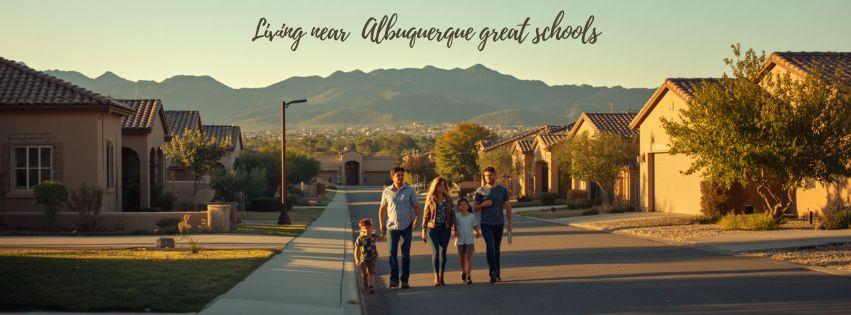
In Albuquerque, the school zone premium is not a national abstraction. It is a specific, measurable, street-by-street price differential that represents some of the most concentrated value in the city's residential market.
The La Cueva Zone (87122) — The Premium That Numbers Confirm
The La Cueva High School zone in northeast Albuquerque (primarily ZIP code 87122, North Albuquerque Acres and adjacent neighborhoods) is the city's premium residential real estate zone — and it is specifically the premium school zone that produces this value:
- Q1 2026 median home value: $855,000 — the highest of any identified Albuquerque neighborhood or zone.
- Q1 2026 appreciation rate: +10.32% year-over-year — the highest single-zone appreciation rate in the Albuquerque market in Q1 2026.
- Demographic correlation: 74% of adults in the 87122 ZIP code hold bachelor's degrees or higher — the highest educational attainment rate in any Albuquerque ZIP code. The professional community that specifically values school quality self-selects into this zone.
- The La Cueva premium over the citywide median: $855,000 vs. $355,000-$387,500 citywide — a premium of approximately $470,000-$500,000. The premium is not entirely attributable to school quality (the acreage lots, mountain views, and North Albuquerque Acres character also contribute), but the school zone is the most consistent single variable that differentiates this zone from comparable-quality homes in other parts of the city.
- Market behavior: Correctly priced La Cueva zone homes go pending in 12-19 days. The most precisely school-zone-motivated buyer pool in Albuquerque produces the market's fastest-selling premium homes.
The Eldorado Zone (87111) — The Accessible Premium Alternative
The Eldorado High School zone (primarily 87111) is the most commonly identified alternative for buyers who want premium school zone quality at a lower entry price point:
- Eldorado High School Niche rating: A grade.
- Price point vs. La Cueva: Typically 20-30% lower than comparable homes in the La Cueva zone — offering the school quality premium at a more accessible purchase price. For buyers who want to be in an APS premium zone and need the school zone premium for resale but cannot reach the La Cueva zone price floor, the Eldorado zone is the most practical alternative.
- The investment case: A buyer who purchases in the Eldorado zone at a 20-30% discount to La Cueva captures a zone that has historically appreciated alongside La Cueva, serves the same school-motivated buyer demographic at resale, and enters at a lower absolute cost. The long-term premium capture is real.
Rio Rancho Public Schools — The Sandoval County Option
For buyers who consider Rio Rancho as an alternative to Albuquerque, the Rio Rancho Public Schools (RRPS) is the relevant district:
- Niche rating: B+ — the most commonly cited Niche grade for Rio Rancho Public Schools.
- The price and tax advantage: Rio Rancho homes are generally priced 10-15% below comparable Albuquerque Northeast Heights homes, and Sandoval County's effective property tax rate (0.71%) is lower than Bernalillo County (0.84%). The buyer who chooses Rio Rancho specifically for RRPS captures a school quality premium at a lower purchase price and lower annual property tax cost.
- The appreciation pattern: Rio Rancho's Intel CHIPS Act employment growth is specifically driving residential demand that should sustain appreciation in RRPS-zone homes through the 2026-2030 period as Intel employment ramps up.
The Boundary Effect — The Street-Level Precision That Matters Most
The most practically important school zone fact for any Albuquerque buyer: school zone assignment is a street-level determination, not a neighborhood determination. Two homes on opposite sides of the same street can be in different school zones — with value differentials of $20,000-$50,000 that are attributable entirely to the zone boundary that runs between them.
This is the most consistently underestimated home value variable in Albuquerque real estate. Buyers who purchase by neighborhood rather than by verified school zone assignment may find at resale that their home is in a less competitive zone than they assumed — with a correspondingly smaller buyer pool and a lower price realization.
- The APS school zone locator:aps.edu — the official tool for verifying the elementary, middle, and high school assignment for any specific Albuquerque address. This is not a neighborhood-level tool. It is an address-level tool that identifies the specific schools assigned to 1423 Specific Street NW vs. 1427 Specific Street NW, which may be in different zones.
- The verification requirement: Any Albuquerque buyer who is purchasing in part for school zone reasons must verify the school zone assignment at the specific address of the specific property they are considering — not the neighborhood, not the ZIP code, not the street, but the specific house number. Zone boundaries shift. Properties that appear to be in a zone may not be.
- The practical due diligence sequence: (1) Enter the specific property address at myschool.aps.edu. (2) Confirm the elementary, middle, and high school assignment. (3) Verify the school's current Niche grade or GreatSchools rating at the identified school (not the zone, the school). (4) Confirm that the school's rating is current — ratings change annually.
The School Zone Premium for Sellers — What It Means When You List
For Albuquerque sellers in premium school zones, the school zone is not just a feature — it is the marketing anchor of the listing. The family buyer who is searching specifically for the La Cueva zone or the Eldorado zone is using the school zone as the primary filter before they consider price, square footage, or neighborhood amenities.
- List the school zone prominently: The listing description should identify the specific high school, middle school, and elementary school assigned to the property in the headline or the first paragraph. "La Cueva zone" or "Eldorado zone" should appear in the listing before the bedroom count.
- Price with the zone in mind: Comparable sales within the specific school zone are the most relevant comps for a premium zone property — not comparables from adjacent zones that look physically similar but lack the school zone assignment. The school zone comp premium is real and should be specifically captured in the pricing analysis.
- Market to the school-zone buyer specifically: The listing marketing for a La Cueva zone home should reach the family demographic that is specifically researching school zones — not just the general buyer market. The buyers who pay the school zone premium are the buyers who are searching for it.
The School Zone Premium for Buyers Without School-Age Children
The most consistent misunderstanding about school zone home value: the belief that buyers without school-age children should not pay the school zone premium because they will not use the schools. The data consistently refutes this reasoning:
- The future buyer calculation: Even if you have no children, the family who buys your home in 10 years will evaluate the school zone. The premium you pay today is the premium you recover at resale — from the same school-motivated buyer demographic that drove the price when you purchased.
- The market depth advantage: A premium school zone home has a deeper buyer pool than a comparable home outside the zone. More potential buyers = more competition at resale = better price realization. The non-parent buyer who avoids the school zone premium has a shallower buyer pool at resale — specifically the buyers who do not care about schools, which is the minority.
- The downside protection: In market downturns, premium school zone homes consistently outperform non-zone homes in price stability. The demographic demand for school zone access does not disappear in a market correction the way speculative or investor demand does. The school zone premium provides specific downside protection that comparable non-zone homes do not.
What Diminishes the School Zone Premium — Risks to Understand
- School zone reassignment: APS periodically reassigns neighborhoods to different schools as demographic patterns change. A home that is in the La Cueva zone today may be reassigned in a future APS boundary adjustment. While these changes are infrequent, they can materially affect the home's zone-based premium. Research the stability of the zone boundary in the specific area before purchasing.
- School quality change: School ratings change annually as performance data is updated. A school rated A in 2024 may receive a different rating in 2026 based on updated test scores, teacher retention, and other factors. The premium is sustained only as long as the school quality that created it is sustained.
- Private school growth in the area: The growth of private school options in a neighborhood reduces the school-zone-motivated buyer pool proportionally, as some families who might have paid the public school zone premium instead opt for private education and apply that premium budget elsewhere.
- The premium ceiling: In some Albuquerque neighborhoods, the school zone premium is already fully priced in. Buyers who pay a 30% premium over the citywide median to be in the La Cueva zone should understand that they are not finding an undiscovered value — they are paying the current market price for the zone. The question is whether the zone will sustain and grow that premium over their holding period, not whether they are purchasing at a discount.
For the complete guide to the best family-friendly neighborhoods in Albuquerque with school zone information — including the specific schools and their Niche ratings for each neighborhood — our post on the best family-friendly neighborhoods in Albuquerque with schools covers the complete family neighborhood guide. And for the complete analysis of how school districts specifically affect home values in the Albuquerque market — with the zip code level data — our post on how school districts affect home values in Albuquerque covers the detailed analysis.
The Albuquerque School Zone Reference Guide
- APS school zone verification:aps.edu — address-level lookup required, not neighborhood or ZIP code
- School ratings:org and niche.com for current school-level ratings
- La Cueva zone (87122): Highest premium, $855K median Q1 2026 (+10.32% YoY), 74% bachelor's degree+
- Eldorado zone (87111): Accessible premium alternative, Niche A grade, 20-30% below La Cueva entry
- Rio Rancho Public Schools: B+ Niche, Sandoval County 0.71% tax rate, Intel employment proximity premium
- School boundary changes: Monitor APS redistricting proposals at aps.edu for any zone boundary adjustments
- Annual rating updates: Verify current school ratings at greatschools.org and niche.com before any purchase decision
The Bottom Line — School Zone Is the Most Durable Home Value Variable
The research is consistent: living near great schools increases home resale value. The mechanism is consistent: family demand for school access, non-family demand for resale protection, and the community stability halo effect combine to create a premium that is more durable than most other home value variables. The premium survives interest rate changes, economic cycles, and market corrections in a way that location amenities, architectural character, and renovation quality do not.
In Albuquerque specifically, the school zone premium is measurable at the street level and substantial at the zone level. The $470,000 gap between the La Cueva zone median and the citywide median is not entirely school-driven — but the school zone is the most consistent single variable that explains why a home in 87122 commands the premium that a comparable home elsewhere in the city does not. Buyers who purchase with the zone in mind buy with a structural advantage; sellers who list in the zone with the zone prominently identified reach the buyers who will pay for it.
Want Help Identifying the Best School Zone for Your Albuquerque Home Search?
Jenn & Vinay from The Rodgers Neighborhood Real Estate Group verify the school zone assignment for every home our buyers seriously consider — at the specific address level using the APS school locator — and provide the comparable sales analysis within the specific zone rather than the broader neighborhood. We know which Albuquerque school zones produce the most durable premiums, which have been subject to boundary adjustment risk, and which offer the best value for buyers who want premium school access at accessible prices. The conversation about school zone and home value in Albuquerque starts with a buyer consultation.
Jenn & Vinay Rodgers are Albuquerque's trusted real estate professionals with The Rodgers Neighborhood Real Estate Group, brokered by Real Broker, LLC, serving buyers and sellers across Albuquerque, Rio Rancho, Corrales, Los Lunas, Tijeras, Cedar Crest, Sandia Park, the East Mountains, Bernalillo County, Sandoval County, and surrounding New Mexico communities.
The Rodgers Neighborhood Real Estate Group
Jenn & Vinay Rodgers
Real Broker, LLC
Albuquerque, NM
📞 505-417-2733
🏠 Search Albuquerque homes by school zoneCategories
- All Blogs (340)
- 2026 & Beyond for Real Estate (235)
- Doctors and Nurses looking for homes in NM (4)
- Guide to buying a home in NM (152)
- Health Care Heros (7)
- Home Upgrades (40)
- Jenn & Vinay your Local Real Estate Experts! (116)
- Moving to Albuquerque (132)
- Neighborhoods in Albuquerque NM (91)
- Rent or Own (2)
- Sellers Questions for Selling homes (2)
Recent Posts


GET MORE INFORMATION