
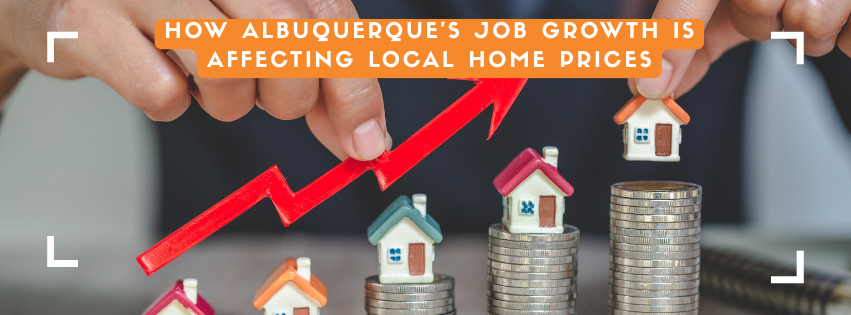
How Albuquerque's Job Growth Is Affecting Local Home Prices
Steady hiring from healthcare, tech, and defense sectors is pushing buyer demand higher, tightening inventory, and driving Albuquerque's median detached home sale price to a record $387,500 by mid-2026.
Why This Matters Right Now in Albuquerque
If you are thinking about buying your first home in Albuquerque, New Mexico, you are stepping into a market shaped by forces that go well beyond interest rates. The city's job engine, anchored by Sandia National Laboratories, Kirtland Air Force Base, Intel's nearby Rio Rancho campus, and a booming healthcare sector at Presbyterian and UNM Health, is pulling new buyers into the market faster than sellers can keep up. That demand pressure is real, and we see it every single day.
With 12 years helping buyers navigate Albuquerque's neighborhoods and over 250 closed transactions under our belts, we can tell you this: the connection between local employment and home prices has never been more direct. Inventory sits at just 1,802 homes as of early July 2026, while 1,135 pending sales signal buyer activity running ahead of last year. If you are a first-time buyer, understanding this job-to-housing pipeline is not optional. It is the key to making a smart, well-timed purchase.
Which Albuquerque Industries Are Fueling Buyer Demand
You might wonder which employers are actually creating the competition you will face when you start your home search. Let us break it down.
Healthcare and education led the charge, adding 1,900 jobs (a 2.6% gain) in the most recent annual period. The information and tech sector surged by 7.7%, a stat driven partly by a cybersecurity boom that is projected to grow 32% through 2032, with average salaries reaching $88,412. Meanwhile, Sandia National Laboratories and Intel continue actively recruiting, drawing candidates from across the country who need housing the moment they arrive.
What does that actually mean for you at the kitchen table reviewing listings? It means that when a well-maintained three-bedroom hits the market in the Northeast Heights near Juan Tabo Blvd., you are not just competing against other Albuquerque locals. You are competing against a Sandia Labs engineer relocating from California and a cybersecurity analyst moving from Denver, both of whom see Albuquerque's cost of living (4% below the national average) as a bargain compared to where they came from.
One couple we recently worked with, both healthcare professionals at UNM Hospital, assumed they had plenty of time to browse. By the time they found a home near Montgomery and Eubank, they were competing against four other offers, three of which came from out-of-state relocators. We helped them structure a winning offer, but it was a wake-up call about how Albuquerque's hiring pipeline directly translates into housing competition.
The Out-of-State Relocation Factor
Albuquerque's median sale price remains roughly 13% below the national average. That price gap is a magnet for remote workers and transferees from Denver, Phoenix, and Austin. As top Albuquerque Realtors, we track this pattern closely: relocation buyers tend to shop in the $350,000 to $500,000 range, which is exactly the sweet spot where most first-time buyers are looking.
How Albuquerque's Tight Inventory Is Pushing Prices Higher
Here is the supply side of the equation, and it is just as important as demand. For the week ending July 10, 2026, Albuquerque's inventory dropped below last year's levels. The Market Action Index sits at 38.5, confirming a slight seller's market. The median list price has climbed to $440,120, while the median pending price is $385,000.
So why is supply so constrained? Existing homeowners who locked in mortgage rates below 4% during 2020 and 2021 have very little incentive to sell and re-buy at today's higher rates. That "lock-in effect" removes homes from the market that would normally turn over. Combined with construction sector job losses of 2,400 positions (an 8.6% decline), fewer new homes are being built to offset the shortage.
What we tell our clients is this: do not wait for a flood of new listings to bring prices down. The data does not support that expectation. Expert analysis points to approximately 2.5% average home price appreciation during 2026, and a housing crash in New Mexico remains unlikely given the absence of overbuilding or high-risk lending conditions.
Where Albuquerque First-Time Buyers Should Focus Their Search
Not every Albuquerque neighborhood responds to job growth the same way. Here is how two of the most popular areas are trending, and what that means for your budget.
Nob Hill: Walkable, Competitive, and Climbing
If you want the walkable, artsy vibe along Central Avenue and Historic Route 66, expect home values in the $320,000 to $430,000 range. Nob Hill's proximity to UNM, its Walk Score of approximately 80, and the ART rapid transit line make it a favorite for young professionals employed at the university and nearby hospitals. Flying Star Café, Scalo Northern Italian Grill, and the iconic Nob Hill neon sign make this neighborhood feel alive at every hour. Monte Vista Elementary carries a GreatSchools rating of 6 out of 10, and Albuquerque High School holds a Niche grade of B.
The catch? Nob Hill's walkability premium means you pay more per square foot, and well-maintained bungalows near Girard and Central move fast.
Northeast Heights: Foothills Living Near the Jobs
The Northeast Heights, stretching along the Sandia foothills corridor from Candelaria to Tramway, is where many Sandia Labs and UNM Medical employees target their searches. The typical median falls in the mid-$300,000s to mid-$400,000s, with homes closer to Tramway pushing into the $450,000 to $550,000 range. The intersection of Eubank and Montgomery anchors the commercial hub, and our office on Juan Tabo Blvd. NE puts us right in the heart of this neighborhood.
A first-time buyer we worked with last spring was a cybersecurity analyst who had just accepted a position at Sandia Labs. She initially looked in the far West Side for lower prices, but after we showed her how a Northeast Heights home cut her commute to 15 minutes and positioned her in a neighborhood appreciating at a faster clip, she pivoted. She closed on a three-bedroom near Candelaria for under $400,000 and is already seeing equity growth.
Albuquerque Programs That Help First-Time Buyers Compete
Even with prices climbing, New Mexico offers powerful tools for first-time buyers that many people overlook:
- FirstHome Program: Housing New Mexico's primary mortgage program for first-time buyers financing single-family properties
- FirstDown Plus: A $15,000 down payment assistance loan at 0% interest, forgiven after 10 years of continuous occupancy
- HomeNow Program: Provides $7,000 toward down payment and closing costs for buyers earning at or below 80% of area median income, also at 0% interest and forgivable after 10 years
- FHA Loans: Require as little as 3.5% down (approximately $13,563 on a $387,500 home)
- VA and USDA Loans: Zero down payment for eligible borrowers, particularly relevant near Kirtland Air Force Base
With our average client review rating of 5 out of 5 stars across 20 reviews, one theme comes up repeatedly: people appreciate that we walk them through these programs step by step. As one past client shared, "Vinay was absolutely fantastic, explained everything taking me from start to finish. No question unanswered."
You need a minimum credit score of 620 and a $500 personal contribution that cannot come from gift funds. Pre-purchase counseling is also required. These are easy hurdles when you know about them in advance, but they trip up buyers who go in unprepared.
What Albuquerque's Job Market Means for Your Long-Term Investment
Should you worry about buying at a record-high median? Here is the honest answer. If you are buying a home in Albuquerque to live in for five or more years, the city's economic stability works in your favor. Albuquerque's economy moves at a steadier pace than national averages. When the broader economy slows, New Mexico tends to stay more resilient. That resilience, combined with persistent demand from defense, healthcare, and tech employers, supports gradual appreciation rather than boom-bust cycles.
Average weekly wages in Albuquerque reached $1,232 in Q3 2025. That is below the national average of $1,459, but the lower cost of living here helps balance your purchasing power in ways that matter when you are calculating your monthly mortgage payment versus rent at $1,300 to $1,650 per month.
Frequently Asked Questions About Albuquerque Job Growth and Home Prices
Is Albuquerque's housing market expected to crash in 2026?
A crash remains unlikely. New Mexico does not show signs of overbuilding or high-risk lending conditions. Inventory remains tight at 1,802 homes, and buyer demand from steady employment sectors continues. The more probable outcome for 2026 is gradual price stabilization with approximately 2.5% appreciation, not a sharp correction.
How much do I need for a down payment on an Albuquerque home?
With the median detached home at $387,500, a 3.5% FHA down payment comes to roughly $13,563. Programs like FirstDown Plus can provide an additional $15,000 in forgivable assistance. VA and USDA loans offer zero-down options for eligible buyers.
Which Albuquerque neighborhoods are most affordable for first-time buyers?
Southeast Albuquerque offers entry points in the mid-$200,000s to low $300,000s. Downtown (ZIP 87102) has the lowest median home value at $241,332. Nob Hill starts around $320,000, and the Northeast Heights typically begins in the mid-$300,000s.
What industries are driving job growth in Albuquerque?
Healthcare and education added 1,900 jobs recently (2.6% growth). The information sector grew 7.7%. Cybersecurity is projected to grow 32% through 2032. Sandia National Laboratories, Kirtland Air Force Base, Intel, Presbyterian, and UNM Health are the major employers fueling housing demand.
Are out-of-state buyers affecting Albuquerque home prices?
Yes. Albuquerque's median sale price sits 13% below the national average, attracting relocation buyers from Denver, Phoenix, and Austin. These buyers often shop in the $350,000 to $500,000 range, directly competing with local first-time buyers.
How competitive is the Albuquerque housing market right now?
The Market Action Index of 38.5 confirms a slight seller's market. Pending sales (1,135) are outpacing last year's activity, while inventory has dropped below prior-year levels. Homes under $400,000 in desirable neighborhoods see the most competition.
Is it better to rent or buy in Albuquerque in 2026?
With average rents between $1,300 and $1,650, a mortgage payment on a median-priced home at current rates often falls in a comparable range, especially with down payment assistance. Buying builds equity in a market appreciating roughly 2.5% annually; renting does not.
What is the average property tax in Albuquerque?
Bernalillo County properties are assessed at a 2.44% rate, resulting in approximately $5,188 per year for a median-priced home. This should be factored into your monthly budget alongside your mortgage payment.
How does Albuquerque's cost of living affect homebuying power?
Albuquerque's overall cost of living is 4% below the national average. While average weekly wages ($1,232) trail the U.S. average ($1,459), your dollar stretches further here, meaning your qualifying income goes further toward homeownership.
Should I wait for prices to drop before buying in Albuquerque?
Waiting carries risk. Persistent job growth, tight inventory, and out-of-state demand create upward price pressure. If you are planning to stay for five or more years, today's record median of $387,500 is likely to look affordable compared to where prices are headed.
The Bottom Line on Buying in Albuquerque's Growing Market
Albuquerque's job growth is not a headline. It is the engine behind the record $387,500 median sale price and the competition you will face as a first-time buyer. The good news? You are entering a market that remains significantly more affordable than most Western cities, with powerful state programs that can put $15,000 or more toward your down payment.
We are Jenn and Vinay Rodgers with The Rodgers Neighborhood Real Estate Group. As top-producing Realtors recognized in the top 5% in 2023 and 2024, we have spent over a decade helping first-time buyers in Albuquerque find the right home at the right price. If you are ready to make your move, contact us at 505-417-2733 or visit us at 4800 Juan Tabo Blvd. NE, Ste D, Albuquerque, NM 87111. Let us help you turn Albuquerque's job growth into your homeownership opportunity.
Categories
- All Blogs (349)
- 2026 & Beyond for Real Estate (243)
- Doctors and Nurses looking for homes in NM (4)
- Guide to buying a home in NM (156)
- Health Care Heros (7)
- Home Upgrades (40)
- Jenn & Vinay your Local Real Estate Experts! (119)
- Moving to Albuquerque (135)
- Neighborhoods in Albuquerque NM (92)
- Rent or Own (2)
- Sellers Questions for Selling homes (2)
Recent Posts






GET MORE INFORMATION