
Why Albuquerque Is One of the Southwest’s Most Underrated Travel Destinations
When people plan a Southwest trip, the default itinerary is predictable: Las Vegas for the spectacle, Sedona for the spiritual vibe, the Grand Canyon because you have to, maybe Santa Fe for the galleries and the posole.
Albuquerque is usually not on the list. It is the city people fly through on their way to somewhere else. The airport is the most-visited destination in the state by a significant margin. And the people who only pass through the airport miss everything.
In April 2026, the travel publication Undiscovered America TV named Albuquerque one of America's three most underrated travel destinations of 2026 — alongside Astoria, Oregon and Bentonville, Arkansas. The specific facts they highlighted: Albuquerque was founded in 1706. It sits higher than Denver at 5,312 feet. It has the longest aerial tram in North America, which takes you from desert floor to alpine summit in 15 minutes for $30 round trip. And the sky here produces colors that most visitors from lower-elevation, more humid environments have simply never seen before.
The people who have been saying this for years are the people who live here. This guide is their argument — organized, specific, and honest about what makes Albuquerque genuinely worth a trip rather than just a flyover.
The Facts That Change the Conversation
Before the experiential case, the factual context is worth establishing — because some of what makes Albuquerque underrated is that the basic facts about it are genuinely surprising to people who have never researched the city.
- It is older than most American cities: Founded in 1706 by Spanish colonial governor Francisco Cuervo y Valdés, Albuquerque has 320 years of continuous habitation — more than most East Coast cities, more than every city in the Sun Belt that gets more tourism attention, and decades more than many cities that tourists consider historically significant. The adobe buildings in Old Town are not replicas. They are original.
- It sits higher than Denver: At 5,312 feet above sea level, Albuquerque is higher than Denver (5,280 feet) — a fact that surprises visitors from other parts of the country, who do not associate New Mexico with altitude. The elevation produces measurably different air, measurably different light, and measurably different sky conditions than anything available at lower elevations.
- The mountains are 10,378 feet: The Sandia Mountains immediately east of the city rise to 10,378 feet — a prominence of over 5,000 feet from the city floor to the summit. The tramway ascending that prominence is the longest single-span aerial tram in the United States at 2.7 miles, and it costs $30 round trip. That is 5,000 feet of vertical ascent, four ecological life zones, and one of the most dramatic urban mountain access experiences available in North America — for the price of a restaurant lunch.
- 310+ days of sunshine: Albuquerque averages over 310 days of sunshine per year — more than Miami, more than Los Angeles, more than Phoenix. The combination of altitude, low humidity, and the specific scattering qualities of high-desert air produces light that photographers and painters have been specifically seeking since Georgia O'Keeffe described it in letters more than a century ago.
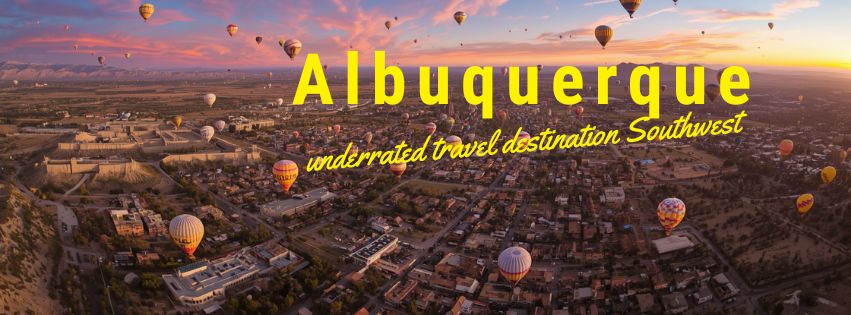
- The world's largest balloon event: The International Balloon Fiesta is not a large regional event. It is the largest hot air ballooning event in the world — 500+ balloons, 900,000 visitors, nine days in October. It exists here specifically because Albuquerque's unique wind pattern (the Albuquerque Box, created by the Rio Grande Valley's geography) allows balloons to take off and land at the same location — a meteorological feat nearly impossible anywhere else on Earth.
Why "Underrated" Is the Right Word — What the City Gets Wrong About Itself
Part of Albuquerque's underrated status is self-inflicted. The city has historically been a poor self-promoter — it presents its most accessible attractions (Old Town, the Tramway, the Balloon Fiesta) competently but fails to communicate the depth beneath them. A first-time visitor following the standard tourist map will have a good time. A first-time visitor who digs one layer deeper will have the experience that converts them.
"Having family in Albuquerque, I've been lucky enough to visit several times over the years and each time I visit, there's always an experience that leaves a lasting impression on me. Overall, I'd consider Albuquerque to be a very underrated destination with so much to offer," confirmed travel writer Carly Marie, who covers the Southwest extensively. That assessment — underrated, with so much to offer — reflects the consistent experience of visitors who give the city a genuine chance rather than a transit-level engagement.
The deeper problem with Albuquerque's brand is positioning. When most Americans think of the Southwest, they think of the landscape-as-spectacle (Grand Canyon, Monument Valley, Arches) or the resort-as-experience (Sedona, Scottsdale, Las Vegas). Albuquerque is neither of those things. It is a functioning city of 565,000 people where the extraordinary things are embedded in daily life rather than presented as attractions. The petroglyphs are accessible for free. The bosque trail is in the city. The mountains are visible from every traffic light. The extraordinary is ambient, not staged.
That ambience is exactly what makes the city underrated — and exactly what makes it compelling for visitors who have already done the staged-spectacle Southwest and want something with more texture.
The Experiences That Create Lasting Impressions — What First-Time Visitors Consistently Describe
The Balloon Fiesta — The Event That Has No Equivalent
Every Southwest destination has a signature experience. Sedona has the red rock vortexes. Las Vegas has the Strip. The Grand Canyon has the rim. Albuquerque has the Balloon Fiesta — and it is not comparable to any of the others, because there is no other event like it anywhere in the world.
Over 500 hot air balloons lifting off in coordinated mass ascensions as the Sandia Mountains catch the first light of morning. The specific Albuquerque Box wind pattern that makes this possible. The pre-sunrise Dawn Patrol balloons blazing in the dark. The evening Balloon Glows where tethered balloons illuminate at dusk in synchronized bursts of color. The 2026 edition — the 54th annual, themed "The Scenic Route" for Route 66's centennial — adds historical significance to an event that already needs no additional justification.
First-time Fiesta visitors describe the same experience: they expected a large event and experienced something that did not fit any existing category of event in their experiential repertoire. The scale, the beauty, and the specific quality of watching hundreds of balloons fill the sky against a mountain backdrop at 5,300 feet of elevation produces a response that is more like the response to a genuinely moving work of art than to an entertainment event.
The 2026 Balloon Fiesta runs October 3 through 11. General admission is $15 per session. Book accommodations at least six months in advance — the entire city fills up.
The Sandia Peak Tramway — $30 for the Most Dramatic Urban Mountain Access in North America
The Sandia Peak Aerial Tramway is the longest single-span aerial tram in the United States — 2.7 miles from the city's eastern edge to the 10,378-foot summit of Sandia Crest. The 15-minute ascent passes through four ecological life zones. The view from the summit takes in over 11,000 square miles of New Mexico landscape. The round-trip ticket costs $30.
No American city of comparable size offers mountain access that competes with this combination of scale, accessibility, and cost. Denver is adjacent to ski resorts that require driving, parking, and lift tickets that start at $200. Albuquerque puts you at an alpine summit in 15 minutes from the city's edge for $30.
The TEN3 restaurant and bar at the summit — open during tramway operating hours — serves food and drinks at 10,378 feet with panoramic views. The sunset view from TEN3, watching the city lights emerge below as the sky transitions from orange to deep purple, is the specific experience that travel writers and locals agree is among the most spectacular available in any American city. Reservations for the restaurant are strongly recommended. The bar is walk-in.
The Petroglyph National Monument — 24,000 Ancient Images at the City's Edge
Petroglyph National Monument sits on the western edge of Albuquerque — where suburban streets end and a volcanic basalt escarpment begins, covered with approximately 24,000 images carved by ancestral Puebloan people and early Spanish settlers over seven centuries. Entry to most of the monument is free. The images include geometric spirals, animals, human figures, and cultural symbols maintained in living memory by the Pueblo communities whose ancestors carved them.
The monument is not an isolated historical site. It is a 17-mile-long protected landscape that begins where the city ends and includes five extinct volcanic cones that erupted approximately 150,000 years ago. Walking through the Rinconada Canyon — a free, dog-friendly trail through the southern section — produces the specific vertigo of standing in the middle of an ancient volcanic field, looking at images carved into that field by people whose descendants live nearby, while the Sandia Mountains are visible to the east and the entire western horizon is open to the Jemez Mountains.
The combination of geological time (150,000-year-old lava), cultural time (700 years of rock art), and immediate accessibility (free, within the city limits, open daily) makes the Petroglyph Monument one of the most genuinely underrated single attractions available in any American city.
The Food — Green Chile Is Not a Topping, It Is a Philosophy
Albuquerque's food culture is built on New Mexican cuisine — a distinct culinary tradition that is not Mexican food and is not Tex-Mex. It is the food of 400 years of Spanish colonial, Native American, and Southwestern frontier intersection, and its defining ingredient is the green chile grown in the Hatch Valley of southern New Mexico.
The green chile harvest happens in August and September. Roasters appear on street corners across the city. The smell of roasting chile fills entire neighborhoods. It is one of the most specifically New Mexican sensory experiences available to a visitor who times their trip to the harvest season.
"Albuquerque and the surrounding cities are truly some of the most enchanting areas in the world starting with the beautiful sunsets (California sunsets have nothing on NM!), mountains and the unique culture," confirmed Jina Michael-Smith, a native Albuquerquean interviewed by Travelocity for their Under the Radar Destination feature on the city. The mention of sunsets first — before the food, before the attractions, before anything else — reflects the priority that residents give to the sky as the defining daily experience.
The essential food experiences for first-time visitors: a green chile cheeseburger (order it Christmas — red and green chile both), a breakfast burrito (egg, potato, meat, and chile in a flour tortilla), posole (hominy stew with red chile), and whatever is being sold at the Rail Yards Market on a Sunday morning in August when the green chile harvest is happening in real time fifty feet away from your table.
Old Town at Golden Hour — 320 Years on the Same Plaza
Old Town Albuquerque is the oldest part of the city — established in 1706 by Spanish settlers around a central plaza that still exists today. The San Felipe de Neri Church on the north side of that plaza has held services continuously since the year of the city's founding, making it one of the oldest continuously active Catholic parishes in the United States.
The tourist version of Old Town is adequate: browse the turquoise jewelry, eat at the restaurants, visit the Albuquerque Museum of Art and History. The local version is better: go at 5pm on a weekday when the crowds are thin and the golden hour light is falling on the church's adobe facade. Sit on a bench in the courtyard. Listen to the bells. Watch the plaza exist — as it has, essentially unchanged in character, for over three centuries. The continuity of use is the thing. This is not a preserved historical district. It is a living community that has been itself for 320 years.
Why 2026 Is a Particularly Good Year to Visit
2026 is not simply another year in Albuquerque's calendar. Two specific events make this year unusually worth visiting.
Route 66 Turns 100 — Albuquerque Has 18 Miles of It
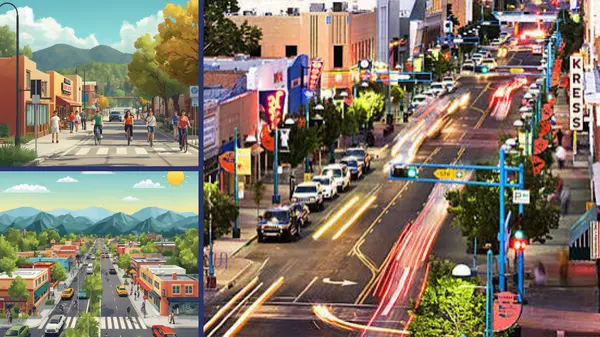
Route 66 was established in 1926. The centennial in 2026 is being celebrated across the route, but nowhere more authentically than in Albuquerque, which contains the longest continuous urban stretch of Route 66 in any American city — 18 miles of Central Avenue still running the original alignment.
New murals and public art installations have been commissioned and installed throughout 2026 along the Central Avenue corridor. The historic neon signs have been restored and re-lit. Events celebrating the Mother Road's centennial have been running through the year. The KiMo Theatre — one of the most architecturally extraordinary buildings on Route 66 anywhere in the country — is specifically featured in centennial programming.
The specific 2026 experience: drive the full Central Avenue corridor at night in late spring or early summer, when the new centennial art is fresh, the restored neon is glowing against the New Mexico sky, and the specific combination of new and old is at its most visually complete. This version of Route 66's most authentic urban stretch will not exist again in exactly this form. The centennial happens once.
The 54th Balloon Fiesta — Themed for the Centennial
The 2026 International Balloon Fiesta is the 54th annual event and is specifically themed "The Scenic Route" in honor of Route 66's centennial. The convergence of these two anniversaries — the balloon event and the highway centennial, both in October 2026 — creates a cultural moment that is specific to this year and this city. The special shape balloons designed for the centennial theme, the events connecting the Fiesta to Route 66's history, and the specific energy of a city celebrating two major anniversaries simultaneously produce a travel experience that is genuinely time-limited.
What Makes Albuquerque Different From the Other Southwest Destinations
It Is Not Trying to Be Anything Other Than What It Is
Sedona has been so thoroughly tourism-optimized that the visitor experience feels curated at every turn. Las Vegas is explicitly a constructed entertainment environment. The Grand Canyon is so famous that the expectation management itself has become part of the experience.
Albuquerque does not perform for visitors. It is simply itself — a city of 565,000 people living their lives in one of the most extraordinary natural settings available in the American Southwest. The mountains are there because they are there, not because someone built them as an attraction. The petroglyphs are accessible because they are on federal land and the access is free. The green chile is the food of the culture, not a menu item designed for tourists.
That authenticity is exactly what makes Albuquerque underrated by the standards of tourism marketing. There is no single iconic experience that can be summarized in a tagline. There is a city that requires engagement and rewards it — and the visitors who give it genuine attention consistently leave more impressed than they expected to be.
The Price Is Better Than Every Comparable Southwest Destination
Sedona's median hotel rate in peak season exceeds $300 per night. Santa Fe is comparable. Scottsdale can run $400+ for resort properties. The Grand Canyon's most popular lodging options require reservations months in advance and still cost $200+ per night.
Albuquerque's average hotel rate is significantly lower than any of those destinations — the Undiscovered America TV piece cited average nightly rates well below the comparable Southwest alternatives. The Tramway is $30. The petroglyphs are free. The bosque trail is free. The Old Town is free. The food is genuinely affordable. A quality multi-day visit to Albuquerque costs a fraction of what comparable time in Sedona or Santa Fe costs.
The value proposition is not that Albuquerque is cheap. It is that Albuquerque is genuinely extraordinary and also not expensive — a combination that is genuinely rare among the Southwest's most compelling destinations.
The Combination of Culture, Nature, and History Has No Parallel
The specific combination that Albuquerque offers — 320 years of Spanish and Native American history, the oldest surviving Pueblo communities accessible within an hour's drive, the largest hot air balloon event in the world, the longest aerial tram in the country, 700-year-old petroglyphs at the city's edge, the most extraordinary sunset conditions available in the continental United States, and a food culture built over four centuries that belongs to this place and cannot be replicated elsewhere — is not available in any other single city in the American Southwest.
Sedona has extraordinary geology and spiritual tourism infrastructure. It does not have 320 years of continuous habitation on the same plaza, or 24,000 petroglyphs accessible for free, or the world's largest balloon event in October. Santa Fe has the gallery culture and the food. It does not have the Tramway, the Fiesta, or the specific elevation-and-light combination that makes Albuquerque's sky what it is. The Grand Canyon has the awe-inspiring geological spectacle. It does not have a city.
Albuquerque has all of it — because it is a city that has been built in and around one of the most extraordinary natural and cultural landscapes in the country for over three centuries.
The Honest Qualifications — What Albuquerque Is Not
A genuinely useful travel guide needs to be honest about what a destination is not, alongside what it is. Albuquerque deserves the same honesty.
Albuquerque is not a resort city. There is no luxury resort experience here that compares to what Scottsdale or Santa Fe offer in that specific category. The hotels are generally functional and well-priced rather than boutique and destination-worthy.
Albuquerque's walkable downtown area is less developed than comparable cities its size. The most compelling experiences are distributed across the city rather than concentrated in a single walkable district — which means a car is essentially required to access the full range of what the city offers.
The safety research that applies to any major city applies here. The citywide crime statistics are above the national average, and neighborhood selection matters. First-time visitors should stay in the Northeast Heights corridor or in Old Town adjacent hotels for the most comfortable experience.
And the city does not promote itself well. The visitor who arrives having done minimal research will have a decent time. The visitor who read this guide will have an extraordinary one. That gap — between what casual engagement produces and what genuine engagement produces — is the specific measure of what underrated means.
The Real Reason Albuquerque Is Underrated — And Why That Might Change
The honest reason Albuquerque is underrated is simple: it is not where wealthy coastal travelers historically went for Southwest experiences. Sedona and Santa Fe captured that market decades ago and built tourism infrastructure that self-perpetuates through brand recognition and repeat visitation.
Albuquerque has the older history, the larger scale, the more extraordinary natural setting by most objective measures, and the more affordable access. What it has lacked is the cultural momentum that converts exploratory travelers into advocates who bring their networks.
That is changing. The April 2026 Undiscovered America TV feature is one marker. The Route 66 centennial focus on Albuquerque's 18-mile corridor is another. The film industry presence — Netflix Studios, ongoing production activity — is bringing a new generation of creatives and their networks into contact with the city. The remote work migration from Los Angeles and Seattle is populating the city with residents who came for a different kind of Southwest life than Scottsdale offers and found it.
The visitors who come to Albuquerque in 2026 and give it genuine attention are coming at exactly the right moment — when the city is still affordable, still uncrowded by the standards of its Southwest peers, and still offering the authentic experience that tourism optimization tends to erode once the mainstream discovers a place.
For visitors who want to understand what the full Albuquerque experience looks like beyond the highlights — including where to eat, which neighborhoods feel different, and what it might look like to live here rather than just visit — our complete guide to things to do in Albuquerque covers the city's full lifestyle picture. And for visitors experiencing what we call the Albuquerque Reveal — the moment when a trip starts to feel like research for a potential move — our guide to relocating to Albuquerque gives you the honest starting point for that conversation.
The Bottom Line — Come Before Everyone Else Does
Every travel destination that eventually becomes famous was underrated first. The people who discovered Sedona before it became Sedona, who found Santa Fe before the galleries took over every storefront — they experienced something that can no longer be exactly replicated.
Albuquerque is in that position right now. The city is genuinely extraordinary, genuinely affordable, and genuinely undiscovered by the mainstream Southwest travel market. The Balloon Fiesta fills hotels in October. The rest of the year, the city is accessible, uncrowded, and waiting.
The Sandia Mountains turn pink at sunset every evening. The petroglyphs are free and empty at sunrise. The tramway costs $30 and goes to an alpine summit. The green chile is grown 200 miles south and roasted on street corners every August.
These things are here, now, waiting for visitors who are willing to look past the airport. They have been here for a long time. Come before the secret is entirely out.
Thinking About More Than a Visit?
Jenn & Vinay from The Rodgers Neighborhood Real Estate Group help visitors who have experienced the Albuquerque Reveal take the next step — understanding what it would actually look like to make this city their home. From the neighborhoods closest to the Balloon Fiesta Park to the foothills homes with the morning tramway view to the bosque-adjacent properties of the North Valley, we know which addresses deliver the daily experience that first-time visitors fall in love with.
Jenn & Vinay Rodgers are Albuquerque's trusted real estate professionals with The Rodgers Neighborhood Real Estate Group, brokered by Real Broker, LLC, serving buyers and sellers across Albuquerque, Rio Rancho, Corrales, Los Lunas, Tijeras, Cedar Crest, Sandia Park, the East Mountains, Bernalillo County, Sandoval County, and surrounding New Mexico communities.
The Rodgers Neighborhood Real Estate Group
Jenn & Vinay Rodgers
Real Broker, LLC
Albuquerque, NM
📞 505-417-2733
🏠 Browse Albuquerque homes for saleCategories
- All Blogs (322)
- 2026 & Beyond for Real Estate (218)
- Doctors and Nurses looking for homes in NM (4)
- Guide to buying a home in NM (146)
- Health Care Heros (7)
- Home Upgrades (38)
- Jenn & Vinay your Local Real Estate Experts! (107)
- Moving to Albuquerque (127)
- Neighborhoods in Albuquerque NM (87)
- Rent or Own (2)
- Sellers Questions for Selling homes (2)
Recent Posts
GET MORE INFORMATION