
Home Staging and Decorating Tips That Help Albuquerque Homes Sell Faster
Staging a home is not decorating it. Staging is a sales strategy — a system for presenting the home's best attributes to the widest qualified buyer pool in a way that produces the emotional connection that transforms an online browser into a scheduled showing and a scheduled showing into an offer. This guide covers the national ROI framework, then specifically addresses how staging in Albuquerque is different from staging in any other American city.
The ROI Case — Why Staging Is the Highest-Return Pre-Sale Investment
"With an average investment of 1% of the sale price into staging, about 75% of sellers saw an ROI of 5% to 15% over asking price, according to data from the Real Estate Staging Association (RESA). A recent survey from the International Association of Home Staging Professionals shows that staging helps sell homes three to 30 times faster than the nonstaged competition. The average price reduction on a home was five to 20 times more than what the staging investment would have been," confirmed the National Association of Realtors' Styled, Staged, and Sold report.
The 2025-2026 staging data that every Albuquerque seller should know:
- RESA Q3 2025 (84 staged homes tracked): Average 109% sale-to-list ratio. Average ROI: 3,551%. Average staging spend: $3,813. Sellers recovered their staging investment nearly 36 times over.
- RESA Q1 2025: Average return of $23.34 for every $1 invested in professional staging.
- Done & Done Home research: Staged homes averaged 23 days on market versus 47 days for non-staged homes — 51% faster.
- NAR 2025: 48% of agents say buyers now expect homes to look like the staged homes they see on television. 58% of agents report buyer disappointment when homes do not meet those elevated expectations.
- The price reduction alternative: The average price reduction on an unstaged home is five to 20 times larger than the staging investment would have cost. In Albuquerque's current market where 38-40% of active listings have already taken price reductions, spending $3,000-$5,000 on staging before listing is specifically the alternative to spending $15,000-$40,000 on a price reduction after listing.
- The online first showing: 95% of buyers first view homes online. Listings with professional staging photos receive up to 40% more online views than non-staged listings. In a market where 34 days is the average DOM, the online presentation quality that staging produces determines whether a home receives the showings required to generate offers before the listing starts aging.
What Makes Albuquerque Staging Specifically Different
National staging guides correctly identify the universal principles: declutter, neutralize, depersonalize, maximize light. Albuquerque staging shares all of these — and adds a layer of local context that differentiates the best Albuquerque staging from generic national staging:
- The architectural features that only exist here: Kiva fireplaces, vigas (exposed wood ceiling beams), latillas (smaller sticks crossed between vigas), Saltillo tile, carved wood doors, portal entries, and adobe walls are the Albuquerque-specific architectural assets that buyers — especially buyers relocating from California, Seattle, and Phoenix — specifically respond to and specifically pay premium for. Generic staging that ignores or backgrounds these features is leaving the home's most distinctive assets underperforming.
- The mountain view orientation principle: Any window or outdoor space with a Sandia Mountain view is the home's most valuable visual asset. Staging that orients furniture away from these views or blocks them with heavy window treatments specifically undermines the home's most compelling selling story.
- The natural light advantage: Albuquerque's 310 days of sunshine produce a light quality at altitude that makes appropriately staged homes dramatically more photogenic than the same homes in lower-altitude or cloudy markets. Staging that opens the blinds, removes heavy window treatments, and maximizes the penetration of high-desert light is specifically capitalizing on an asset that no other major American city can match.
- The outdoor living space as primary: In Albuquerque's climate, the patio, portal, and outdoor fireplace are year-round amenities. Many buyers — particularly from California — specifically evaluate the outdoor living space as a primary decision factor. Staging the outdoor space is specifically more important in Albuquerque than in markets with harsh winters or humid summers where outdoor living is seasonal.
The Pre-Staging Foundation — Before You Touch a Single Piece of Furniture
The highest-ROI staging investment is also the lowest-cost: cleaning, decluttering, and depersonalizing. Professional staging that happens on top of clutter and grime is invisible beneath the clutter and grime.
Step 1 — Deep Clean Everything
A spotless home signals to buyers that the property has been well maintained — that the seller cares about the home. This perception extends from the physical cleanliness to the buyer's inference about how the systems have been maintained, the roof has been serviced, and the HVAC has been changed.
- Kitchen priority: Degrease surfaces, clean the oven interior and hood, clean inside the refrigerator, clean the microwave, run the dishwasher empty to eliminate odors.
- Bathroom priority: Regrout and recaulk if the existing grout is discolored or the caulk is pulling away. Clean all tile surfaces. Polish fixtures. Replace any dated toilet seats.
- Windows inside and out: Clean windows allow maximum natural light penetration — the most important single pre-photography improvement available. In Albuquerque's dusty high-desert environment, exterior windows collect significant dust. Professional window cleaning for the listing photos is specifically worth the investment.
- Floors: Refinish hardwood if not recently done (147% ROI, the highest single interior improvement return). Steam clean Saltillo tile. Deep clean grout lines. Professionally clean any carpeted areas.
- Professional cleaning service: Budget $200-$500 for a professional cleaning before photos. This is the highest-ROI $300 expenditure in the pre-listing process — it is immediately visible in photography and immediately noticed in showings.
Step 2 — Declutter to the Point of Discomfort
The staging industry's consistent finding: most sellers remove too little. The decluttering target is a home that feels slightly minimal to the seller — which feels appropriately spacious and clean to the buyer.
- The 50% rule for horizontal surfaces: Remove at least 50% of everything currently on countertops, bookshelves, tables, and mantels. What remains should be intentional and deliberate — not the accumulated objects of daily living.
- Personal items specifically: Family photos, children's artwork, sports trophies, refrigerator magnets, personalized decorations, collections. Buyers who encounter strong personal presence have difficulty visualizing themselves in the home. Depersonalizing is the single most consistently recommended staging principle across every professional staging source.
- Closets and storage: Buyers open closets. A closet that is 70% full signals adequate storage. A closet that is completely packed signals inadequate storage — even if the same items would fit with organization. Remove 30-40% of clothing and items from each closet before photos and showings.
- The furniture audit: Most Albuquerque homes benefit from staging with FEWER pieces of furniture than currently in the space. Removing one large sofa, an oversized accent chair, or a secondary dining table from a room typically makes the room photograph and show significantly better. Consider renting short-term storage for furniture that makes rooms feel smaller than they are.
Step 3 — Address the Sensory First Impressions
- Smell: The single most impactful first impression in a home showing — and the one sellers are least aware of because they have adapted to their home's ambient scent. Eliminate pet odors, cooking odors, and musty smells before staging. Do not replace them with artificial air fresheners, which smell like something being hidden. Clean, neutral-smelling homes sell faster than fragrant ones.
- Temperature: Schedule showings during the hot season with refrigerated air running 30 minutes before buyers arrive. Albuquerque buyers arriving for a summer showing who walk into a hot, stuffy home will not stay to appreciate the kiva fireplace.
- Entryway first impression: The front door, entry path, and first interior view produce the 7-10 second first impression that sets the buyer's emotional tone for the entire showing. Clean the front door, polish hardware, sweep the entry path, and ensure the first interior view is staged, bright, and welcoming.
Room-by-Room Staging Tips — Albuquerque-Specific
"Staging the living room was found to be very important for buyers (46%), followed by staging the master bedroom (43%), and staging the kitchen (35%)," confirmed Home Staging Institute's 2026 staging statistics (March 2026). Prioritize these rooms first.
Living Room — Highlight What Only Albuquerque Homes Have
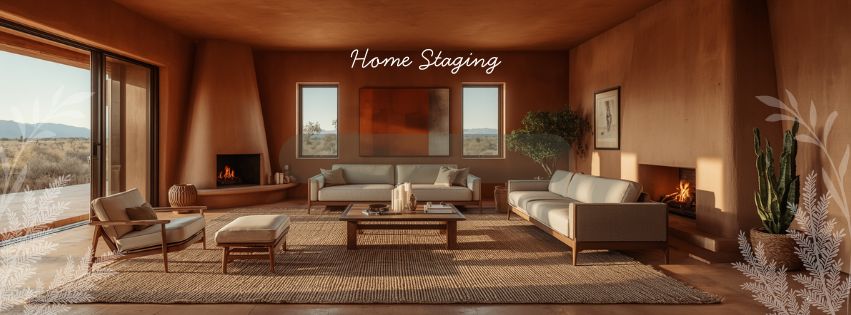
- Kiva fireplace staging: The beehive-shaped adobe kiva fireplace is the most specifically New Mexican architectural feature — buyers from other cities specifically note and respond to it. Stage with three or five uniform pillar candles in varying heights (odd numbers photograph better) or a simple cast iron grate with a small stack of decorative firewood. Clean the firebox interior completely. Do not obstruct the opening with a screen that hides the kiva's distinctive shape.
- Viga ceiling staging: Exposed wood beam (viga) ceilings with latillas (smaller sticks crossed between beams) are specifically prized in Albuquerque homes. Stage lighting to uplight rather than downlight these features — warm accent lighting on the ceiling plane highlights the beam texture in photography. Do not install ceiling fans that visually compete with the beam pattern.
- Mountain view orientation: If any window or door has a Sandia Mountain view, arrange the primary seating to face it. This is the Albuquerque staging principle that no national guide addresses: buyers from California and Seattle who can see the Sandia Mountains from the living room sofa have found something that does not exist in their origin city. Make that view the living room's focal point.
- Area rug to anchor the conversation group: In Albuquerque homes with Saltillo tile or hardwood, a properly-sized area rug (large enough that all front furniture legs rest on it) warms the space and defines the seating arrangement. Choose a neutral but warm tone — cream, warm gray, or natural fiber — not turquoise or patterned Southwestern motifs.
- The color one piece of intentional art: One piece of authentic, local art on the primary wall adds cultural authenticity without the kitsch of mass-produced Southwestern decoration. An original painting from a local Albuquerque artist purchased at a gallery or the First Friday ArtWalk is the specific decoration that communicates authenticity rather than tourism.
Kitchen — Clear, Clean, and Functional
- 80% clear countertops: Remove everything except one intentional element — a small bowl of seasonal fruit, a simple herb pot, or a cutting board with a wooden bowl. The empty counter space communicates the kitchen's functionality; clutter communicates inadequate storage.
- The appliance audit: Store the coffee maker, toaster, knife block, and all small appliances out of sight. One coffee maker may remain if it is clean and relatively new. The rest go under the counter for listing photos and showings.
- Refrigerator: Remove all magnets, photos, children's artwork, and notes from the refrigerator exterior. Clean the exterior surface. This single change consistently transforms a cluttered-looking kitchen into a clean-looking kitchen in photos.
- Cabinet hardware: If the cabinet hardware is dated, replacement pulls and knobs cost $200-$500 for the full kitchen and produce a visual upgrade disproportionate to the investment. This is the cheapest kitchen improvement with the largest visual effect.
Primary Bedroom — The Luxury Hotel Standard
- Bedding: Crisp, white or neutral (warm linen or soft gray) duvet cover with matching shams. The luxury hotel bed presentation is the specific standard — no printed comforters, no quilts, no mismatched pillowcases. A throw blanket folded across the foot of the bed adds texture without pattern complexity.
- Furniture reduction: Most master bedrooms in Albuquerque homes have too much furniture. Removing the secondary dresser, the oversized armchair, or the bench at the foot of the bed typically makes the room appear 30-40% larger in photos. The bed, two nightstands, and one dresser is usually sufficient.
- Clear nightstands: Remove all personal items (medications, books, phone chargers, water glasses). Leave one lamp and one simple decorative item per nightstand — a small plant or a single hardcover book with the title visible on the cover.
- Window treatments: In Albuquerque's high-desert light environment, the treatment that maximizes light penetration is the one that photographs best. If the current window treatment is heavy drapes, open them fully for all photography and consider removing them entirely if the view or the natural light is strong enough to stand alone.
Bathrooms — The Spa Impression
- Clear countertops completely: Every personal care item goes into a cabinet or box. The counter should have one decorative element: a small plant, a trio of candles, or a decorative soap dispenser.
- Fresh white towels: New or newly-purchased white bath towels, folded neatly or rolled in a basket, instantly transform the bathroom's visual presentation. Store the household towels.
- Grout and caulk condition: The single most important bathroom maintenance item for staging. Buyers notice discolored grout and failing caulk specifically. Professional regrouting and recaulking costs $200-$600 and produces a bathroom that photographs and shows dramatically better.
- Toilet lid down — always: In all photography and all showings, the toilet lid is closed. This is the simplest and most consistently overlooked bathroom staging instruction.
The Outdoor Space — Albuquerque's Most Underutilized Staging Asset
The portal, patio, and outdoor fireplace or fire pit are specifically more important in Albuquerque staging than in most national markets because Albuquerque's climate makes outdoor living a year-round reality — not a seasonal one. Buyers relocating from California, Seattle, and Phoenix specifically evaluate the outdoor living space as a primary criterion.
- Portal staging: The traditional New Mexico portal (a covered porch or outdoor hallway, typically with wood vigas and tile or brick floor) is the home's most specifically New Mexican exterior feature. Stage with a clean, intentional outdoor furniture arrangement — two chairs with a small table, or a dining set if the portal is large enough. A potted plant or two (drought-tolerant, healthy) on either side of the entry completes the portal presentation.
- Patio or courtyard: Stage as an outdoor room — furniture arranged for conversation, clean cushions, a clean outdoor rug, one or two potted plants. A fire pit or chiminea cleaned and positioned as a featured element. String lights for evening showing appeal.
- Outdoor kiva or fireplace: Clean the firebox. Add a small stack of decorative firewood or simple candle grouping. The outdoor fireplace tells the buyer that Albuquerque evenings are cool enough to use it — which is one of the specific quality-of-life stories that the desert Southwest lifestyle offers.
- Desert landscaping presentation: Xeriscape and desert landscaping should be clean and intentional — not wild and unmanaged. Rake the gravel, weed any visible weeds, trim any dead plant material, and ensure that the intentional design of the landscape is legible rather than accidental. The buyer should see a deliberate aesthetic choice, not deferred maintenance.
The Albuquerque Color and Décor Strategy
The most common Albuquerque staging mistake is getting the décor tone wrong in one of two directions:
- The over-Southwestern trap: Mass-produced turquoise-and-red Southwestern kitsch — dream catchers, howling coyote silhouettes, sand-painting prints, wagon wheel chandeliers — is the staging equivalent of a souvenir shop. Buyers from Los Angeles and Seattle who encounter this décor do not see authentic New Mexico; they see a theme park version of it. The Angi guide for Albuquerque specifically names overusing Southwestern décor as the most common local staging mistake.
- The generic gray trap: The national staging default of "paint everything Sherwin-Williams Agreeable Gray and add a navy pillow" specifically fights against Albuquerque's architectural warmth. The earthen wall color of an adobe home, the warm wood tones of vigas, and the terracotta warmth of Saltillo tile all interact specifically poorly with the cool gray of generic national staging.
The Albuquerque color palette that works:
- Walls: Warm whites (Sherwin-Williams Antique White, Benjamin Moore White Dove), soft warm beiges, or warm sage greens that complement the architecture's earthen warmth rather than fighting it. Avoid cool grays and clinical whites.
- Textiles: Warm neutrals — linen, cream, warm gray, natural fiber. Texture adds warmth without pattern complexity. A chunky knit throw, a jute area rug, a linen duvet cover all work better in Albuquerque's light than pattern-heavy Southwestern textiles.
- One color accent per room: If color is added through a pillow, a throw, or a vase, choose a single muted earth tone (rust, sage, dusty blue) used consistently rather than mixed saturated colors.
The Photography Timing Advantage — Albuquerque's Most Underused Staging Tool
Staging for photography is more important than staging for showings — because the photographs are the first showing for 95% of buyers. And in Albuquerque specifically, the timing of photography matters more than in most other markets:
- Golden hour exterior photography: Schedule exterior photography 1-2 hours before sunset. The alpenglow on the Sandia Mountains, the warm amber light on the stucco facade, and the specific quality of high-desert late-afternoon light produce listing photos that the same home cannot produce at midday. This is the single most underused Albuquerque photography advantage.
- East-facing rooms in the morning: Rooms with east-facing windows capture the best interior natural light in the morning hours. Schedule interior photography to sequence east-facing spaces early and west-facing spaces in afternoon.
- The Sandia Mountain shot: If the home has any window or outdoor space with a Sandia Mountain view, this photo should be planned specifically. Position the camera to include both the interior staging and the mountain view in a single frame — it is the most compelling single photo in any Albuquerque listing.
DIY Staging vs. Professional Staging — The Albuquerque Decision
- DIY staging is appropriate when: The home is occupied with well-maintained furniture in good condition. The seller can genuinely depersonalize and declutter sufficiently. The price point is below $350,000 where professional staging ROI is harder to achieve. The seller has a design eye and can apply the principles in this guide.
- Professional staging is specifically recommended when: The home is vacant (empty rooms make spaces look smaller and every flaw visible). The price is above $450,000 where buyer expectations are elevated. The home has been sitting on market without offers. The seller cannot emotionally detach from their own furniture and décor choices. The home's kiva fireplace, vigas, portal, or mountain view assets need expert highlighting.
- The Albuquerque professional staging options: GAAR (Greater Albuquerque Association of REALTORS) maintains an affiliate directory of approved local stagers at gaar.com — this is the most reliable local referral source. Sandia Staging (Melody, 505-289-1164) specifically offers a Pay at Close option — no upfront cost to the seller, with staging fees paid at closing from proceeds. Su Casa Staging & Redesign has nearly a decade of Albuquerque experience and approximately 1,000 staged homes in their portfolio.
For the full decision framework on whether to stage, sell as-is, or do targeted renovations before listing — with the Albuquerque-specific cost-vs-benefit analysis — our post on home staging vs. selling as-is in Albuquerque covers the decision. And for the complete pre-listing preparation timeline — from inspection through photography — our post on how to prepare your Albuquerque home before listing covers the full seller preparation sequence.
The Albuquerque Staging Quick Reference
- Do: Orient furniture toward mountain views. Stage the kiva fireplace with simple, deliberate decoration. Uplight vigas. Open every blind. Stage the portal as a living room. Use warm earth tones. Schedule exterior photos at golden hour.
- Do not: Over-Southwesternize the décor. Block mountain views with window treatments. Leave personal items on countertops or walls. Use cool grays that fight the adobe warmth. Skip the outdoor space. Stage only for in-person showings without prioritizing photography.
- Most impactful low-cost actions: Professional window cleaning ($100-$200). Toilet lid down. Fresh white towels in bathrooms. Refrigerator exterior cleared. Cabinet hardware replacement if dated. Light bulb upgrade to warm-tone LED throughout.
- The single most important Albuquerque-specific staging decision: Find the mountain view. Stage toward it. Photograph it. Put it first in the listing photo sequence.
The Bottom Line — Staging Is the Pre-Sale Investment That Returns the Most
The numbers are clear: RESA's Q3 2025 data shows a 3,551% average ROI on staging investment, with sellers recovering their $3,813 average staging spend nearly 36 times over. The price reduction that the unstaged home eventually requires is five to 20 times larger than the staging cost would have been.
In Albuquerque specifically, the ROI case for staging is amplified by the specific architectural assets — the kiva fireplace, the vigas, the portal, the mountain view — that professional staging highlights in ways that generic furnished-and-lived-in homes do not. The buyer from Los Angeles who encounters a well-staged Albuquerque home that shows them a kiva fireplace styled correctly, a portal staged as an outdoor living room, and a Sandia Mountain view oriented as the living room's focal point has found something that does not exist at home. That specific discovery is the emotional transaction that staging is designed to produce.
Stage for the buyer who is seeing this city for the first time and who needs to understand, in the 7-10 seconds of a first impression, that this home and this city are the specific upgrade they have been looking for.
Want Personalized Staging Advice for Your Specific Albuquerque Home?
Jenn & Vinay from The Rodgers Neighborhood Real Estate Group provide pre-listing staging consultations that identify your home's specific architectural assets — the kiva fireplace, the viga ceiling, the portal, the mountain view — and prioritize the staging actions that will produce the strongest photography and the fastest path to offer. We also connect sellers with Albuquerque's best professional staging resources when full staging is the right decision. The conversation about preparing your home to sell starts with a free home evaluation.
Jenn & Vinay Rodgers are Albuquerque's trusted real estate professionals with The Rodgers Neighborhood Real Estate Group, brokered by Real Broker, LLC, serving buyers and sellers across Albuquerque, Rio Rancho, Corrales, Los Lunas, Tijeras, Cedar Crest, Sandia Park, the East Mountains, Bernalillo County, Sandoval County, and surrounding New Mexico communities.
The Rodgers Neighborhood Real Estate Group
Jenn & Vinay Rodgers
Real Broker, LLC
Albuquerque, NM
📞 505-417-2733
🏠 Get a free home evaluation before you listCategories
- All Blogs (322)
- 2026 & Beyond for Real Estate (218)
- Doctors and Nurses looking for homes in NM (4)
- Guide to buying a home in NM (146)
- Health Care Heros (7)
- Home Upgrades (38)
- Jenn & Vinay your Local Real Estate Experts! (107)
- Moving to Albuquerque (127)
- Neighborhoods in Albuquerque NM (87)
- Rent or Own (2)
- Sellers Questions for Selling homes (2)
Recent Posts


GET MORE INFORMATION