
How Albuquerque Became One of America’s Most Unique Cities
Uniqueness in a city is not self-declared. It is earned — through geography that produces outcomes no other location can replicate, through cultural depth that accumulates across centuries rather than being installed over a decade, through specific accidents of history that concentrate unusual phenomena in the same place. Albuquerque's uniqueness is all three of these simultaneously. This guide explains how it got there.
The National Recognition — 2026 Confirms What Locals Already Know
"Albuquerque has been named one of the best places to travel in 2026 by multiple leading travel publications, earning a place on high-profile lists released by Frommer's, AFAR, Condé Nast Traveler, and AARP. Travel editors across all four publications emphasized a growing demand for immersive cultural travel, and Albuquerque's blend of Indigenous, Hispanic, and contemporary influences, along with its unique landscapes, cuisine, and creative community, earned it top rankings alongside destinations in Europe, Asia, and the South Pacific," confirmed the City of Albuquerque's official announcement (December 2025). 'Albuquerque stands apart because it offers authentic, meaningful experiences rooted in thousands of years of culture and history,' said Mayor Tim Keller.
AFAR's specific characterization is the most precise: Albuquerque offers "a sense of place that travelers won't find anywhere else." This is the editorial way of saying what takes a longer explanation to justify. This guide provides that explanation — the 8 specific factors that produced the specific sense of place that Albuquerque has and no other American city does.
Factor 1 — The Geography Nobody Else Has
Albuquerque's specific geography is the first and most foundational reason it became unique. The combination of geographic features concentrated in and around the city produces a physical environment that no other major American metropolitan area can replicate:
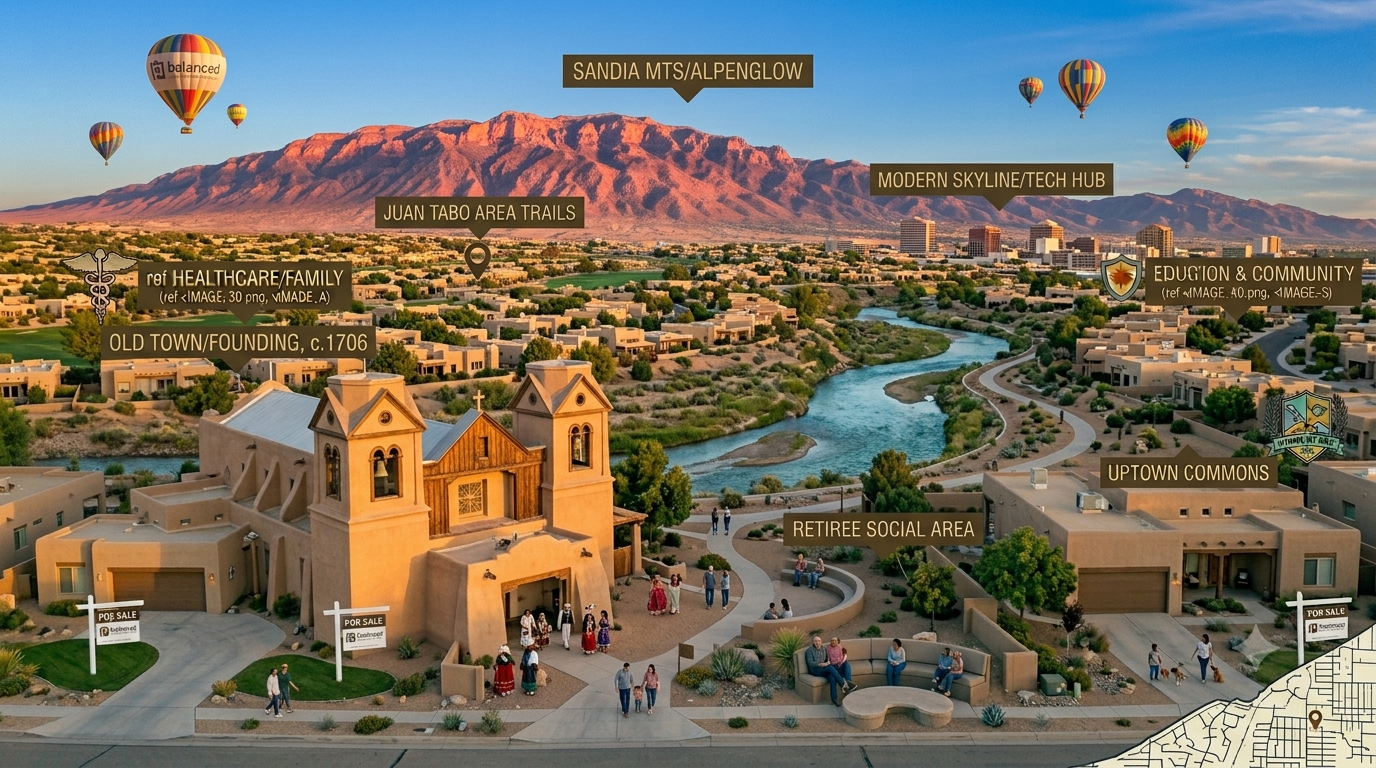
- The Sandia Mountains (5,000 feet of vertical rise within city limits): No other major American city has a mountain range of this scale rising from within its urban boundary. The Sandias — which peak at 10,378 feet and rise immediately east of the residential grid — are accessible from residential streets by trail, produce alpenglow every evening that turns the limestone crest pink (Sandia means watermelon in Spanish), and define the city's visual orientation as completely as any landmark in any American metropolitan area.
- The Rio Grande through the center: The river that named this continent's third-longest river runs north to south through the city, with its bosque (riparian cottonwood forest) creating a 1-3 mile green ribbon of wildlife habitat through the desert urban landscape. The Rio Grande is why the city is where it is — 1,000 years of agricultural civilization depended on its water and crossing.
- The volcanic West Mesa: Five extinct volcanoes on the western horizon and the 7,244-acre Petroglyph National Monument on the volcanic basalt escarpment — containing more than 24,000 images carved into the rocks by Native Americans and Spanish settlers over 400-700 years — create a western boundary that is both geologically dramatic and archaeologically irreplaceable.
- Mile-high elevation: At 5,312 feet (over a mile above sea level), Albuquerque's elevation produces the specific climate — dramatic 30-40°F daily temperature swings, low humidity, 310 days of sunshine annually, intense colors at altitude — that makes the city look and feel specifically different from any comparable-sized city at lower elevations.
The geographic combination is specific: mountain range + desert river + volcanic landscape + mile-high elevation + 310 days of sunshine. No other American city of comparable scale has all five of these simultaneously. The geography is not incidental to the city's character — it is the reason every dimension of the city's culture, architecture, and identity took the specific form it took.
Factor 2 — The Longest History of Continuous Human Habitation
Albuquerque is older than almost anyone who visits it imagines. The Villa de Alburquerque was established in 1706 — 70 years before the United States declared independence — but the human habitation of this specific Rio Grande crossing predates the 1706 founding by at least 1,000 years and the first European contact by many centuries before that.
The Tiwa-speaking Pueblo people were farming this valley by approximately 1250. Their ancestors had been building multi-story adobe dwellings in the region by 750 CE. The petroglyphs on the West Mesa were being carved at least 400 years before Coronado arrived in 1540. The oldest continuously inhabited community in North America — Acoma Pueblo (Sky City), founded around 1250 — is 60 miles west of Albuquerque.
The depth of this habitation is not an abstraction. It is visible in the city every day: in the traditional dances performed at the Indian Pueblo Cultural Center (owned and operated by the 19 Pueblos themselves on 80 acres they own in central Albuquerque), in the acequia irrigation system still functioning in the North Valley, in the blue corn that was domesticated in this valley and that still appears on every New Mexican restaurant menu, in the adobe architectural language that connects the oldest building in the city (San Felipe de Neri Church, 1793) to the newest residential construction's stucco-and-portal aesthetic.
This depth is specifically different from the "history" most American cities can offer. Albuquerque's history is not preserved in a separate museum district while the rest of the city moves forward. It is present, active, and ongoing in the daily life of people whose families have been here for longer than the United States has existed.
Factor 3 — The Four-Layer Cultural Architecture
Albuquerque is the specific result of four distinct cultural traditions operating on the same geographic space in consecutive historical layers, each leaving permanent deposits that remain visible in the 2026 city:
- Layer 1 — Pueblo indigenous culture (1,000+ years): The agricultural, architectural, ceramic, and spiritual traditions of the Tiwa and other Rio Grande Pueblo peoples. Present today in the 19 active Pueblos surrounding the city, the IPCC, the petroglyph cultural sites, and the continuing ceremonial traditions of the Pueblo peoples whose invitation to attend feast days is the most direct access to a living cultural tradition that is still fully operational.
- Layer 2 — Spanish colonial culture (1598-1821, 220 years): The adobe architecture, the plaza design, the Catholic church, the New Mexican cuisine's structural elements (pork, wheat flour, dairy, the sopapilla), the acequia water system, the Spanish language presence (New Mexico leads the US in Spanish-speaking households), and the flamenco tradition that earned Albuquerque recognition as the Flamenco Capital of North America — all Spanish colonial deposits on the Rio Grande landscape.
- Layer 3 — Route 66 and the American industrial era (1880-1960s): The railroad brought the first Anglo-American commercial culture. Route 66 made Albuquerque a transcontinental waypoint. The Pueblo Deco architecture of the KiMo Theater (1927) fused Native American decorative vocabulary with Art Deco commercial aesthetics in a way that could only have happened here. The 98 motor courts that lined the Route 66 corridor created a vernacular architectural tradition that the 2026 centennial is actively preserving.
- Layer 4 — The Atomic Age and the federal research era (1940s-present): Sandia National Laboratories, Kirtland Air Force Base, and the Manhattan Project's proximity transformed Albuquerque into the federal scientific research capital of the Mountain West. This layer added the professional demographic (94th-98th percentile nationally in income and education in the premium neighborhoods), the technical workforce, and the government employment that made the modern city economically sustainable.
The result: nowhere else in the American Southwest does a Pueblo elder's agricultural heritage, a Spanish colonial church, a Pueblo Deco theater on Route 66, and quantum computing research by the descendant of WWII German refugee scientists occupy the same city simultaneously. Albuquerque's cultural architecture is specifically this accumulated, layered, ongoing combination.
Factor 4 — The Cuisine That Belongs to No Other Place
New Mexican cuisine — which is not Mexican food, not Tex-Mex, and not generic "Southwestern" — is the specific food expression of the city's cultural layers. The stacked red chile enchilada (not rolled, smothered in a sauce with no cumin, topped with a fried egg), the green chile stew with Hatch Valley-grown chile that cannot be replicated by growing the seed anywhere else, the sopapilla that is both dessert and entrée, the blue corn that was domesticated in this valley, the biscochito that is the only official state cookie in the United States — this cuisine specifically emerged from the same geographic-cultural combination that produced the city.
The Hatch Valley, 200 miles south of Albuquerque, produces the specific green chile cultivar — the Big Jim variety developed by NMSU's Roy Nakayama in 1975 — whose flavor and heat profile cannot be replicated elsewhere because the soil, altitude, temperature differential, and low humidity of the Hatch Valley are irreplaceable. September in Albuquerque, when the roasting drums appear in grocery store parking lots and the specific aroma of roasting green chile fills the city, is an experience that is not available anywhere else on Earth.
AFAR's 2026 recognition specifically cited the "evolving culinary landscape" as one reason for naming Albuquerque a top destination. The evolution is happening on top of a foundation that has been four centuries in construction. The James Beard-nominated kitchens, the farm-to-table restaurants sourcing from the Rio Grande flood plain, and the innovative chefs at Sawmill Market and Downtown are building on something that already existed — the specific food culture of a specific place.
Factor 5 — The Atmospheric Phenomenon That Created the World's Largest Balloon Festival
The most specifically scientific reason Albuquerque is unique is the meteorological phenomenon called the Albuquerque Box — and understanding it explains why the world's largest hot air balloon festival is here and not anywhere else.
The Albuquerque Box is produced by the specific interaction of the Sandia Mountains, the Rio Grande valley, and the prevailing wind patterns at different elevations near the city. At low altitude (below 1,000 feet above ground), the wind near the Sandia Mountains consistently blows south to southwest. At higher altitude, the wind flows from the south northward and eventually eastward. This creates a box pattern — a near-rectangle of wind currents that allows balloons launched from Balloon Fiesta Park to travel north at altitude, then descend to lower altitude and be pushed back south, returning to near their launch point.
The box is the specific operational requirement for the Balloon Fiesta's mass ascension format — the simultaneous launch of 500+ balloons that is the most visually spectacular element of the world's largest balloon event. A mass ascension requires balloonists to be able to land near their launch point. Without the Box, the balloons would simply drift away and a mass ascension would be logistically impossible. The Box is here; the festival is here. The 800,000+ annual visitors who attend the Albuquerque International Balloon Fiesta every October are specifically attending because of a meteorological accident of geography.
Factor 6 — The UNESCO Creative City and the Film Identity
In 2019, Albuquerque was designated a UNESCO Creative City of Media Arts — one of fewer than 50 cities globally to hold any UNESCO Creative City designation, and one of very few in North America. The designation recognizes the city's contributions to film, television, digital media, and the broader creative economy.
The film identity that earned this recognition was built in decades but crystallized globally through Breaking Bad (2008-2013) and Better Call Saul (2015-2022). The specific visual vocabulary of these productions — the Sandia Mountains, the volcanic landscape, the adobe architecture, the blue sky with its specific altitude-produced color, the light quality of 310 days of sunshine at 5,312 feet — embedded Albuquerque's geography into the consciousness of 65+ million viewers worldwide. The city that produces a specific look visible in every frame of the most globally discussed TV dramas of their era is a city whose visual identity has become internationally known.
"In 2026, Albuquerque is the Flamenco Capital of North America. Festival Flamenco Alburquerque brings dozens of renowned flamenco dancers and musicians to Albuquerque for a series of extraordinary performances and classes," noted Visit Albuquerque's 10 Reasons to Visit Albuquerque in 2026 (December 2025). The flamenco tradition is the Spanish colonial cultural layer expressed as a living performance art — and Albuquerque is its North American capital.
The creative economy data: 250 arts organizations, 45 guilds, 400+ artisan manufacturing companies producing furniture, jewelry, pottery, clothing, and textiles. More than 40 art galleries. A film production industry that generates hundreds of millions annually and that attracted Netflix's confirmed 300-acre campus expansion. A consistently performing arts scene that the Albuquerque Library's historical overview describes specifically as "the more vital art center" relative to Santa Fe — a city with a far higher national arts reputation — because Albuquerque's artists "looked eagerly forward, rather than toward an idealized, mythic past."
Factor 7 — The Federal Research Concentration That Made the Modern City
Albuquerque's professional identity — the educational attainment, the income levels in the premium neighborhoods, the specific demographics of the Northeast Heights — is the direct result of a federal policy decision made in 1940: the establishment of what became Kirtland Air Force Base, followed by Sandia National Laboratories in 1949.
The Manhattan Project, centered at Los Alamos 90 miles north, made New Mexico the location where the atomic age was born. Trinity Test Site, 200 miles south, is where the first nuclear weapon was detonated. Sandia National Laboratories, built on the Kirtland installation, became the agency responsible for engineering and stewardship of the nation's nuclear weapons stockpile — employing a workforce of 16,900 of the most highly credentialed technical professionals in the federal research system.
The result: North Albuquerque Acres has a median household income of $173,059 — 98th percentile nationally. Seventy-four percent of adults in that neighborhood hold bachelor's degrees or higher, versus 31% nationally. These are not the demographics of a generic Sun Belt city or a regional service economy. They are the demographics of a city that was specifically chosen as the location for the most consequential technological programs of the 20th century.
In 2026, this legacy continues forward: Intel's $7.86 billion CHIPS Act-funded Rio Rancho expansion, Sandia's quantum computing program (at the frontier of the most significant technological development since the transistor), and the Air Force Research Laboratory at Kirtland are all active expressions of the federal research concentration that has defined the city's professional character for 80 years.
Factor 8 — The Counternarrative Identity: The City That Was Not Santa Fe
The final factor in Albuquerque's uniqueness is what it specifically is not: it is not Santa Fe, and the distinction has been formative.
Santa Fe — 60 miles north, New Mexico's state capital — built its identity on a specific and highly curated version of Southwestern history: the adobe architectural standard enforced by city code, the gallery district built around collectors' tourism, the political and cultural capital prestige, and the boutique luxury economy that the oldest capital city in the American West commands. Santa Fe is the mythologized Southwest.
Albuquerque is the actual Southwest — less curated, more diverse, more economically comprehensive, and in the words of the Albuquerque Library's historical overview, "often the more vital art center" specifically because its artists "looked eagerly forward, rather than toward an idealized, mythic past." The city that absorbed every railroad worker, defense contractor, health seeker, filmmaker, federal scientist, and out-of-state remote worker that came through it became something more layered and more genuinely diverse than the city that specifically preserved one architectural aesthetic and one curatorial identity.
The population demographics confirm this: Albuquerque's 37% White (Non-Hispanic), 23.6% White (Hispanic), 14.9% Two+ Race (Hispanic), 9.46% Other (Hispanic), and 3.82% American Indian population reflects a city that absorbed and integrated multiple demographic streams rather than curating one.
The 2026 Recognition — What the World Is Just Now Discovering
The simultaneous Frommer's, AFAR, Condé Nast Traveler, and AARP recognition of Albuquerque for 2026 represents the point at which national and international travel culture caught up with what people who live here have understood for decades. The Route 66 centennial gave the moment a specific narrative hook. The Gathering of Nations' final 2026 event gave it cultural urgency. The Route 66 Remixed art installations gave it a new permanent visual identity. The Netflix campus expansion gave it a contemporary economic story.
But the factors behind the recognition — the geography, the depth, the cultural layers, the cuisine, the Box, the UNESCO designation, the federal research legacy, and the counternarrative identity — were not created for 2026. They were accumulated across 1,000 years of continuous human habitation at the same Rio Grande crossing. The world's travel media found them; the city had been building them since before anyone writing about them was born.
For the physical landmarks that make this uniqueness visible and experiential — the Old Town plaza, the Sandia Peak Tramway, the petroglyphs, the KiMo Theater, the Balloon Fiesta Park — our post on the unique experiences in Albuquerque you won't find anywhere else covers the experiential landscape. And for the annual events that make the city's uniqueness a living calendar — the Balloon Fiesta, the Gathering of Nations, the Green Chile Festival, the Route 66 centennial events — our post on the biggest annual events in Albuquerque you should never miss covers the complete cultural calendar.
The Summary — Eight Factors That Produced One Irreplaceable City
- Geography: Mountain range inside the city + river through the center + volcanic mesa + mile-high elevation + 310 days of sunshine. No other American city has all five.
- Depth of habitation: 1,000+ years of continuous human presence at the same location, with the cultural descendants of the original inhabitants still present, still farming, still governing themselves, still performing their traditions at the Indian Pueblo Cultural Center they own.
- Four-layer cultural architecture: Pueblo, Spanish colonial, Route 66, and Atomic Age — each layer permanently deposited on the same geographic space, all simultaneously visible in 2026.
- Cuisine: The only regional cuisine in North America that is centuries old, that requires one specific ingredient (Hatch Valley green chile) that cannot be grown anywhere else, and that does not exist in any form outside this specific region.
- The Albuquerque Box: The meteorological phenomenon that produced the world's largest balloon festival in this specific city because no other city in the world has the specific wind pattern that makes a mass ascension logistically possible.
- UNESCO Creative City and film identity: The creative economy that turned a mid-sized desert city into a globally recognized film destination, a Flamenco Capital, and a UNESCO Creative City of Media Arts — on the foundation of cultural depth that made the city worth filming in the first place.
- Federal research concentration: Sandia Labs + Kirtland + Intel + quantum computing — the specific federal investment decision that made Albuquerque a scientific research capital and produced the professional demographic that sustains the city's 98th-percentile-nationally income neighborhoods.
- The counternarrative identity: The city that was not Santa Fe — more diverse, more forward-looking, more genuinely multicultural — that produced the art history's characterization of Albuquerque as "the more vital art center" precisely because it was not curating a single identity.
The Bottom Line — Unique by Accumulation, Not by Design
Albuquerque did not set out to become unique. No city does. Uniqueness in a city is the result of specific geography intersecting with specific history intersecting with specific policy decisions intersecting with specific cultural traditions — and then time, the long kind, compressing them into a character that becomes irreplaceable.
The city named for a Spanish duke in 1706 at a Rio Grande crossing where Pueblo people had been farming for centuries became, without particularly planning to become it: the meteorological accident that produced the world's balloon festival capital, the cinematic landscape that defined the visual grammar of the most-discussed TV dramas of an era, the UNESCO Creative City where flamenco and quantum computing share a metropolitan area, and the food culture capital of the one cuisine in North America that is specifically here and nowhere else.
When AFAR says it offers "a sense of place that travelers won't find anywhere else," the statement is not promotional language. It is an accurate description of what 1,000 years of accumulated geography, history, and culture produces when it is left to compound. Albuquerque is what compounding uniqueness looks like.
Want to Live in the City That Earned All of This?
Jenn & Vinay from The Rodgers Neighborhood Real Estate Group know which Albuquerque neighborhoods give you the Sandia Mountain alpenglow in the east-facing living room window, the bosque trail within walking distance, the New Mexican food culture on the regular lunch rotation, and proximity to the creative, scientific, and cultural institutions that make this specific city worth being from. The conversation about finding your place in one of America's most unique cities starts with a call.
Jenn & Vinay Rodgers are Albuquerque's trusted real estate professionals with The Rodgers Neighborhood Real Estate Group, brokered by Real Broker, LLC, serving buyers and sellers across Albuquerque, Rio Rancho, Corrales, Los Lunas, Tijeras, Cedar Crest, Sandia Park, the East Mountains, Bernalillo County, Sandoval County, and surrounding New Mexico communities.
The Rodgers Neighborhood Real Estate Group
Jenn & Vinay Rodgers
Real Broker, LLC
Albuquerque, NM
📞 505-417-2733
🏠 Find your home in one of America's most unique citiesCategories
- All Blogs (322)
- 2026 & Beyond for Real Estate (218)
- Doctors and Nurses looking for homes in NM (4)
- Guide to buying a home in NM (146)
- Health Care Heros (7)
- Home Upgrades (38)
- Jenn & Vinay your Local Real Estate Experts! (107)
- Moving to Albuquerque (127)
- Neighborhoods in Albuquerque NM (87)
- Rent or Own (2)
- Sellers Questions for Selling homes (2)
Recent Posts
GET MORE INFORMATION