
Unique Experiences in Albuquerque You Won’t Find Anywhere Else
The word "unique" gets applied to everything in travel writing. Unique views. Unique atmosphere. Unique dining. It has been used so indiscriminately that it has become nearly meaningless.
This guide uses it literally. The experiences in this post are things that do not exist anywhere else. Not things that are better in Albuquerque than in other places. Not things that are special to this city in a general way. Things that exist here and nowhere else, for reasons that are specific to this geography, this meteorology, this history, or this cultural community.
There are not many cities in the world with a list this long. Albuquerque has one.
AFAR magazine confirmed it in naming Albuquerque among its Best Places to Travel in 2026, noting that the city delivers "a sense of place that travelers won't find anywhere else," according to the City of Albuquerque's 2026 tourism recognition announcement. Condé Nast Traveler named Albuquerque among its Best Places to Go in 2026, calling it 'a destination where culture is alive, layered, and celebrated year-round.' These recognitions are not courtesy descriptions. They reflect what the guide below documents: a city with a density of genuinely irreplaceable experiences that most comparable-sized cities cannot approach.
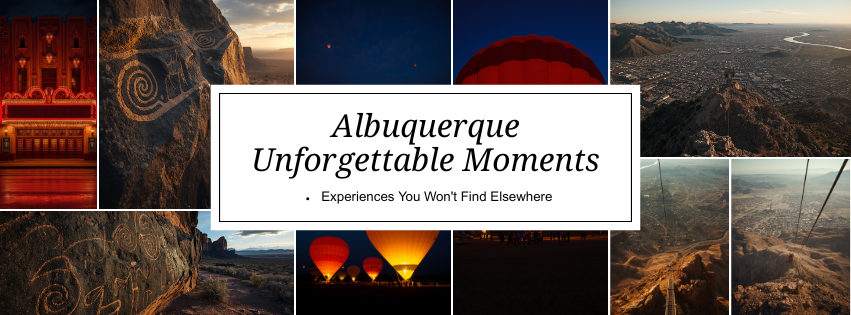
1. The Albuquerque Box — The Meteorological Phenomenon That Exists Almost Nowhere Else
Before the Balloon Fiesta. Before the experience of watching 700 balloons rise. Before any of it: the explanation for why Albuquerque is the world balloon capital.
The Albuquerque Box is a layered wind pattern created by the Rio Grande Valley's specific topography and thermal conditions. Surface-level winds typically blow from the north-northeast, while winds at altitude blow from the west or southwest. This two-direction wind layering allows hot air balloon pilots to ascend in one wind layer, travel downwind, then descend into the surface-level wind to return toward the launch site — essentially allowing the pilot to drive the balloon back to its starting point by controlling altitude rather than direction.
This degree of navigation precision is almost unique in the world. It is the reason the Balloon Fiesta exists in Albuquerque rather than anywhere else. It is the reason 700 balloons can launch from a single field without the logistical chaos that the same event would produce in any other location. The Box is not a marketing invention. It is a meteorological fact, and it is the specific reason that the world's most extraordinary annual gathering of balloon flight has been happening here since 1972.
For visitors who understand the Box before they watch the mass ascension, the event communicates something different than it does to observers who see it as spectacle without context. What they are watching is 700 pilots simultaneously exploiting a meteorological anomaly that belongs to this specific valley. It is the most concentrated expression of human engagement with local geography that any annual event in the world produces.
2. The International Balloon Fiesta — October 3-12, 2026
The Balloon Fiesta is the largest hot air balloon event in the world — 700 balloons, 1,000 pilots from 50 countries, 900,000 visitors over nine days in October. The specific experiences within it that are most completely unique:
- The Dawn Patrol: Before sunrise, three to five special shape balloons are inflated and lit from within, glowing against the dark sky before ascending into the pre-dawn blackness. The specific visual of a glowing balloon rising from darkness — the only light on the field — is the Fiesta moment that most consistently produces the silence of genuine awe rather than the noise of entertainment.
- The Mass Ascension: On the first Saturday and Sunday mornings, all 700 balloons inflate and launch simultaneously from a single field over approximately 90 minutes. The specific sensory experience of being in the middle of 700 balloons simultaneously inflating — the sound, the visual, the sense of scale — cannot be replicated in any other environment because there is no other environment where 700 balloons are present simultaneously.
- The Balloon Glow: On Friday evenings, tethered balloons light their burners in choreographed sequences at dusk, transforming the field into a temporary landscape of glowing geometric forms against the darkening sky. The Glow is consistently rated by experienced Fiesta attendees as the most visually extraordinary single event of the week.
- The Special Shapes Rodeo: Balloons in forms ranging from cartoon characters to architectural shapes to entirely abstract geometric forms. The Special Shapes competition is the Fiesta's most visually playful session and the source of most of the photographs that go viral without caption.
2026 dates: October 3-12. The Fiesta celebrates the Route 66 Centennial this year under the theme "The Scenic Route" — connecting the two most iconic Albuquerque experiences in a single week that will not be replicated again for another century.
3. The KiMo Theatre — The Only Pueblo Deco Building in the World
At 423 Central Avenue NW, the KiMo Theatre was built in 1927 by architect Carl Boller in a style that Boller created specifically for this commission and that has never been used on any other building before or since. He called it Pueblo Deco — a synthesis of Navajo textile patterns, Pueblo pottery motifs, Zuni sand painting geometries, and 1920s Art Deco commercial architecture that produces a building whose aesthetic is completely specific to the American Southwest and to this single architect's specific vision of what that culture deserved as a commercial building form.
The specific details that make the KiMo visually extraordinary: the terracotta buffalo skulls with glowing orange glass eyes flanking the theater entrance, the Navajo textile band running along the exterior facade, the interior murals depicting New Mexico landscapes and Pueblo ceremony, the specific chandelier design whose form references both Art Deco geometry and Pueblo ceramic tradition. There is no building anywhere in the world that looks exactly like the KiMo because the KiMo was invented rather than derived. Its architect made the only one.
The KiMo's Route 66 centennial role in 2026: the theater has been restored and its neon marquee is lit throughout the centennial year as part of the Central Avenue celebration. It is the most architecturally significant building on the entire 18-mile Route 66 urban stretch that Albuquerque owns, and its restored neon state in 2026 makes it the most completely itself it has been in decades.
Practical: the KiMo hosts regular film screenings, theatrical performances, and community events. It is also open for daytime tours when events are not scheduled. The experience of standing in the lobby of the KiMo, surrounded by the specific objects and surfaces that Boller designed in 1927 for this specific building in this specific city, is the experience of a building that was invented for exactly where it stands.
4. The Indian Pueblo Cultural Center — Owned by All 19 Pueblos
The Indian Pueblo Cultural Center at 2401 12th Street NW is the cultural institution that most completely addresses what Albuquerque visitors consistently underestimate before they arrive: the living presence of the Indigenous Pueblo civilization that has been continuous in this landscape for over a thousand years.
The IPCC is not a museum that presents Pueblo culture from the outside. It is owned and operated by all 19 Pueblos of New Mexico simultaneously — the only institution of its kind in the United States. Each Pueblo has contributed to the permanent collection's representation of its specific culture, history, and contemporary creative practice. The result is not a generic Native American experience but a genuine encounter with 19 distinct sovereign nations whose cultures share a landscape but not an identity.
The specific experiences within the IPCC that are available nowhere else: the traditional dances performed in the outdoor performance courtyard on weekend mornings from spring through fall — real dancers from Pueblo communities performing the ceremonial and celebratory traditions their communities maintain. The Indian Pueblo Kitchen, serving traditional Pueblo cuisine alongside contemporary interpretations, is the only restaurant in the United States where the food is prepared in the context of the cultural institution that its sources created. The gift shop carries authentic work from Pueblo artists with direct attribution to the individual artist and community.
For visitors who come to Albuquerque primarily to see the Balloon Fiesta or the Tramway and leave without visiting the IPCC, the experience is incomplete. The Balloon Fiesta is extraordinary. The IPCC is profound. The distinction matters, and the IPCC consistently produces the response that visitors describe as the most emotionally affecting encounter of their visit — not the most spectacular, but the deepest.
5. The National Museum of Nuclear Science and History — The Atomic Age's Only Museum
The National Museum of Nuclear Science and History at 601 Eubank Blvd SE is the world's only museum dedicated to the full history of the nuclear age — and it exists in Albuquerque because the history it documents happened here.
Trinity Site, where the world's first nuclear device was detonated on July 16, 1945, is 60 miles south of Albuquerque near Socorro. Los Alamos National Laboratory, where the Manhattan Project's scientific work was conducted, is 60 miles north. Sandia National Laboratories, the primary US nuclear weapons development institution, is within the city's eastern boundary. Kirtland Air Force Base, one of the military's primary nuclear storage and delivery facilities, is Albuquerque's largest employer. The nuclear age's most consequential events, institutions, and ongoing infrastructure are geographically centered on this specific city.
The museum's collection encompasses the full arc from the 1930s physics that made the technology possible through the Manhattan Project's development, the Cold War weapons race, the arms control treaties that ended the most dangerous phase of that race, and the contemporary applications of nuclear technology in medicine, energy, and research. The outdoor Heritage Park displays actual aircraft, missiles, and bombs that are available for close inspection in ways that Washington's museums — bound by their institutional contexts — typically cannot provide.
For visitors from the generation that grew up in the Cold War shadow, the museum produces a specific kind of recognition: this is where those weapons were created. For visitors from subsequent generations, the museum produces a specific kind of education: this is what that history actually consisted of. Both responses are more available here than anywhere else because the museum's proximity to the actual history is geographic as well as archival.
6. Petroglyph National Monument at Dawn — Rock Art Carved Over Seven Centuries
There are petroglyph sites across the American Southwest. There is no petroglyph site accessible from a major American city that approaches Petroglyph National Monument's combination of scale (24,000 images), accessibility, and preservation state.
The monument's volcanic basalt escarpment — the remnant of a lava flow from five extinct volcanic cones visible to the north — carries the accumulated visual record of seven centuries of Pueblo and Spanish colonial image-making. Spirals, bighorn sheep, human figures, clan symbols, geometric forms, and images whose meaning has been lost but whose presence communicates the same impulse that drives contemporary graffiti: I was here, and I marked the fact.
The specific experience that is available at no other petroglyph site in the United States: arriving at the Rinconada Canyon trailhead on a weekday morning before 7am, when the trail is empty, the low-angle desert light illuminates the basalt face in the specific way that makes the carved images most readable, and the volcanic cones to the north are lit against the morning sky. For 90 minutes, you are in a landscape that has been inhabited, used, and marked by human beings for a millennium, in complete solitude, within the physical boundary of a major American city.
The contrast is the specific thing that visitors who have experienced it most frequently describe: you drove 15 minutes from a hotel in a city of 565,000 people to be completely alone in an ancient landscape. That specific juxtaposition of accessible wildness and urban adjacency is available in Albuquerque and, in this form, nowhere else.
7. The Route 66 Centennial — 2026's Once-in-a-Century Experience
Route 66 was established in 1926, making 2026 its 100th anniversary. Albuquerque has 18 miles of the original Route 66 alignment along Central Avenue — the longest continuous urban stretch in any American city. "2026 is a particularly exciting year for Route 66, as it's the centennial. Albuquerque has the longest continuous urban stretch of Route 66 in the country at 18 miles, and the city is going all-out with celebrations, including new murals and art installations along Central Avenue, special events, and a Route 66 Summerfest in the Nob Hill neighbourhood," confirmed the Finding the Universe 2026 Albuquerque travel guide.
The specific centennial experiences that are available in 2026 and will not be available in any subsequent year:
- The new centennial murals: Dozens of new murals commissioned specifically for the Route 66 centennial have been installed along Central Avenue throughout 2025 and 2026. Walking the Central Avenue corridor in 2026 is walking through a gallery of commissioned public art created specifically for this moment.
- The Route 66 Summerfest: The annual Nob Hill summer festival expanded and themed for the centennial, bringing the specific street-festival energy of Central Avenue's cultural corridor to its most significant anniversary.
- The Balloon Fiesta 'Scenic Route' theme: The 2026 Balloon Fiesta (October 3-12) is themed 'The Scenic Route' in honor of Route 66's centennial — connecting the city's two most iconic experiences in a single October week.
- The restored neon: Signs along the Central Avenue corridor have been restored and lit for the centennial, producing the most complete neon corridor presentation that Albuquerque's Route 66 has offered in decades.
This specific combination — the centennial year, the new art, the expanded programming, the thematic connection to the Balloon Fiesta — exists only in 2026. The Route 66 bicentennial will be in 2126. What is available in 2026 is the first opportunity most living people will have to celebrate it.
8. The Green Chile Cheeseburger — A Cultural Identity, Not Just a Food
There are green chiles grown in other places. There is no green chile like the Hatch Valley New Mexico green chile, and there is no food culture built around that chile the way New Mexico's is.
The green chile cheeseburger is the specific intersection of American diner culture and New Mexican chile cultivation that produces a food experience that is genuinely unavailable anywhere else — not because the recipe is secret or the ingredients are inaccessible, but because the specific Hatch chile that defines the New Mexican version is a distinct agricultural product whose flavor is the result of the specific soil, water, and climate of the Hatch Valley of New Mexico and cannot be replicated by growing similar chiles elsewhere.
The New Mexico Tourism Department's official Green Chile Cheeseburger Trail documents the specific restaurants across the state where the experience is most authentically expressed. In Albuquerque, the trail covers everything from the Frontier Restaurant's classic green chile cheeseburger ($10) to the higher-end interpretations at restaurants like Standard Diner. The specific instruction that the trail provides to first-time visitors: order it Christmas — red and green chile simultaneously. Christmas is the only correct first-time answer to the red-or-green question, and it communicates either that you know what you are doing or that you are learning correctly.
The August-September green chile roasting season — when propane-powered drum roasters appear at grocery stores, farms, and roadside stands across the city — is the specific New Mexico sensory experience that anyone who has experienced it describes with a precision that suggests the memory is particularly acute. The smell of fresh-roasting Hatch green chile in August is the smell of New Mexico in a way that no other food experience in any other state replicates its specific geography.
9. The Sandia Peak Tramway at Night — The Specific Version That No Other Experience Replicates
The Sandia Peak Aerial Tramway is the longest single-span aerial tram in the United States. That fact is in every guide. What is less frequently described is the specific version of the Tramway experience that most completely distinguishes itself from every other elevated experience available in any American city.
The version: board the late-afternoon tram departure. Arrive at the Crest at 10,378 feet as the sun is approaching the western horizon. Spend 30-40 minutes on the Crest as the city below transitions from full daylight to the specific amber of late afternoon to the first emergence of the city lights as the sun sets behind the Jemez Mountains. Take the final tram descent after dark, with the city grid fully illuminated in the valley 5,000 feet below you, visible through the cable car windows as you descend toward it.
The specific quality of the city-lights descent that no other elevated experience in the United States provides: the speed of the descent (15 minutes from summit to base), the angle (nearly vertical descent from an alpine summit to a desert valley floor), and the silence (aerial tram, not helicopter) combine to produce the specific sensation of flying into an illuminated city from above without engine noise. No city observation deck provides this. No other tram in the United States has the vertical relief that makes it possible here.
10. The Only Place Three Distinct Civilizations Continuously Share a Single Landscape
This one is not an attraction. It is not a museum or an event. It is the specific cultural condition that makes everything else in this guide possible — and that most visitors encounter without fully registering.
Albuquerque is the city where the Pueblo civilization's 1,000-year presence, the Spanish colonial 400-year presence, and the American territorial and statehood 175-year presence are all simultaneously active, visible, and culturally maintained. Not as historical exhibits. As living cultural communities whose members are present, practicing, and contributing to the city's daily life.
The Pueblo pottery being sold at Old Town is made by contemporary Pueblo artists living in communities whose direct ancestors made the petroglyphs at the monument. The Spanish colonial architecture of the Old Town plaza plaza was built by families whose descendants still attend San Felipe de Neri. The Frontier Restaurant has been feeding the democratic plurality of a city that is majority-minority — Hispanic and Native American together outnumbering Anglo-American residents — since 1971. The specific cultural layering that Condé Nast Traveler called 'alive, layered, and celebrated year-round' is not a tourism construction. It is the actual daily condition of a city where three civilizations have been sharing a landscape for centuries without any of them leaving.
For visitors from cities where cultural heritage is primarily one tradition's — and for prospective residents from coastal markets where the demographic narrative is more recent and less layered — the specific quality of Albuquerque's cultural coexistence is the experience most consistently described as irreplaceable. Not the most dramatic. The most genuinely unlike anywhere else.
The Bonus Genuinely Unique Experiences — The Shorter List
The American International Rattlesnake Museum
Near Old Town at 202 San Felipe St NW: the world's largest collection of live rattlesnake species — approximately 30 species from across the Americas — in what was once a trading post. The owner is typically present and talks about the snakes with the enthusiasm of someone who has been doing this since 1990. The building is small enough that the collection and the curator coexist in a single intimate space. There is no other place on Earth where you can see this many live rattlesnake species in one room.
The Turquoise Museum
2107 Central Ave NW: the museum that claims the world's most comprehensive collection of turquoise specimens and turquoise history, housed in a castle-styled building on Route 66. The geological, mining, cultural, and commercial history of turquoise — New Mexico's state gem — with a depth that transforms what most people know as a jewelry color into a geologically and culturally complex material with a 7,000-year human history. The specific exhibit on artificial versus natural versus treated turquoise is the education that every person who has bought turquoise jewelry without understanding what they were buying needs.
The Dog House Drive-In on Route 66 — Sixty-Plus Years of Chili Dogs
1216 Central Ave NW: the hot dog and chili stand that has been operating on Route 66 since the late 1950s and that the series Breaking Bad immortalized in a cameo that produced a specific kind of pilgrimage tourism that the stand's original customers never anticipated. The neon sign is original. The chili dogs are covered in green chile. The operation is modest and consistent and has never tried to be anything other than what it is. Appearing in Breaking Bad did not change it. That specific continuity — the stand that was there before the show and is still there after it — is itself a kind of urban authenticity that chain-food-dominated cities cannot produce.
The Apothecary Lounge at Hotel Parq Central
806 Central Ave SE: a rooftop bar on the penthouse level of a boutique hotel that was converted from the Atchison, Topeka, and Santa Fe Railway's 1926 hospital — a building that served the medical needs of AT&SF railway workers for decades before becoming, after renovation, the most architecturally interesting small hotel in Albuquerque. The Apothecary Lounge's rooftop view — the city to the west, the Sandia Mountains to the east, the Route 66 corridor visible in both directions — is available nowhere else in the city because no other rooftop has this specific combination of position and architectural history beneath it.
The National Hispanic Cultural Center Performing Arts Complex
1701 4th St SW: The NHCC's torreón, a 72-foot tall round tower containing the largest commissioned fresco in North America — a 4,000-square-foot ceiling painting by artist Frederico Vigil that depicts 3,000 years of Hispanic cultural history from pre-Columbian Mesoamerica through the present. The fresco took Vigil 11 years to paint, was executed entirely on plaster in the traditional fresco method, and covers a surface area that has no comparable in American public art. Visiting the torreón is the experience of standing inside the largest single artwork in North America and looking up.
For visitors who want to organize these unique experiences into a practical Albuquerque itinerary, our 48-hour Albuquerque itinerary provides the specific sequence. And our complete guide to things to do in Albuquerque extends the picture beyond the genuinely unique to the full range of what the city offers visitors and residents.
The Bottom Line — What Makes Albuquerque Irreplaceable
The length of this list is the point.
Most cities with 565,000 people have one or two genuinely irreplaceable experiences. They have one building that exists nowhere else, or one natural phenomenon, or one food tradition. Albuquerque has the Albuquerque Box and the Balloon Fiesta, the KiMo Theatre, the Indian Pueblo Cultural Center's 19-nation ownership structure, the National Museum of Nuclear Science and History, the Petroglyph National Monument, the Route 66 centennial, the green chile as cultural identity, the Sandia Peak Tramway's city-lights descent, the three-civilization cultural coexistence, the Rattlesnake Museum, the NHCC's torreón fresco, and the Turquoise Museum. All in the same city.
AFAR's characterization — 'a sense of place that travelers won't find anywhere else' — is precise rather than promotional. The specific sense of place that Albuquerque provides is a function of the specific things that exist here and not elsewhere. Those things are documented above. They are the reason that visitors who give the city genuine attention consistently describe their experience as surprising — not because their expectations were low, but because the city's specific depth exceeds what the advance research suggests.
They are also, for people who live here, the texture of daily proximity to the irreplaceable. Residents of the Northeast Heights foothills can see the petroglyphs from their windows. Residents of the Downtown and Nob Hill corridors walk past the KiMo on the way to dinner. The specific quality of living in a city where these things are your local landmarks rather than your travel itinerary is a quality-of-life variable that is genuinely difficult to communicate in real estate terms but that residents consistently name as the most unexpected gift of having moved here.
Considering Making Albuquerque Your City?
Jenn & Vinay from The Rodgers Neighborhood Real Estate Group help people who have experienced the Albuquerque Reveal — the moment when the city's genuine depth became clear — take the next step. If the unique experiences in this guide are making you wonder what it would feel like to have them as neighbors rather than destinations, the conversation about which neighborhood puts you closest to the things you care about most starts with a call.
Jenn & Vinay Rodgers are Albuquerque's trusted real estate professionals with The Rodgers Neighborhood Real Estate Group, brokered by Real Broker, LLC, serving buyers and sellers across Albuquerque, Rio Rancho, Corrales, Los Lunas, Tijeras, Cedar Crest, Sandia Park, the East Mountains, Bernalillo County, Sandoval County, and surrounding New Mexico communities.
The Rodgers Neighborhood Real Estate Group
Jenn & Vinay Rodgers
Real Broker, LLC
Albuquerque, NM
📞 505-417-2733
🏠 Browse Albuquerque homes — live where the unique happens dailyCategories
- All Blogs (332)
- 2026 & Beyond for Real Estate (228)
- Doctors and Nurses looking for homes in NM (4)
- Guide to buying a home in NM (146)
- Health Care Heros (7)
- Home Upgrades (40)
- Jenn & Vinay your Local Real Estate Experts! (113)
- Moving to Albuquerque (131)
- Neighborhoods in Albuquerque NM (89)
- Rent or Own (2)
- Sellers Questions for Selling homes (2)
Recent Posts


GET MORE INFORMATION