
The Fascinating Story Behind Old Town Albuquerque, New Mexico — The Complete 2026 Guide
The ten blocks of Old Town Albuquerque are among the most historically dense ten blocks in the American Southwest. They contain the original 1706 settlement location, the oldest continuously active Catholic parish west of the Mississippi, the architectural vocabulary of Spanish colonial New Mexico, and the specific story of a place that survived three governments, a Confederate occupation, a railroad that tried to kill it by ignoring it, and more than three centuries of desert weather. This is that story.
Chapter 1 — Why Here? The Geographic Logic of the 1706 Decision
"In 1706, a group of colonists were granted permission by King Philip of Spain to establish a new villa on the banks of the Rio Grande. The colonists chose a spot at the foot of the mountains where the river made a wide curve, providing good irrigation for crops and a source of wood from the bosque — the cottonwoods, willows, and olive trees that grow along the river. The site also provided protection from, and trade with, the Native Americans in the area," confirmed Visit Albuquerque's official history of Albuquerque.
The specific geographic logic of the 1706 site choice is not incidental to the story — it is the explanation for why Old Town exists and why it is where it is. The colonists making this decision were applying the same criteria that every human settlement on the Rio Grande had applied for centuries before them:
- The wide river bend: A curve in the Rio Grande creates a larger than usual flood plain on the inside of the bend — more agricultural land, better soil from the deposited silt, lower flood risk for structures built back from the bend's inner edge. The geography that placed the colonial plaza where it is was selected because it was the most productive agricultural site available at this crossing point.
- The bosque timber: The bosque — the cottonwood and willow forest that grows along the Rio Grande's banks — provided the sugar pine and cottonwood vigas (ceiling beams) that are the structural element of every adobe building in Old Town. Without the bosque, the adobe architecture that defines Old Town is physically impossible. The buildings and the forest that provided their structural framework are part of the same geographic decision.
- The mountain protection: The Sandia Mountains to the east provided both a defensive advantage (the eastern approach to the settlement is bounded by a mountain range) and a hunting and gathering resource in the piñon and juniper woodland above the desert valley.
- The Camino Real crossing: Old Town sits on the Camino Real — the royal road from Mexico City to Santa Fe that was the primary trade and communication route of colonial New Mexico. A settlement at the Rio Grande crossing on the Camino Real was a settlement on the main road of the colonial world.
The combination — productive agricultural land, building material, mountain defense, and trade route position — explains why human beings have been choosing this specific Rio Grande crossing for settlement since long before the Spanish colonial era. The 1706 founding was the most recent of many decisions to put a community in this specific location.
Chapter 2 — April 23, 1706: The Day the City Was Made
On April 23, 1706, Governor Francisco Cuervo y Valdés wrote the formal founding document that established the Villa de Alburquerque as a royally chartered town. The document certified that 35 families — 252 people — were settling the villa in compliance with Spanish colonial law. The villa would be named for the 10th Duke of Alburquerque, Francisco Fernández de la Cueva, the current Viceroy of New Spain — following the colonial practice of naming new settlements for powerful patrons whose blessing the document needed.
"Alburquerque" — with two r's — was the original spelling. The second r was gradually dropped over the following century, producing the modern "Albuquerque." The name of the Duke is still embedded in the city's identity through the nickname "Duke City" — the city named for a duke, whose title remained attached 320 years later.
The designation of "Villa" was specifically significant. It was the third of only four villas established in all of colonial New Mexico — a formal royal designation that came with specific legal rights and privileges that simple settlements or missions did not have. A Villa was a chartered community with the legal status to have its own local government, its own plaza, its own church, and its own military garrison. It was the Spanish colonial equivalent of being incorporated.
Chapter 3 — The Plaza Layout: Laws of the Indies in Adobe
The physical form of Old Town Albuquerque is not arbitrary. The Spanish colonial government issued a comprehensive set of regulations for colonial town planning — the Laws of the Indies — that specified exactly how a Villa was to be laid out: a central plaza, the church on the north side of the plaza, government buildings on another side, residential and commercial buildings completing the remaining sides, all streets running north-south and east-west from the plaza corners.
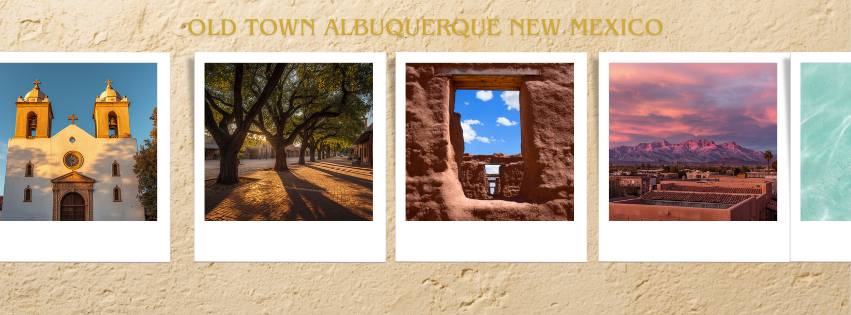
Old Town Albuquerque follows this template precisely. The central plaza has been in continuous use since 1706. San Felipe de Neri Church occupies the north side of the plaza. The surrounding blocks have been continuously commercial and residential. The result is that when you walk into Old Town Albuquerque today, you are walking into a Spanish colonial urban design that is 320 years old — and that is still legible as the design it was built to be.
- The portal architecture: The long covered porches (portals) that line the fronts of most Old Town buildings are not decorative additions — they are functional responses to the New Mexico climate. The portal provides shade in the summer sun while allowing the entry of winter light (the sun is lower in the winter sky and the portal's depth allows winter light to penetrate while blocking the high summer sun). The portal is where the seller sits outside their shop, where the vendor displays their goods without weather exposure, and where the banker (banco — adobe bench built into the back wall of the portal) waits for weary customers. Every portal in Old Town is a 300-year-old climate-response system.
- The walled courtyards: The hidden patios that visitors discover behind the storefronts are the surviving remnants of the original residential courtyards — the private interior of the colonial block that provided security, garden space, and communal family life in the densely-packed adobe structure. Many of the most atmospheric Old Town restaurants are in former courtyards.
Chapter 4 — San Felipe de Neri Church: The Building That Has Never Stopped
The most important single building in Old Town Albuquerque is not the oldest — it is the most continuous. San Felipe de Neri Church on the north side of the plaza has held Mass without interruption since 1793. Two hundred and thirty-three years of continuous parish.
The original 1706 church on this site collapsed in 1793 after heavy rainfall — the adobe construction, inadequately maintained or built on a site with drainage problems, simply dissolved in an abnormally wet season. The replacement was built the same year, 1793, on the same north side of the same plaza, in the same general form. This is the building that stands today.
- The 1850s German missionaries: The twin bell towers that define the church's silhouette — and that appear in virtually every photograph of Old Town — were not part of the 1793 original. German Franciscan missionaries who arrived in the 1850s added the Gothic-influenced bell towers to the original Spanish colonial building, producing the architectural hybrid that now defines Old Town's skyline. The bell towers look Romanesque; the underlying structure is adobe.
- The adobe walls: Three to five feet thick at the base. The specific thickness is not excessive construction — it is the thermal mass engineering of adobe building. Thick adobe walls absorb heat during the day and release it slowly at night, producing interior temperatures that are significantly moderated relative to the exterior without any mechanical systems. The church stays cool in summer and retains warmth in winter because of the physics of its walls.
- Active parish: Mass is held daily. The church is open to visitors, but it is a functioning Catholic parish — not a museum. The same bell tower that has rung for 233 years rings today. Visitors who arrive during Mass encounter the specific experience of a living religious institution whose continuity is 70 years older than the United States itself.
Chapter 5 — Three Flags Over the Plaza
"This village — which has flown the flags of three nations (Spain, Mexico, U.S.A.), was center-stage for the brutal merger of two civilizations, and has become one of the most unique and culturally significant melting pots in the history of the United States — is known as Old Town Albuquerque," confirmed the Old Town Albuquerque story map. The succession of flags is not merely historical decoration — each transition changed the community's relationship to its land, its church, and its commercial life.
The Spanish Flag (1706-1821): The Founding Era
For 115 years, Old Town Albuquerque was a colonial Spanish settlement — governed from Mexico City, loyal to the Spanish Crown, farming the Rio Grande flood plain with the acequia irrigation system that Spanish colonial law mandated, celebrating Catholic feast days, trading in silver, wool, and agricultural products on the Camino Real.
The Spanish colonial era established the physical and cultural vocabulary of Old Town that has never changed: the adobe construction, the plaza layout, the church on the north, the Spanish language, the Catholic faith, the New Mexican cuisine combining Spanish and Pueblo ingredients, and the acequia water system that still functions in Corrales and the North Valley today.
The Mexican Flag (1821-1846): Independence and the American Traders
In 1821, Mexico gained independence from Spain — and Old Town Albuquerque changed its political loyalty without changing its daily life. The same people farmed the same land in the same way. The same church held the same Mass. The change was felt primarily in the increased commercial traffic that Mexican independence enabled: the Santa Fe Trail was opened, and American traders began arriving with manufactured goods in exchange for New Mexico's wool, silver, and mules.
The American traders who came to Old Town in the 1820s-1840s were often the first Anglo-Americans many residents had encountered. Their presence created the first commercial connection between the colonial New Mexican community and the industrial American economy — a connection that would define the community's relationship with the United States when annexation arrived 25 years later.
The American Flag (1846-Present): Annexation, Civil War, and Survival
In 1846, the Mexican-American War brought U.S. Army General Stephen Kearny into Albuquerque. New Mexico was claimed for the United States without significant military resistance. Old Town became an American community overnight — its residents citizens of a country most of them had never intended to join, speaking a language most of them did not know.
The Civil War produced Old Town's most dramatic episode. In 1862, Confederate forces from Texas — Sibley's Brigade — advanced up the Rio Grande and captured Albuquerque. The Confederate commander declared Albuquerque the western capital of the Confederacy. The occupation lasted weeks. Residents buried the church's valuables in the plaza — silver candlesticks, religious objects — to prevent Confederate confiscation. The Battle of Glorieta Pass on March 28, 1862, fought in the Sangre de Cristo Mountains southeast of Santa Fe, effectively ended Confederate ambitions in New Mexico. The retreating Confederates blew up their own supply train rather than let it fall to Union forces and fled south, never to return.
- The buried treasures: Local legend holds that some of the valuables buried during the Confederate occupation were never fully recovered — a specific historical mystery that adds one more layer to the church and plaza's already dense history.
Chapter 6 — The Railroad Disaster That Saved Old Town
The most important event in the history of Old Town Albuquerque was not the founding in 1706, not the Civil War occupation of 1862, and not the three flags. It was a decision made in 1880 by the Atchison, Topeka and Santa Fe Railway: to build the railroad depot a mile east of Old Town rather than in or adjacent to the historic plaza.
The railway's decision was purely practical — the flat land east of Old Town was easier to build on and provided space for the rail yards, shops, and facilities that a division point required. The existing community in Old Town was not the railroad's concern. The depot went east, and "New Town" emerged around it within months.
The effect on Old Town was immediately devastating commercially: the commercial center of Albuquerque moved a mile east. The hotels, banks, newspapers, and commercial blocks followed the railroad. Old Town's commercial role withered. Property values in Old Town declined. The community that had been the center of New Mexico life for 174 years became, within a decade, a backwater of the new American commercial city growing around the railroad.
This commercial abandonment is precisely what saved Old Town architecturally. The buildings that were not economically valuable were not torn down and replaced. The adobe structures that a booming commercial city would have demolished to make way for brick commercial blocks were left standing because no one had enough economic reason to demolish them. Old Town's architectural character was preserved by neglect.
In the 20th century, the historic preservation movement recognized the treasure that economic neglect had accidentally protected. Old Town was designated a nationally recognized historic district. The ten blocks of adobe that the railroad's indifference had preserved became the most valuable architectural legacy in New Mexico's largest city.
Chapter 7 — Old Town Today: The Living Landmark
"Old Town Albuquerque is where the city's story began. Founded in 1706 by Spanish settlers from the nearby village of Bernalillo, it remains one of the most historic and charming places to visit in New Mexico. With its narrow streets, central plaza, and centuries-old adobe buildings, Old Town feels like stepping back in time while still offering the energy of a living, breathing community. Locals, small businesses, and visitors mingle in this walkable neighborhood filled with museums, restaurants, and boutiques," confirmed the Bottger Mansion B&B's 2026 Old Town Albuquerque guide (May 2026).
Old Town in 2026 is specifically a living community — not a preserved historical display. People live in the surrounding neighborhoods. Independent businesses own and operate the shops and galleries. The San Felipe de Neri Parish serves its congregation every day, not just during visitor hours.
- The museum cluster: Within walking distance of the plaza: the Albuquerque Museum (10,000 artworks, 35,000 historical objects), the New Mexico Museum of Natural History and Science (recently reopened after renovation, now featuring Mars Perseverance mission connections), the American International Rattlesnake Museum (world's largest collection of live rattlesnakes), and the Turquoise Museum (the only museum of its type in the world). The Old Town museum cluster is the densest concentration of museums in New Mexico.
- The 120+ independent businesses: The shops, galleries, and restaurants of Old Town are overwhelmingly locally owned and operated — independent businesses rather than national chains. Native American jewelry made by the artisans who sell it. New Mexican food in restaurants whose recipes reflect the culinary tradition of the place rather than a corporate menu. The specific character of Old Town is the cumulative result of 120+ individual business decisions, not a franchise design.
- The artisan portal market: Local artisans sell handmade jewelry, pottery, and textiles under the portal at the northeast corner of the plaza — a direct continuation of the trading tradition that made the colonial plaza the commercial center of the community. The physical format (seller, portal, buyer in the plaza) is unchanged from 1706.
- The December luminarias: On Christmas Eve, thousands of small paper bag luminarias filled with sand and candles are placed along every Old Town wall, pathway, and building edge — illuminating the adobe district in the specific warm amber glow that is among the most photographed seasonal traditions in New Mexico. The luminaria tradition predates the United States.
- The ghost tours: Old Town's 300+ years of accumulated history — the Confederate occupation, the Spanish colonial religious life, the stories of the families who lived and died in these specific buildings — have produced a ghost tour industry that is among the most popular visitor activities in Albuquerque. Whether or not the stories are supernatural, they are specifically the stories of real historical events at real historical locations.
Old Town and Real Estate — The Living Neighborhood Context
Old Town is surrounded by residential neighborhoods — Huning Highland, Barelas, Old Town adjacent streets — where people live within walking or biking distance of the plaza, the church, the museums, and the restaurants. These are not exclusively tourist destinations. They are the regular Saturday morning destinations of the families who live nearby.
Residential listings in and immediately adjacent to Old Town in 2026 range from $300,000 to $1,750,000 depending on property size, condition, and historical designation. The Old Town adjacent residential market commands a premium for exactly the reason that proximity to New York's Central Park commands a premium: the public amenity of Old Town — the plaza, the museum cluster, the walking streets, the seasonal events — is permanently, unconditionally available to the person who lives next door.
The person who lives within a 10-minute walk of Old Town has the Albuquerque Museum available on any free Sunday morning. Has the Saturday portal artisan market on their schedule whenever they want it. Walks their route to the farmers market past a church that has been holding Mass since before the American Revolution. That specific dailiness — the casual familiarity with 300 years of history — is the quality of life asset that makes Old Town adjacent real estate specifically worth what it costs.
For the complete guide to all of Albuquerque's historic attractions — the petroglyphs, the KiMo Theater, the National Hispanic Cultural Center, and the Route 66 centennial — our post on the top historic attractions in Albuquerque covers the complete historic landscape. And for the full list of things to do in and around Old Town year-round — including the museum calendar, the seasonal events, and the best food — our post on the things to do in Albuquerque New Mexico covers the complete activities guide.
The Bottom Line — A Story That Is Still Being Written
The story of Old Town Albuquerque is a 320-year story that is specifically not finished. The church rings its bell today. The plaza fills with visitors and locals today. The artisan sells jewelry from the portal today. The neighborhoods adjacent to the plaza are occupied by families who chose to live near this specific place today.
The three flags that have flown over the plaza represent three different governments' relationship to the same community. The community outlasted all three. The adobe walls are still standing. The acequia tradition still irrigates the North Valley. The descendants of the 1706 settlers are still here.
That durability — the 320-year continuity of a specific community in a specific place — is what makes Old Town Albuquerque specifically worth understanding. It is not a theme park recreation of a historical place. It is the historical place itself, still in use, still changing, still producing the annual December luminarias and the daily Mass and the Saturday morning plaza that it has produced for three centuries.
Want to Live Where Old Town Is Part of Your Regular Life?
Jenn & Vinay from The Rodgers Neighborhood Real Estate Group know which Albuquerque neighborhoods put the Old Town plaza, the San Felipe de Neri Church, and the museum cluster within the morning walk distance that makes them part of regular life rather than special occasion destinations. The communities adjacent to Old Town have specific character, specific price ranges, and specific lifestyle qualities that make living here a particular kind of Albuquerque experience. The conversation about finding your home in this specific city starts with a call.
Jenn & Vinay Rodgers are Albuquerque's trusted real estate professionals with The Rodgers Neighborhood Real Estate Group, brokered by Real Broker, LLC, serving buyers and sellers across Albuquerque, Rio Rancho, Corrales, Los Lunas, Tijeras, Cedar Crest, Sandia Park, the East Mountains, Bernalillo County, Sandoval County, and surrounding New Mexico communities.
The Rodgers Neighborhood Real Estate Group
Jenn & Vinay Rodgers
Real Broker, LLC
Albuquerque, NM
📞 505-417-2733
🏠 Find a home where Old Town is part of your regular SaturdayCategories
- All Blogs (324)
- 2026 & Beyond for Real Estate (220)
- Doctors and Nurses looking for homes in NM (4)
- Guide to buying a home in NM (146)
- Health Care Heros (7)
- Home Upgrades (38)
- Jenn & Vinay your Local Real Estate Experts! (108)
- Moving to Albuquerque (128)
- Neighborhoods in Albuquerque NM (87)
- Rent or Own (2)
- Sellers Questions for Selling homes (2)
Recent Posts



GET MORE INFORMATION