
Top Historic Attractions in Albuquerque
Albuquerque's history runs deeper than most American cities — 70 years before the United States became a country, the city was already established at its Rio Grande crossing. That depth is visible across the city in layers: the pre-European petroglyphs on the West Mesa, the 1706 colonial plaza, the 1793 church, the 1927 Pueblo Deco theater on Route 66, and the 20th-century atomic age that gave the city its most consequential modern legacy. This is the complete historic attraction guide — organized chronologically by the layer of history each site represents.
The Context — Why Albuquerque's History Is Different
Most American cities have one primary layer of history. Albuquerque has four distinct, visible, overlapping layers that exist simultaneously in the same physical space:
- Pre-European Pueblo and indigenous: 24,000+ petroglyphs on the West Mesa, the Tiwa-speaking Pueblo people who inhabited the Rio Grande valley for centuries before Spanish contact, the agricultural and spiritual heritage that continues uninterrupted to the present day at 19 New Mexico Pueblos.
- Spanish colonial (1598-1821): The founding of the city in 1706 under the Spanish colonial administration, the adobe architectural language that defines the city's physical character, the mission churches, the colonial plaza format, the acequia irrigation system still operating in Corrales and the North Valley.
- Route 66 and American frontier (1926-1960s): The designation of US Highway 66 in October 1926 — now celebrating its centennial — transformed Albuquerque from a regional city into a transcontinental waypoint. The motor court motels, the neon signs, the Pueblo Deco architecture that fused indigenous and Art Deco aesthetics, the diner culture.
- Atomic age and federal research (1940s-present): The Manhattan Project's connection to New Mexico, Kirtland Air Force Base's establishment in 1942, Sandia National Laboratories' founding in 1949 — the era that brought federal research infrastructure to the city and made Albuquerque the nuclear science capital of the United States.
Layer 1 — The Pre-European Heritage
Petroglyph National Monument
West Mesa, Albuquerque | Free entry for most trails | Open daily
"Petroglyph National Monument protects one of North America's largest petroglyph sites. Here, you can see over 24,000 images carved into volcanic rocks by Native Americans and early Spanish settlers between 400 and 700 years ago. These designs and symbols are more than just ancient art; they are a valuable record of cultural expression and hold deep spiritual meaning for contemporary Native American communities," confirmed SMART Landscape's guide to Albuquerque historical landmarks (November 2025).
The petroglyphs at the monument are not rock art in the museum-display sense — they are living cultural documents that continue to hold spiritual and cultural significance for the Pueblo peoples whose ancestors carved them. The three primary visitor areas — Boca Negra Canyon, Rinconada Canyon, and Piedras Marcadas Canyon — allow visitors to walk among the images on self-guided trails ranging from 15 minutes to 2 hours. The volcanic escarpment that runs along the West Mesa was produced by eruptions approximately 150,000 years ago; the petroglyphs are the most recent layer of human marking on a landscape formed by deep geological time.
- Best time to visit: Morning or late afternoon when the low-angle light rakes across the rock surfaces, making the carved images most visible. Midday sun flattens the surface and makes many images difficult to distinguish.
- Practical note: Rinconada Canyon trail is free. Boca Negra Canyon charges a small parking fee on weekends. No fee to access the trails themselves.
Indian Pueblo Cultural Center
2401 12th St NW | Admission: Adults $10, Seniors $8, under 16 free | Open daily 9am-5pm
The Indian Pueblo Cultural Center is the only institution of its type in the United States: a comprehensive cultural museum and gathering space owned and operated by the 19 Pueblos of New Mexico themselves. This is not a museum about Pueblo people — it is a museum by and for Pueblo people, which produces a fundamentally different relationship between the institution and what it presents.
The permanent exhibits cover the history, culture, and contemporary life of each of the 19 Pueblos, with particular depth on the pre-European agricultural heritage, the Spanish colonial contact period, and the continuous cultural survival to the present day. The "Grounded in Clay" pottery exhibit has received specific praise for presenting Pueblo ceramics not as decorative objects but as meaningful cultural artifacts with the interpretive depth they deserve. The restaurant (Indian Pueblo Kitchen) serves same-day roasted Hatch green chile on blue corn enchiladas sourced from Pueblo-grown corn.
- Weekend cultural demonstrations: Traditional dance performances, pottery demonstrations, and cultural presentations on most weekends. Check the current calendar at indianpueblo.org.
- No admission required for the restaurant: Indian Pueblo Kitchen is accessible without museum admission.
Layer 2 — The Spanish Colonial Heritage
Old Town Albuquerque — Founded 1706
Old Town Plaza, north of Central Ave at Rio Grande Blvd | Free to visit | 100+ shops and galleries | 5 museums within walking distance
Old Town is the geographic and historical origin of the city. On April 23, 1706, Governor Francisco Cuervo y Valdés formally established the Villa de Albuquerque at this location on the Rio Grande, naming it after the Duke of Albuquerque, Viceroy of New Spain. The colonial plaza layout — the church on the north side, residential and commercial buildings surrounding a central open square — is the standard Spanish colonial urban design that arrived from Spain via Mexico City, and Old Town is one of the most intact examples of this design remaining in the United States.
More than 100 shops, galleries, and restaurants occupy the adobe buildings surrounding the plaza and extending through the winding alleyways that radiate from the central square. The turquoise, silver, and pottery that Albuquerque's craft economy is built on are available here — authentic pieces from local artisans and the 19 Pueblos alongside tourist trade goods.
- The Old Town Museum cluster: The Albuquerque Museum, New Mexico Museum of Natural History and Science, American International Rattlesnake Museum, Turquoise Museum, and the Albuquerque BioPark are all within walking distance of the plaza — making Old Town the single most museum-dense area in the city.
- December luminarias: Old Town at Christmas, lit by thousands of small paper bag luminarias filled with candles, is one of the most specific and most beautiful seasonal events in Albuquerque.
San Felipe de Neri Church — Built 1793
2005 North Plaza NW, Old Town | Free entry | Active parish | Mass schedules available
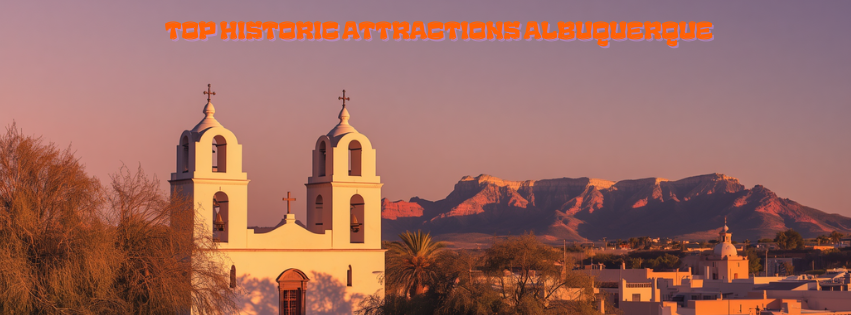
"San Felipe de Neri Church — an enduring symbol of Albuquerque's spiritual and architectural heritage. Built in 1793, it is one of the oldest surviving buildings in the city and remains an active Catholic parish today. The stunning adobe structure is a beautiful example of Spanish colonial architecture. Step inside to admire its thick adobe walls, beautiful religious art, and historic interior that feels like a quiet retreat from the bustling plaza outside," confirmed SMART Landscape's guide to Albuquerque historical landmarks.
The original 1706 church on this site collapsed in 1793 after heavy rainfall — the current building replaced it in the same year. The adobe walls are three to five feet thick. The twin bell towers were added in the 1850s by German missionaries who brought a Gothic influence to the original Spanish colonial form. The church has held continuous Mass since 1793, making it an active religious institution of 233 years as of 2026.
- Photography note: The white adobe facade against the Sandia Mountains at golden hour is one of the most photographed scenes in New Mexico. Best light: 1-2 hours before sunset when the mountains turn pink behind the church.
The Albuquerque Museum
2000 Mountain Rd NW, Old Town | Admission: Adults $6, Seniors $4, under 4 free | Closed Mondays
The Albuquerque Museum holds the most comprehensive collection of Albuquerque and New Mexico history available to the public — 10,000 works of art and 35,000 historical objects representing the Native, Hispanic, and Anglo cultural layers of the city's 300-year history. The "Journeys/Jornadas" exhibition is the permanent anchor: a chronological walk through Albuquerque's story from the Pueblo peoples' Rio Grande settlement through the Spanish colonial era, the Mexican period, the American Territorial period, and into the 20th century. The outdoor sculpture garden covers a half-acre adjacent to the museum building.
Layer 3 — Route 66 and the American Era
2026 is Route 66's centennial year. The highway was commissioned on October 11, 1926 — exactly 100 years before this year's fall season. For Albuquerque, this is the anniversary of the designation that transformed the city from a regional railroad town into a transcontinental waypoint on the Mother Road.
Route 66 — Central Avenue — The Road's Best Surviving Urban Stretch
Central Avenue from Old Town east through Nob Hill | Drive or walk the corridor | Route 66 Centennial 2026
Route 66 runs through Albuquerque's heart on Central Avenue — the same alignment it has followed since 1926. Albuquerque's Central Avenue is specifically the most intact urban stretch of Route 66 remaining in the American West: the neon signs, the vintage motel vernacular architecture, the Nob Hill archway that marks the neighborhood's Route 66 identity, the 66 Diner at 1405 Central with its 1950s diner format, and the specific character of a main street that has been commercially active for a century.
- The 2026 centennial context: Route 66 turns 100 in October 2026. Albuquerque's Route 66 Association and Visit Albuquerque are coordinating centennial events along the Central Avenue corridor. Check visitalbuquerque.org for the centennial programming schedule.
- The drive: Drive Central Avenue from the Rio Grande crossing near Old Town eastward through the UNM campus and into Nob Hill. The progression from the oldest commercial district through the mid-century motor court era to the 1950s diner and the walkable Nob Hill corridor covers the full Route 66 century in a single drive.
The KiMo Theater — Built 1927
423 Central Ave NW, Downtown | Tours available | Active performance venue
"The KiMo Theater has entertained residents for nearly a century, becoming one of Albuquerque's most celebrated historic landmarks. Built in the distinctive Southwestern Pueblo Deco style, which fuses Native American–inspired decorations with art deco influences — complete with colorful murals, chandeliers, and buffalo skulls with glowing red eyes — it's both an architectural gem and a popular destination for concerts, screenings, and other events," confirmed Viator's 2026 Albuquerque best attractions guide.
The KiMo Theater is Albuquerque's most architecturally distinctive building — the creation of architect Carl Boller and Oreste Bachechi, who specifically invented the Pueblo Deco style (also called Mayan Revival or Territorial Revival) for this commission in 1927. The exterior and interior combine Native American decorative motifs with the geometric Art Deco aesthetic of the 1920s in a combination that exists nowhere else in quite this form.
The buffalo skull wall sconces with glowing red eyes are the most photographed interior detail. The hand-painted murals depicting Pueblo ceremonial figures are the most artistically significant. The theater is still an active performance venue — seeing a show at the KiMo is the specific way to experience the building as it was intended to be experienced.
- Tours: Guided tours of the KiMo are available on weekday afternoons. Check cabq.gov/kimo for the current schedule.
The Huning Highland Historic District
Broadway Blvd to Girard, between Central and Gibson | Self-guided walking tour
The Huning Highland Historic District is Albuquerque's Victorian-era residential neighborhood — the first suburb built east of Old Town by Franz Huning, a German merchant who arrived in 1857 and became one of Albuquerque's most significant 19th-century figures. The homes along Central Avenue and the surrounding streets in the Huning Highland district represent the architectural transition from Spanish colonial adobe to Victorian wood-frame construction that accompanied the arrival of the railroad in 1880.
Layer 4 — The Atomic Age and the National Museum of Nuclear Science & History
National Museum of Nuclear Science & History
601 Eubank Blvd SE | Admission: Adults $16, Seniors $14, ages 6-17 $14 | Open daily 9am-5pm
Albuquerque is the most appropriate city in the world to host a national museum of nuclear science and history — home to Sandia National Laboratories (nuclear weapons research and stewardship), Kirtland Air Force Base (nuclear weapons storage), and the birthplace of the U.S. atomic weapons program in the adjacent mountains of Los Alamos.
The museum covers the full narrative from Marie Curie's radioactivity discoveries through the Manhattan Project (told with special attention to the New Mexico connections — Los Alamos, Trinity Test Site, Albuquerque's role), the Cold War deterrence era, and the contemporary nuclear science and energy landscape. The outdoor Heritage Park contains actual aircraft, missiles, and artillery pieces from the Cold War era, including a B-29 bomber and an actual Little Boy atomic bomb case (non-functional — the case type used at Hiroshima).
- The New Mexico Manhattan Project connection: Los Alamos, 90 minutes north of Albuquerque, was the specific site where the atomic bomb was designed. Trinity Test Site, 3 hours south, is where it was first detonated. The National Museum of Nuclear Science connects these New Mexico sites into a coherent historical narrative.
The Cultural Institutions — Cross-Layer History
National Hispanic Cultural Center
1701 4th St SW, Barelas | Admission: Adults $3, Seniors $2, under 16 free | Closed Mondays
The National Hispanic Cultural Center, in the Barelas neighborhood south of Downtown, is one of the largest Hispanic cultural institutions in the United States — a campus of museums, theaters, educational facilities, and performance spaces celebrating 700 years of Hispanic culture in the Americas, with special attention to the New Mexico heritage. The Roy E. Disney Center for Performing Arts is the premier performing arts venue, hosting flamenco, opera, theater, and film year-round. The permanent exhibits cover the Spanish colonial period in the Americas, the Mexican period, and the continuous Hispanic cultural presence in New Mexico through the present day.
New Mexico Museum of Natural History and Science
1801 Mountain Rd NW, Old Town | Admission: Adults $10, Seniors $8, ages 3-12 $7 | Open daily 9am-5pm
Adjacent to the Albuquerque Museum in the Old Town museum cluster, the New Mexico Museum of Natural History and Science covers the deep geological and biological history that predates even the earliest human presence in the region. The dinosaur exhibits — New Mexico produced some of the most significant North American dinosaur fossil discoveries — are the centerpiece, including the state's own Coelophysus and full skeleton mounts. The planetarium and the Lockheed Martin DynaTheater (giant screen) are the family attraction anchors.
The Turquoise Museum
2107 Central Ave NW | Admission: Adults $15-$20 (guided tour) | Open by appointment, limited hours
"Boasting some of the 'rarest and most collectible pieces of turquoise and turquoise jewelry in the world,' the Turquoise Museum offers a deep dive into New Mexico's state gemstone in the elevated setting of an enormous castle mansion. The private museum is the only one of its kind on the subject, offering a highly personable, interactive, and well-curated experience," confirmed Viator's 2026 guide to Albuquerque attractions.
The Turquoise Museum is the most specifically unusual institution in the Albuquerque museum landscape — a private museum dedicated entirely to turquoise, housed in an ornate castle-style building on Central Avenue. New Mexico is the largest turquoise-producing state in the US, and the turquoise jewelry tradition of the Pueblo and Navajo peoples is the most recognized Indigenous art form in the Southwest. The museum's collection of historical and contemporary turquoise, combined with the interpretive content on mining, geology, and cultural significance, produces an experience unavailable anywhere else.
The One-Day Historic Albuquerque Itinerary
- Morning: Start at Petroglyph National Monument for the Rinconada Canyon petroglyphs at 8am when the light is best. Drive east to Old Town by 10am.
- Mid-morning: Walk the Old Town plaza. Enter San Felipe de Neri Church. Walk through the alleyways. Choose one museum — the Albuquerque Museum for history and art, or the New Mexico Museum of Natural History for dinosaurs and geology.
- Lunch: Lunch at a traditional New Mexican restaurant in or near Old Town. Church Street Cafe is within the Old Town boundaries.
- Afternoon: Drive to the Indian Pueblo Cultural Center (15 minutes north). Spend 1.5-2 hours with the permanent exhibits and, if available, a cultural demonstration.
- Late afternoon: Drive south on 4th Street to the National Hispanic Cultural Center in Barelas (15 minutes).
- Evening: Drive east on Central Avenue (Route 66) through Nob Hill to the KiMo Theater Downtown. Check the KiMo's performance schedule — an evening show here completes the historic day with the experience the building was built for.
For visitors who want to understand the living cultural context behind the historic attractions covered in this guide — particularly the Pueblo and New Mexican culinary traditions that are the indigenous and Spanish colonial heritage made edible — our post on the truth about New Mexican cuisine explained covers the food history. And for the complete guide to all the things to do in Albuquerque year-round — seasonal events, outdoor activities, and cultural experiences that complement the historic attractions — our post on the best indoor and outdoor things to do in Albuquerque year-round covers the complete activities guide.
The Bottom Line — History Is Everywhere in Albuquerque
What separates Albuquerque's historic landscape from most American cities is its continuity. The Pueblo peoples whose ancestors carved the West Mesa petroglyphs are still here — operating the Indian Pueblo Cultural Center, running the restaurant that serves food grown from the same agricultural tradition. The Spanish colonial church on Old Town Plaza has held Mass without interruption for 233 years. Route 66 still runs the full length of Central Avenue. The KiMo Theater still shows performances.
Albuquerque's history is not preserved and then sealed away. It is in active use. The 1706 plaza is still the commercial center of Old Town. The Pueblo pottery tradition is still evolving. The Route 66 centennial in October 2026 is not a retrospective — it is a celebration of something that is still happening, on the same street, with the same neon signs.
Living in Albuquerque means living inside a history that has not finished yet. That is a specific kind of place, and there are not many like it.
Want to Live Where History Is Part of Every Drive?
Jenn & Vinay from The Rodgers Neighborhood Real Estate Group know which Albuquerque neighborhoods put Old Town on the regular lunch run, the petroglyphs visible from the Westside commute, and the KiMo Theater 10 minutes from home. The history and cultural depth of Albuquerque is one of the most consistently cited reasons people who move here decide to stay. The conversation about finding the right home in this specific city starts with a call.
Jenn & Vinay Rodgers are Albuquerque's trusted real estate professionals with The Rodgers Neighborhood Real Estate Group, brokered by Real Broker, LLC, serving buyers and sellers across Albuquerque, Rio Rancho, Corrales, Los Lunas, Tijeras, Cedar Crest, Sandia Park, the East Mountains, Bernalillo County, Sandoval County, and surrounding New Mexico communities.
The Rodgers Neighborhood Real Estate Group
Jenn & Vinay Rodgers
Real Broker, LLC
Albuquerque, NM
📞 505-417-2733
🏠 Live where history is part of every driveCategories
- All Blogs (362)
- 2026 & Beyond for Real Estate (256)
- Doctors and Nurses looking for homes in NM (4)
- Guide to buying a home in NM (160)
- Health Care Heros (7)
- Home Upgrades (42)
- Jenn & Vinay your Local Real Estate Experts! (124)
- Moving to Albuquerque (139)
- Neighborhoods in Albuquerque NM (94)
- Rent or Own (2)
- Sellers Questions for Selling homes (2)
Recent Posts




GET MORE INFORMATION