

Best Albuquerque Neighborhoods for Easy Commutes
Most neighborhood guides for commuters organize by neighborhood — then note what the neighborhood is near. This guide reverses the structure. It organizes by employer destination, then identifies which neighborhoods give you the shortest commute to that specific place. If you know where you work, you can find the right section and know immediately which neighborhoods to search.
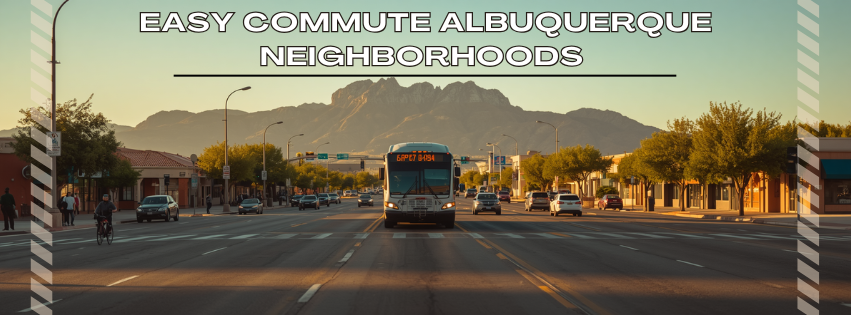
The Albuquerque Commute Context — Better Than You Expect
Albuquerque's average commute time is approximately 21 minutes — meaningfully below the national average of 27 minutes. This advantage is most visible to buyers relocating from higher-traffic metros:
- Los Angeles average commute: 32 minutes (plus the traffic variability that can triple that number)
- Seattle average commute: 32 minutes
- Denver average commute: 26 minutes
- Albuquerque average commute: 21 minutes — with minimal traffic variability compared to larger metros
The 21-minute city-wide average obscures significant variation by neighborhood and employment destination. Some neighborhood-employer combinations produce 5-8 minute commutes; others produce 35-40 minutes. This guide maps the specific combinations.
The important caveat: Albuquerque is a car-dependent city. While bus rapid transit (the ART line) and the ABQ Ride system provide genuine alternatives in specific corridors, 83.8% of Albuquerque commuters drive to work. This guide primarily addresses driving commutes, with transit options noted where they provide meaningful alternatives.
The Commute Reference Map — Key Employment Destinations
"Consider your commute: Downtown is 5 minutes from Nob Hill, 15 minutes from North Valley, 20 minutes from Northeast Heights, and 25+ minutes from Rio Rancho or Corrales," confirmed Apartments.com's Best Neighborhoods in Albuquerque for Renters guide (May 2026). These reference times provide the baseline framework for the employment-destination analysis below.
The major Albuquerque employment destinations:
- Downtown Albuquerque: Government, legal, financial services, hospitality, healthcare administration, non-profits, city/county agencies
- UNM / Lomas Corridor: University of New Mexico (27,000+ employees, faculty, staff), UNM Hospital, Presbyterian Hospital, UNM Health Sciences
- Kirtland Air Force Base / Eubank corridor: Military personnel, DoD civilians, defense contractors, Sandia National Laboratories access
- Uptown / Journal Center (I-25/I-40 junction): Corporate offices, retail management, insurance, financial services, technology companies in the Big I corridor
- Northwest / Intel Rio Rancho: Intel Corporation (Fab 11X expansion), Rio Rancho technology employment
- Mesa del Sol (Gibson/I-25 South): Netflix studios expansion, emerging southeastern employment corridor
- Remote / Work From Home: No commute — but specific neighborhood characteristics affect quality of the work-from-home experience
Commuting to Downtown Albuquerque
Downtown Albuquerque's government, legal, financial, and hospitality employment base draws commuters citywide. The neighborhoods with the shortest driving commute:
Nob Hill — 5 Minutes, Plus Transit Options
Drive time: 5 minutes | Home prices: $280,000-$500,000+ | Walk Score: 85
"Nob Hill blends historic Route 66 charm with some of the most walkable streets in Albuquerque. Located along Central Avenue, the neighborhood offers easy access to Downtown Albuquerque, the University of New Mexico, and Presbyterian Hospital, making commuting simple for renters who want to stay close to major employment hubs," confirmed Apartments.com's May 2026 Albuquerque neighborhood guide.
Nob Hill is the single best commute neighborhood in Albuquerque for multiple employment destinations simultaneously — Downtown is 5 minutes, UNM campus is walkable or a short bus ride via the ART line, and Presbyterian Hospital is minutes away. No other Albuquerque neighborhood provides this multi-destination commute efficiency.
- ART line access: The Albuquerque Rapid Transit Bus Rapid Transit line runs the length of Central Avenue from the Westside through Nob Hill to Downtown and UNM — Nob Hill residents can commute to Downtown or UNM without a car.
- The trade-off: Nob Hill homes are smaller, older (bungalow and mid-century stock), and more expensive per square foot than equivalent-sized homes in car-dependent suburbs. The commute efficiency premium is real — you pay for it in square footage.
Downtown / EDo — Zero Commute to Downtown Employment
Drive time: 0 minutes | Home prices: $150,000-$400,000 (condos and lofts) | Character: Urban, loft/condo stock
For the Downtown employee, the most radical commute solution is living Downtown. The EDo (East Downtown) and Downtown core loft and condo inventory has grown significantly over the past decade, offering urban housing options from the $150,000-range studio condos to $400,000+ renovated historic building conversions.
- Alvarado Transportation Center: The historic Adobe transit hub at 100 First St SW is the hub for ABQ Ride buses, Rail Runner commuter train to Santa Fe, Amtrak, and Greyhound — making Downtown the most transit-accessible Albuquerque address for anyone whose commute involves Santa Fe or interstate travel.
- The trade-off: Downtown living requires accepting the urban reality — parking, noise, limited single-family inventory, and the ongoing transitional character of the urban core that has been improving but is not yet fully stabilized.
Wells Park / Barelas / Sawmill — 5-8 Minutes, Affordable Entry
Drive time: 5-8 minutes | Home prices: $160,000-$320,000 | Character: Urban transitional, Rail Trail, Sawmill Market
The neighborhoods immediately south and west of Downtown — Wells Park, Barelas, and the Sawmill District — offer Downtown commute times of 5-8 minutes at the most affordable home prices in proximity to the city center. The Rail Trail bike infrastructure makes it the most viable bicycle commute option for Downtown employees who can tolerate the commute in Albuquerque's 310-day sunshine climate.
Commuting to UNM / Lomas Medical Corridor
The University of New Mexico, UNM Hospital, Presbyterian Hospital, and the broader Lomas/University medical and academic corridor is one of the largest single employment concentrations in the city.
Nob Hill — Walkable to UNM Campus
Drive time: 5 minutes | Walk/bike time: 15-20 minutes | Character: The neighborhood most walkable to campus
Nob Hill's eastern edge abuts UNM's western edge — some Nob Hill residents can walk to their UNM office in 15-20 minutes. This makes Nob Hill the only Albuquerque neighborhood where UNM employees can realistically walk or bike to work. The ART line provides a further no-drive commute option for residents anywhere along Central Avenue.
University Heights — Adjacent to Campus
Drive time: 3-5 minutes | Walk Score: 78 | Character: Mid-century residential, tree-lined, campus-adjacent
University Heights, immediately south and east of UNM's main campus, is the closest residential neighborhood to the UNM employment core. Faculty, administrators, and hospital staff who prioritize the shortest possible commute consistently choose University Heights or the adjacent midtown area.
- The specifics: University Heights Walk Score of 78 — the second-highest in the city — reflects the walkability to UNM, Presbyterian, and the services of the Central Avenue corridor.
Ridgecrest — Central Location, Multiple Healthcare Destination Access
Drive time to UNM/Presbyterian: 8-12 minutes | Character: Mid-century established, tree-lined, central Northeast Heights
Ridgecrest, the mid-century neighborhood north of Lomas between Girard and San Mateo, offers the combination of central Northeast Heights residential character — tree-lined streets, well-maintained mid-century homes — with commute access to multiple major employers: UNM and Presbyterian to the south, Kirtland to the southeast, and the Uptown/Journal Center corridor to the north via I-40 or Menaul.
Commuting to Kirtland AFB / Sandia Labs
Kirtland Air Force Base occupies the southeastern quadrant of Albuquerque, with its main gate access concentrated along Gibson Boulevard between Louisiana and Wyoming. Sandia National Laboratories access is through the Kirtland base via Eubank gate. The neighborhoods that produce the shortest Kirtland commutes:
Heritage East (87123) — Closest to Kirtland's East Gate
Drive time to Kirtland: 8-12 minutes | Home prices: $280,000-$480,000 | Niche safety: A+ | Median HH income: $161,108
Heritage East is the neighborhood most consistently recommended by military and civilian Kirtland employees for commute proximity. The eastern gates of Kirtland and the Eubank corridor are the primary access points, and Heritage East's location puts residents within 8-12 minutes of those gates in normal traffic.
The Heritage East combination — Niche A+ safety grade, $161,108 median household income, Kirtland proximity, and Sandia Labs commute access — is specifically the professional military community's preferred address combination in Albuquerque.
Southeast Heights (87108) — Affordable Kirtland Proximity
Drive time to Kirtland: 10-15 minutes | Home prices: $200,000-$320,000 | Character: Established, affordable, established APS schools
The Southeast Heights neighborhoods along Gibson Boulevard — from Central east to Kirtland's perimeter — offer the most affordable homes within direct Kirtland commute range. The $200,000-$320,000 home price range in these established 1960s-1980s neighborhoods specifically appeals to military families on BAH who want the shortest possible base commute at the most accessible price point.
Ridgecrest and Four Hills — 15-20 Minutes, Premium Kirtland Commute
Drive time to Kirtland: 15-20 minutes | Home prices: $300,000-$600,000 | Character: Higher-income, established neighborhoods with premium character
Ridgecrest and Four Hills add 5-10 minutes to the Kirtland commute compared to Heritage East, but provide meaningfully more neighborhood character — Four Hills' views and spacious lots, Ridgecrest's tree-lined mid-century charm — for the Sandia Labs senior scientist or senior military officer who wants commute convenience AND premium residential character.
Commuting to Uptown / Journal Center / Big I Corridor
The Uptown employment corridor — concentrated around the Mall/Journal Center/Big I junction of I-25 and I-40 — is Albuquerque's suburban employment core: corporate offices, healthcare administration, insurance, technology companies, and retail management.
Northeast Heights Mid-Tier (87110, 87112) — Central Access
Drive time to Uptown: 8-15 minutes | Home prices: $230,000-$380,000 | Character: Established suburban, above-average schools
The mid-Heights neighborhoods along the Menaul/Montgomery corridor in 87110 and 87112 sit directly between the UNM/Presbyterian corridor to the south and the Uptown/Journal Center corridor to the north — giving residents easy access to both employment zones via a north-south drive on Wyoming, Carlisle, or Louisiana Boulevards.
Uptown Itself — Zero Commute to Uptown Employment
Drive time: 0-5 minutes | Character: Urban suburban, mall-adjacent, high service density
For employees specifically in the Uptown corporate office cluster, living in Uptown or immediately adjacent neighborhoods eliminates the major arterial commute. Uptown is dense in services (grocery, restaurant, retail) without the walkability premium that Nob Hill commands — it is car-convenient rather than walkable.
Commuting to Intel / Rio Rancho Employment
Intel's Fab 11X facility and the broader Rio Rancho technology employment corridor require a specific commute consideration: most Albuquerque neighborhoods reach Rio Rancho via I-40 or NM-528, and the commute from Albuquerque proper is 25-35 minutes depending on origin.
Taylor Ranch / Paradise Hills (87114) — The Optimal Intel Commute from Albuquerque
Drive time to Intel Rio Rancho: 15-20 minutes | Home prices: $240,000-$380,000 | Character: Established Westside suburban
Taylor Ranch and Paradise Hills — the established Westside communities north of I-40 along the Coors/Unser corridor — are the Albuquerque addresses that minimize the Intel/Rio Rancho commute while keeping the buyer in Albuquerque proper. NM-528 from Coors is the primary Intel commute route; Taylor Ranch residents can reach Intel in 15-20 minutes with access to Albuquerque's full amenity base at home.
Rio Rancho Itself — Minimal Intel Commute, Limited Albuquerque Access
Drive time to Intel: 5-10 minutes | Home prices: $240,000-$350,000 | Character: Master-planned suburban, newer construction
For Intel employees who specifically prioritize the shortest possible commute and do not need frequent access to Albuquerque's urban core, living in Rio Rancho itself produces the shortest commute distance. The trade-off: Rio Rancho's retail, restaurant, and cultural amenity base is growing but remains limited compared to Albuquerque's central neighborhoods.
Commuting to Mesa del Sol (Gibson/I-25 South)
Mesa del Sol's Netflix campus expansion and the emerging southern employment corridor present a growing commute destination. The neighborhoods with the shortest commute:
- Mesa del Sol itself: Live where you work — the neighborhood is self-contained with ongoing residential development at $300,000-$410,000.
- Southeast Heights/Heritage East (87123): 10-15 minutes via Gibson/Yale south.
- Nob Hill / University area: 15-20 minutes via I-25 south or Central south.
- Northeast Heights (87123/87111): 20-25 minutes via Tramway/I-25 or Eubank south.
The Best Commute Neighborhoods by Employer — Quick Reference
- Downtown Albuquerque workers: Nob Hill (5 min, ART line available), EDo/Downtown itself (0 min), Wells Park/Barelas/Sawmill (5-8 min)
- UNM / Presbyterian / Medical corridor workers: Nob Hill (walkable to UNM), University Heights (3-5 min), Ridgecrest (8-12 min)
- Kirtland AFB / Sandia Labs workers: Heritage East (8-12 min), Southeast Heights (10-15 min), Ridgecrest/Four Hills (15-20 min)
- Uptown / Journal Center / Big I workers: Northeast Heights mid-tier 87110/87112 (8-15 min), Uptown itself (0-5 min)
- Intel / Rio Rancho workers: Taylor Ranch/Paradise Hills (15-20 min), Rio Rancho itself (5-10 min)
- Mesa del Sol / Netflix corridor workers: Mesa del Sol itself, Heritage East/Southeast 87123 (10-15 min)
Transit Options for Non-Drivers
While most Albuquerque commuters drive, the city's transit system provides genuine alternatives in specific corridors:
- ART (Albuquerque Rapid Transit) — Central Avenue corridor: Bus Rapid Transit from the Westside through Nob Hill, UNM, and Downtown to the East Side. The fastest and most frequent ABQ Ride service. For commuters whose workplace is on or near Central Avenue, ART is a practical car-alternative.
- ABQ Ride Rapid Ride: Limited-stop fast bus service on several north-south and east-west corridors. More useful for cross-city commutes than the local bus service.
- Rail Runner — Santa Fe commuters: The Rail Runner commuter train from the Alvarado Transportation Center in Downtown serves Santa Fe and points between. For Albuquerque residents with Santa Fe employment, the Rail Runner is a meaningful time saver over the I-25 drive.
- Bicycle commuting: Albuquerque's flat Central Valley, 310 days of sunshine, and growing bike lane infrastructure support bicycle commuting in the Central Avenue and Downtown corridors. The most viable bicycle commutes are Nob Hill to UNM, Nob Hill to Downtown, and Wells Park/Barelas to Downtown.
The Remote Worker's Commute Consideration — Lifestyle Proximity Over Drive Time
For the growing share of Albuquerque buyers who work fully or primarily remote, the commute consideration shifts from drive time to employment destination to daily quality-of-life destination proximity:
- Coffee shop commute: The remote worker whose primary "commute" is walking to a coffee shop to work finds Nob Hill, the UNM/Midtown corridor, and the emerging Downtown creative district the most viable neighborhoods. These are the only Albuquerque areas with the coffee shop density to sustain a regular remote working routine without a car.
- Trail access for midday breaks: Remote workers who specifically value the Sandia Mountain trail access as part of their workday rhythm find the Northeast Heights foothills neighborhoods — North Albuquerque Acres, High Desert, the Elena Gallegos access areas — provide the best combination of trail proximity and residential quality.
- Fiber internet as infrastructure: Remote workers whose work requires high-speed reliable internet should verify fiber availability at the specific address before purchasing. Albuquerque's fiber availability varies significantly by neighborhood. Ask providers directly rather than assuming availability.
For buyers specifically interested in Albuquerque's most walkable neighborhoods — where the car-optional lifestyle is most viable — our post on the most walkable neighborhoods in Albuquerque covers the Walk Score data in detail. And for the remote worker specifically choosing Albuquerque for the lifestyle-commute combination, our post on why remote workers are moving to Albuquerque covers the full remote worker decision framework.
The Bottom Line — Match Your Employment Destination First
The best Albuquerque neighborhood for your commute starts with a single question: where do you work? The 21-minute average commute time is available to residents of many different neighborhoods — but it is produced by different residential choices for each employment destination.
The Kirtland employee who buys in Heritage East, the UNM researcher who buys in University Heights, the Intel engineer who buys in Taylor Ranch, the government attorney who buys in Nob Hill — each is making the same optimization for their specific employment destination, and each arrives at a completely different neighborhood. The mistake is choosing a neighborhood that is conventionally desirable without first verifying that it is near the specific place you will drive to every day.
Albuquerque's short average commute is an advantage worth preserving. A 21-minute morning drive across a clear-sky desert city with the Sandia Mountains visible on the horizon is a specific daily experience that longer-commute metro residents specifically describe as one of the most unexpected quality-of-life gains in their move. Don't give it back by buying in the wrong neighborhood for your employer.
Let Us Help You Find the Neighborhood That Works for Your Commute
Jenn & Vinay from The Rodgers Neighborhood Real Estate Group help buyers identify the specific neighborhoods that minimize their specific commute — with the current drive-time data, the transit access analysis, and the neighborhood character knowledge that makes the difference between a 10-minute commute and a 35-minute commute for the same employment destination. The conversation about which Albuquerque neighborhoods work for your work starts with a call.
Jenn & Vinay Rodgers are Albuquerque's trusted real estate professionals with The Rodgers Neighborhood Real Estate Group, brokered by Real Broker, LLC, serving buyers and sellers across Albuquerque, Rio Rancho, Corrales, Los Lunas, Tijeras, Cedar Crest, Sandia Park, the East Mountains, Bernalillo County, Sandoval County, and surrounding New Mexico communities.
The Rodgers Neighborhood Real Estate Group
Jenn & Vinay Rodgers
Real Broker, LLC
Albuquerque, NM
📞 505-417-2733
🏠 Find a home near your Albuquerque workplaceCategories
- All Blogs (362)
- 2026 & Beyond for Real Estate (256)
- Doctors and Nurses looking for homes in NM (4)
- Guide to buying a home in NM (160)
- Health Care Heros (7)
- Home Upgrades (42)
- Jenn & Vinay your Local Real Estate Experts! (124)
- Moving to Albuquerque (139)
- Neighborhoods in Albuquerque NM (94)
- Rent or Own (2)
- Sellers Questions for Selling homes (2)
Recent Posts







GET MORE INFORMATION