

The Most Beautiful Places in Albuquerque Most Tourists Miss
Most visitors to Albuquerque follow the same route. Balloon Fiesta if it is October. Old Town. The Tramway. Maybe the Petroglyph Monument if the weather is good. A green chile cheeseburger somewhere on Central. And then the airport.
There is nothing wrong with any of that. The famous things in Albuquerque are famous for real reasons. But what gets missed in that standard itinerary is the layer beneath it — the places that locals consider essential and that most travel guides skip entirely, either because they are harder to photograph than a hot air balloon, or because they are the kind of beautiful that requires a sentence of context before you understand why you are standing in front of them.
This is the guide we give our out-of-town guests when they visit. Not the official tourism board version. The local version — written by people who live here, drive past these places regularly, and have watched enough visitors leave Albuquerque saying "it was nice" when they could have been saying "I think I want to move there" if someone had just told them where to look.
The Places That Require No Hike and No Agenda — Just Showing Up
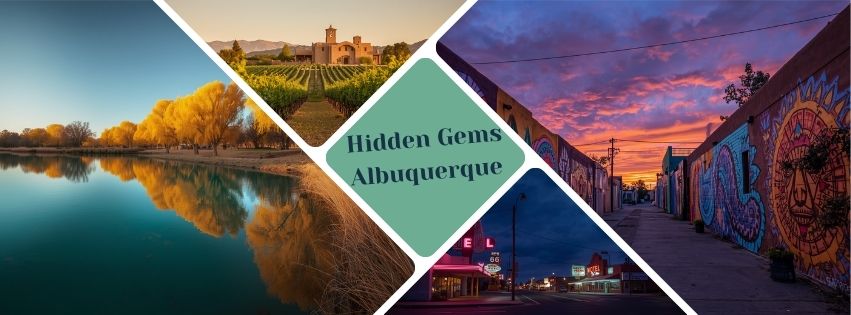
1. Casa Rondena Winery — A Mission Tower in the Rio Grande Bosque
There is a winery in the North Valley of Albuquerque with a four-story Mission Revival tower, a courtyard of shaded vines and pomegranate trees, and an award-winning wine program producing from New Mexico-grown grapes that most visitors to the state never know exists. Casa Rondena Winery sits approximately 15 minutes from Old Town — close enough to walk from if you are staying in the North Valley — and produces bottles that locals buy as gifts for people from wine-producing regions specifically because the reaction is always the same: genuine surprise.
"Ask any local where you can get the best wine, and they'll immediately point you towards the Casa Rondena Winery," noted the Broke Backpacker's comprehensive Albuquerque travel guide for 2026. The winery's architecture alone is worth the visit — the stone tower, the Spanish colonial arcades, the vine-covered walls — but the wine quality is what turns a casual visit into a regular habit for anyone who moves to Albuquerque.
The tasting room is open seven days a week. The courtyard is one of the most beautiful outdoor sitting spaces in the entire city — shaded, fragrant, and entirely unlike what most people picture when they imagine an Albuquerque afternoon. Go in late October when the cottonwood trees in the adjacent bosque are gold and the pomegranates on the courtyard trees are ripe. Bring someone you want to impress.
2. Tingley Beach — The 1930s Swimming Hole Turned Neighborhood Sanctuary
Tingley Beach does not look like a hidden gem on a map. It is a series of fishing ponds along the Rio Grande at the southern edge of the BioPark, easily accessible from Central Avenue, free to enter, and almost entirely absent from standard tourist itineraries.
Originally built in the 1930s as a public swimming pool complex, Tingley Beach has evolved into something more quietly beautiful — three interconnected ponds planted with cattails, watched over by great blue herons and the occasional sandhill crane, surrounded by a walking trail that connects the ponds to the bosque cottonwood forest and the Rio Grande itself. The Albuquerque BioPark's aquarium and botanical garden are adjacent, making Tingley Beach a natural extension of a BioPark visit that most people do not make because no one told them it exists.
In October, when the cottonwoods around the ponds turn gold, Tingley Beach produces a visual that belongs on a New Mexico tourism poster but never appears on one. The combination of golden cottonwood canopy, still water reflecting the color, and the Sandia Mountains visible through the trees is the kind of scene that rewards sitting quietly for twenty minutes rather than photographing and moving on.
3. The 4th Street Neon Corridor — Albuquerque's Unrestored Route 66 at Night
Central Avenue gets all the attention as Albuquerque's Route 66 corridor — and it deserves it, especially in 2026's centennial year. But 4th Street NW, running through the Barelas neighborhood and the manufacturing district north of Old Town, carries a different kind of Route 66 character: the unrestored kind, where the motel signs and commercial frontage have aged into the specific patina that no restoration project can replicate.
At night, when the surviving neon signs light up against the deep blue New Mexico sky — the Blue Swallow colors in retro pinks and greens, the Motor Inn's vintage arrow pointing toward the road — 4th Street becomes one of the most genuinely atmospheric drives in the city. It photographs extraordinarily in the hour after sunset. It feels like the 1950s and the present simultaneously, which is what the best Route 66 corridor experiences always do.
The 2026 Route 66 centennial has added new energy to this corridor without sanitizing what makes it compelling. New murals have gone up alongside the surviving neon. The contrast between the new art and the aged infrastructure tells a story about continuity and change that the more polished Nob Hill section of Central cannot quite match.
4. Canteen Brewhouse — The Oldest Brewery Most Visitors Never Find
Albuquerque has a significant craft brewing scene — Marble Brewery, La Cumbre, Bosque Brewing, Nexus — and these names appear consistently in any guide to the city's food and drink. What gets left off most guides is the one that was there before all of them.
Canteen Brewhouse has been crafting award-winning beer in Albuquerque since 1994, making it the city's oldest brewery. It hosts live local music every Wednesday and Sunday, holds community events that have made it a genuine neighborhood gathering space rather than a tourist destination, and produces beers that the craft brewing community respects without the visibility that newer breweries with better marketing have generated.
"Experience the heart of Albuquerque at Canteen Brewhouse — the city's oldest brewery, crafting award-winning beer since 1994. A true hidden gem, we host live local music every Wednesday (6 pm) and Sunday (9 pm), along with unique community events that bring people together over great beer and good vibes," confirmed the Redfin hidden gems Albuquerque guide. The building itself has character that purpose-built taprooms cannot manufacture. Go on a Wednesday evening when the music is live and the crowd is local.
The Places That Require a Short Drive but Deliver Completely
5. Tinkertown Museum — One Man's 40-Year Obsession in the East Mountains
Tinkertown Museum sits on Highway 536 in the East Mountains — the road up to Sandia Crest — approximately 30 minutes from downtown Albuquerque, and it is almost certainly the most eccentric and affecting museum in the state of New Mexico. That is a significant claim for a state with strong competition.
Ross Ward spent 40 years of his life building Tinkertown — a 22-room museum carved from the hillside and constructed from 50,000 glass bottles, filled with miniature animated circus figures, western village dioramas, and hand-carved characters that perform mechanical routines when a coin drops in the slot. The 35-foot wooden sailing yacht that circumnavigated the world, now permanently anchored inside the museum. The philosophical inscriptions carved into wood and embedded in every surface. The accumulation of a lifetime of obsessive creative work, sitting in a piñon pine forest and available for a $5 admission fee.
The drive to Tinkertown combines with the Sandia Crest Scenic Byway to make this one of the most rewarding short road trips accessible from Albuquerque. Stop at Tinkertown first, then continue up the highway to the Crest for the summit view. The contrast between the intimate human scale of Tinkertown and the enormous geological scale of the mountain above it is the kind of New Mexico juxtaposition that stays with visitors for years.
6. Gallery Hózhó at Hotel Chaco — World-Class Pueblo Art in a Boutique Hotel
Hotel Chaco sits in the Old Town corridor and is, by some distance, the most architecturally extraordinary hotel in Albuquerque — a modern interpretation of the Chacoan Great Houses of New Mexico, built from stacked stone and warm wood, designed with the care and specificity of place that most hotels in any city lack entirely. The gallery within it — Gallery Hózhó — is a collection of significant Pueblo and Southwest Native American art curated with a seriousness of purpose that the hotel's setting makes immediately credible.
"Every piece in the gallery represents the state's rich artistic heritage," confirmed Suzanne Newman Fricke, PhD, Director of Gallery Hózhó at Hotel Chaco, in the Redfin hidden gems guide. The gallery is accessible to non-guests and the hotel's public spaces — the lobby, the rooftop terrace — are worth experiencing independently of the gallery. The rooftop at sunset offers one of the cleanest Sandia Mountain views in the Old Town corridor.
What makes Gallery Hózhó specifically a missed gem is that most visitors who walk into Hotel Chaco do so to see the hotel and leave without understanding that they are standing in front of significant art. Slow down. Read the wall text. Ask the gallery staff a question. The work here represents living artists from Pueblo communities who are continuing a creative tradition that predates the hotel, the city, and the country by centuries.
7. Tingley Velodrome and the Barelas Community — The Neighborhood Nobody Maps
Barelas is one of Albuquerque's oldest Hispanic neighborhoods, sitting south of Downtown along the Rio Grande — and it is almost entirely invisible to visitors who follow standard tourism routes. The National Hispanic Cultural Center, which anchors the neighborhood's southern edge, appears on most tourist maps. The neighborhood itself, with its murals, its community gardens, its old acequia infrastructure, and the specific living character of a barrio that has been here for 300 years, does not.
The Barelas Coffee House on 4th Street SW is the appropriate entry point. Family-owned for decades, serving New Mexican breakfast and lunch in a setting that has not been updated for tourism, with a clientele that is almost entirely local. The green chile is made from scratch. The portions are enormous. The bill will surprise you in the best way.
Walking north from Barelas toward Downtown along 4th Street produces the public art encounter that the neighborhood rewards: murals that cover entire building facades and tell the history of the community in images rather than plaques. The National Hispanic Cultural Center's outdoor sculpture garden, at the neighborhood's south end, is a significant collection of contemporary Latino art installed in a landscape that takes the Sandia Mountains as its backdrop.
8. The UNM Duck Pond and Sunken Gardens — The Campus Secret
The University of New Mexico campus is one of the most architecturally coherent campuses in the American Southwest — every building in the historic core built in a consistent Pueblo Revival style that turns the grounds into a cohesive architectural experience rather than the typical American university hodgepodge of styles. Most visitors to UNM see the main walkways, maybe the Zimmermann Library, and leave.
They miss the Duck Pond. Tucked in the southeast corner of the historic core, the pond is surrounded by mature cottonwood and elm trees that create a canopy entirely unlike anything visible from the main campus paths. In fall, the deciduous trees turn gold and amber over the water, and the combination of Pueblo Revival buildings framing the edges, the mountain visible above the rooflines, and the particular quiet that comes from being five minutes from Central Avenue but entirely screened from it by mature trees produces the kind of campus pocket that students who attend UNM for four years remember specifically for the rest of their lives.
Adjacent to the Duck Pond, toward the south side of the campus, the Sunken Gardens are another architectural hidden gem — a formal garden in a below-grade courtyard that most people walk past without looking down into. In spring, when the flowering trees bloom, this is the most photographically beautiful small space on the campus. In summer, it is one of the quietest places to sit in the Nob Hill corridor.
The Places That Reveal Themselves Slowly — Go More Than Once
9. Albuquerque's Mural Corridors — Art That You Drive Past Every Day
Albuquerque has one of the most active public mural traditions of any American city its size, and the corridors where the murals concentrate are as beautiful as any gallery in the city — more so, because the scale is different. A mural that covers a full building facade cannot be experienced inside a gallery.
The highest concentration of significant murals runs through the EDo (East Downtown) neighborhood, along Central Avenue through Nob Hill and the UNM corridor, and through the Barelas neighborhood on 4th Street. "Doing a mural tour is an excellent way to spend a few hours in the city, learn about the community, and get some great photos," noted Katelynn Kellogg in the Redfin hidden gems guide for Albuquerque.
The specific murals worth seeking: the large-format contemporary pieces on the buildings facing the Rail Yards in EDo, which combine New Mexican iconography with contemporary art practice in ways that are genuinely world-class. The older painted murals in Barelas that document the neighborhood's history in images. And the rotating public art installations along the Paseo del Bosque Trail, where the art and the natural environment interact in ways that gallery art never can.
The most useful approach to the mural corridors is to walk rather than drive, which means parking and picking a corridor to explore on foot. The Nob Hill stretch of Central — from Carlisle east to Washington — is the most concentrated and the most accessible. Late afternoon light produces the best photography conditions.
10. Sandia Foothills at 5am — The City Before the City Wakes
This one requires the alarm clock and the willingness to be cold for 20 minutes. The Sandia foothills at dawn — the Elena Gallegos and Pino Trail trailheads specifically — produce a version of Albuquerque that almost no visitor ever sees and that longtime residents cite most consistently when asked what they would miss if they left.
At 5am in spring or fall, the trailhead parking areas are empty or nearly so. The sky to the east is deep blue transitioning to rose as the Sandia Mountains begin to catch the first light. The city below is lit but quiet. A coyote may be audible somewhere on the mesa. The piñon trees are fragrant in the pre-dawn cool. And in the 20 minutes between first light and the full sunrise, the Sandias undergo the color transformation that the Spanish named them for — the granite catching the orange and pink light until they glow like watermelon flesh.
By 6:30am, the trail is busy with the morning runner crowd and the experience has become communal rather than solitary. The window for the solitary version is narrow and requires getting there before anyone else does. It is worth every minute of the early alarm.
11. The Rail Yards Market — Albuquerque's Best Sunday Morning
The Rail Yards Market runs inside the historic Albuquerque locomotive repair complex on Sundays from May through October — a farmers market and artisan market occupying the enormous repair sheds where steam engines were once maintained, with the iron structure of the repair facility providing an industrial backdrop that no purpose-built market space can replicate.
The market is local in the way that matters: the farmers are from New Mexico, the food vendors are from Albuquerque neighborhoods, the music is performed by local musicians who are playing because they want to be there, and the whole thing operates on a scale and with a community character that the more commercially developed farmers markets in other cities consistently lack.
The green chile sold fresh at the Rail Yards Market in August and September — when the harvest is happening — is the specific product that makes New Mexico residents who move away most homesick when they discover that green chile does not exist everywhere. Buying it fresh from a Hatch Valley farmer at a Sunday market and taking it home to roast yourself is the most direct way to understand what the green chile conversation is actually about.
The One Hidden Gem That Is Actually Hidden — The Center of the Universe
On the University of New Mexico campus, in a courtyard that most visitors walk past without noticing, there is a small circular concrete installation embedded in the ground with a specific acoustic property: when you stand in the center and speak, your voice echoes back to you as if you are in a much larger space. Everyone else around you hears nothing unusual. Only the person standing in the exact center hears the echo.
"On the University of New Mexico campus lies a small, circular concrete structure that locals call the Center of the Universe. When you stand in the center and speak, your voice seems to echo only to you — a strange, delightful auditory phenomenon. It's part of a public art installation and easy to miss if you don't know where to look. But it's the kind of discovery that feels like a secret shared with a friend — an oddly grounding moment in the middle of the city," confirmed the Santuario Grande hidden gems guide for Albuquerque.
There is no sign directing you to it. No queue. No admission. Just a concrete circle set into a campus courtyard, doing something that it will not explain to you unless you stand in exactly the right spot. Take someone you know there without telling them what it does. Watch their face when they speak and realize that no one else heard what they heard.
It is a small thing. It is also, in the specific way that the best hidden gems always are, exactly the right thing.
Why the Hidden Places Matter — What They Reveal About the City
The places in this guide do not appear in most travel writing about Albuquerque because they resist the kind of thumbnail summarization that travel writing requires. Casa Rondena is not one sentence. Tinkertown is not one sentence. The 4th Street neon corridor at night is not one sentence. They are experiences that reward time and curiosity, and they tell you something about Albuquerque that the famous attractions — as beautiful and genuine as they are — cannot communicate in the same way.
What they reveal is that this is a city with extraordinary depth — cultural, artistic, historical, natural — at a scale that rewards exploration beyond the obvious. The people who love Albuquerque most consistently are the people who found these places and understood what they were being shown. Not a tourist attraction. A city that has been building character for three centuries and is still doing it.
For visitors who are seriously evaluating whether Albuquerque could become home, the hidden places are where that evaluation happens. The Balloon Fiesta tells you the city has spectacle. The bosque at October dawn tells you it has quiet. The Rail Yards Market tells you it has community. Tinkertown tells you it has eccentricity of the best kind. Casa Rondena tells you it has beauty that does not require you to go looking for it in the obvious places.
Together, they tell you what it is like to live here. Not visit. Live.
If any of these places made you start thinking about what that life would look like on a daily basis, our guide to relocating to Albuquerque gives you the complete honest picture of what the city looks and feels like as a place to put down roots. And our guide to Albuquerque neighborhoods covers which areas of the city put these hidden gems closest to your front door.
The Bottom Line — The Best Albuquerque Is the One Nobody Mapped
The most beautiful places in Albuquerque are not all in the brochure. Some of them are on the way to somewhere else and never got their own entry. Some of them are too small to justify a full travel article. Some of them are the kind of beautiful that photographs badly but lives perfectly — the 5am foothills, the Center of the Universe echo, the 4th Street neon at dusk.
Every city has a version of itself that reveals itself slowly, to the people who slow down enough to find it. Albuquerque's version is deeper and stranger and more beautiful than most visitors ever discover. This guide is an invitation to find more of it than the standard itinerary allows.
Go to the bosque. Go to Casa Rondena. Go to Tinkertown. Stand in the Center of the Universe and say something into the air and listen to your voice come back to you.
Then call us when you start thinking about making the city yours.
Thinking About More Than a Visit?
Jenn & Vinay from The Rodgers Neighborhood Real Estate Group help people find homes in Albuquerque every week — many of them visitors who came for a weekend, discovered the city the way this guide describes, and started doing the math on what life here could look like. If that is where you are, we are the right conversation to have. We know which neighborhoods put the bosque trail at your back door, which ones sit in the foothills above the mural corridors, and which communities in the East Mountains are closest to Tinkertown and the Sandia Crest drive.
Jenn & Vinay Rodgers are Albuquerque's trusted real estate professionals with The Rodgers Neighborhood Real Estate Group, brokered by Real Broker, LLC, serving buyers and sellers across Albuquerque, Rio Rancho, Corrales, Los Lunas, Tijeras, Cedar Crest, Sandia Park, the East Mountains, Bernalillo County, Sandoval County, and surrounding New Mexico communities.
The Rodgers Neighborhood Real Estate Group
Jenn & Vinay Rodgers
Real Broker, LLC
Albuquerque, NM
📞 505-417-2733
🏠 Browse current Albuquerque listingsCategories
- All Blogs (324)
- 2026 & Beyond for Real Estate (220)
- Doctors and Nurses looking for homes in NM (4)
- Guide to buying a home in NM (146)
- Health Care Heros (7)
- Home Upgrades (38)
- Jenn & Vinay your Local Real Estate Experts! (108)
- Moving to Albuquerque (128)
- Neighborhoods in Albuquerque NM (87)
- Rent or Own (2)
- Sellers Questions for Selling homes (2)
Recent Posts



GET MORE INFORMATION