

Best Outdoor Adventures Around Albuquerque New Mexico — The Complete 2026 Guide
"Part desert, part mountain, part river, all under endless blue skies, Albuquerque offers exhilaration you can't find anywhere else," confirms Visit Albuquerque's official outdoor recreation guide. That three-part geography — desert, mountain, river — is the reason this city's outdoor adventure range is unusual for its size. It is not one landscape. It is three distinct ecosystems accessible from a single residential address, all under the specific quality of light and sky that the high desert at 5,300 feet produces.
This guide covers the full range of outdoor adventures available in and around Albuquerque — organized by activity type, with the specific trails, waterways, seasonal windows, and access details that distinguish useful local guidance from a generic list. Whether you are planning a trip, researching relocation, or simply trying to understand what outdoor life actually looks like for Albuquerque residents, this is the complete picture.
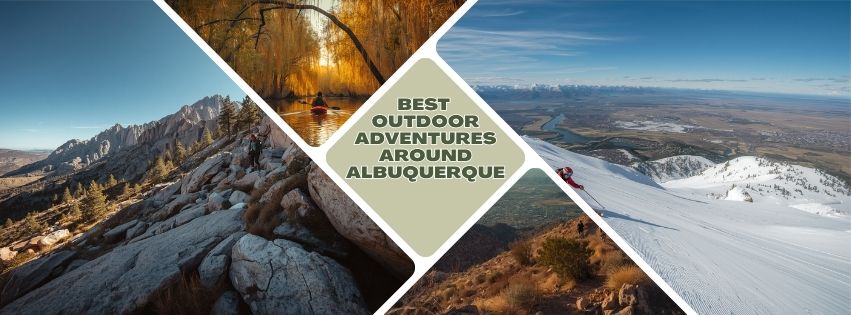
The Outdoor Geography — Why Albuquerque Has More Than Most Cities Its Size
The range of Albuquerque's outdoor adventures is a direct function of the city's geographical position: a high-desert river valley (the Rio Grande Rift) at the foot of a dramatic mountain range (the Sandias), within easy driving range of multiple distinct geological environments including volcanic fields, ancient calderas, and canyon systems.
- The Sandia Mountains: Immediately east of the city, rising from 5,300 to 10,378 feet within a horizontal distance of four miles. The Cibola National Forest and the 37,236-acre Sandia Mountain Wilderness provide the hiking, biking, climbing, and skiing terrain that is the primary outdoor driver of Northeast Heights property premiums.
- The Rio Grande: Running north to south through the center of the city with 16 miles of protected bosque corridor accessible for biking, walking, kayaking, fly fishing, and paddleboarding. The river connects Albuquerque to the dramatic Rio Grande Gorge near Taos to the north.
- The West Mesa: The volcanic basalt mesa west of the city, including Petroglyph National Monument and the volcanic cone field, providing hiking, cycling, and off-road access in a geological environment unlike anything east of the river.
- The Jemez Mountains:90 minutes northwest, encompassing the Valles Caldera National Preserve, the Jemez Springs natural hot springs corridor, and the Bandelier National Monument — a full outdoor day-trip ecosystem accessible as a weekend or single-day excursion from Albuquerque.
- The East Mountains: Tijeras Canyon, Cedar Crest, Sandia Park, and the Manzano Mountains to the south, providing forest hiking, mountain biking, and the Paa-Ko Ridge Golf Club experience within 30-45 minutes.
Hiking — The Most Accessible Year-Round Adventure
The Sandia Foothills Trail Network — Everyday Mountain Access
The Albuquerque Foothills trail system begins within walking distance of Northeast Heights residential streets and provides the most accessible daily hiking in any major American city. The combination of short, moderate, and demanding routes through the same trail network allows every fitness level to find a regular hiking practice within minutes of home.
Key foothills trails: the Embudo Trail (moderate, connects to the ridge via switchbacks through granite and juniper), the Pino Trail (longer, connects to the Cibola National Forest boundary), and the Bear Canyon Open Space loop (accessible and scenic, popular with families and dogs). Elena Gallegos Open Space serves as the primary formal trailhead with parking and trail maps.
Insider note: the foothills trails at 6:30am on a weekday are a different experience from the same trails at 9am on a weekend. The early morning version — few other hikers, low-angle light on the granite, the city still quiet below — is the version that converts people from hikers who come to the foothills occasionally into people who come every day.
La Luz Trail — The Definitive Albuquerque Hike
La Luz is the Albuquerque hike that serious hikers from other cities are told about first — and that Albuquerque residents themselves use as the benchmark for the full Sandia experience on foot. The trail ascends 9 miles from the Tramway Road trailhead to the Sandia Crest at 10,378 feet, gaining approximately 3,600 feet of elevation through five ecological life zones: Chihuahuan desert scrub, piñon-juniper woodland, ponderosa pine, mixed conifer, and alpine meadow.
The La Luz ascent is a full-day commitment — most hikers allow 7 to 10 hours for the complete round trip. The one-way option (ascend La Luz, descend via the Tramway) requires purchasing a tramway ticket but converts the 9-mile ascent into a comprehensive single-direction experience without the full 18-mile commitment.
Seasonal consideration: La Luz is hikeable year-round but requires traction devices in winter when the upper sections carry snow. The fall La Luz hike — when the aspen groves near the Crest are turning gold and the air is clear and cold — is consistently described by residents who have done it multiple times as the best version of the hike.
Sandia Crest Trail — The Alpine Ridge Walk
The Sandia Crest Trail follows the ridge of the Sandia Mountains from the Crest south toward South Sandia Peak — an above-treeline hike along the highest terrain accessible in the metro area. The Crest Trail is accessible either from the Tramway summit (requiring a tram ticket) or from the Sandia Crest Scenic Byway on the east face (no fee, drive to the Crest).
The specific experience of the Crest Trail that no valley-floor hike provides: standing on a granite ridge at 10,000-plus feet with both the Albuquerque valley floor 5,000 feet below to the west and the Estancia Valley stretching to the Manzano Mountains 150 miles to the south. The wind is consistent. The sky is different from below. The silence is the silence of the high ridge — not the absence of sound but the presence of a sound that has no human origin.
Mountain Biking — Technical Terrain at Every Skill Level
The Foothills Trail Network for Mountain Bikers
The same Sandia Foothills trail network that hosts hikers is specifically designed for technical mountain biking — with dedicated flow trails, technical rock features, and the specific granite and volcanic terrain that produces the high-friction, consequence-appropriate riding that mountain bikers seek.
"The Foothills Trails of Sandia Mountain — A network of trails for varying skill levels, featuring a mix of steep climbs and thrilling descents," confirms the Rainbow Ryders outdoor activity guide for Albuquerque. The network specifically caters to cross-country riders who want sustained climbs with technical single-track and riders who want the flowing descent experience with the mountain views that Albuquerque's specific geography produces.
Trail rental availability: Routes Rentals and MST Adventures are among the local outfitters offering mountain bike rentals for visitors who do not bring their own equipment.
Otero Canyon — Desert Single-Track Away From the Mountain
Otero Canyon, in the Manzano Mountains south of Albuquerque, provides the rugged desert mountain bike experience for riders who want the technical single-track character of high-desert canyon riding. The canyon's geology — sandstone and volcanic rock, the specific erosion patterns of the Manzano terrain — produces riding that is visually and technically distinct from the Sandia Foothills experience.
The Otero Canyon trail system is less crowded than the Foothills during peak weekend hours, making it the local's alternative for the rider who wants challenging technical terrain without the Friday-evening traffic that popular Foothills trails accumulate.
Sandia Peak Chairlift-Accessed Mountain Biking — Summer Season
In summer (typically June through Labor Day when snow has cleared), Sandia Peak Ski Area converts to lift-accessed mountain biking — offering chairlift transport to the upper mountain followed by gravity-assisted descents on marked trails through the mixed conifer forest. Bike rentals are available at the base and summit.
The specific experience that chairlift biking at Sandia provides that trail-accessed Foothills riding does not: the elevation gain without the physical climb. A rider who wants to spend four hours on descents rather than splitting time between climbing and descending will find the chairlift option specifically useful.
Road Cycling and Gran Fondos — A Strong Cycling Culture
Albuquerque's road cycling culture is sustained by the specific combination of the flat Rio Grande valley floor for endurance training, the Sandia Crest Scenic Byway for mountain climbing routes, and the Paseo del Norte bike lane network that provides protected urban cycling infrastructure.
The annual cycling events that define the local calendar: century rides that use the regional road network to connect Albuquerque to the East Mountain communities, Gran Fondos that attract regional and national competitive cyclists, and the specific Day of the Tread bike/run event each October that has become a community institution. The Albuquerque BikeABQ program provides bike-sharing infrastructure for urban cycling access across the city.
The Rio Grande — Paddling, Fishing, and Water Adventures
Kayaking and Stand-Up Paddleboarding — Calm Water in the City
The Rio Grande through Albuquerque is a calm, navigable river suitable for kayaking and stand-up paddleboarding at the skill level of a complete beginner — the current is gentle through most of the city corridor, and the bosque views from water level are among the most distinctive visual experiences available in Albuquerque.
New Mexico River Adventures offers guided kayak and paddleboard trips on the Rio Grande with equipment rental and instruction for beginners. The specific river section through the city — from the Montaño launch to the Corrales area — provides the most photogenic stretch, with the cottonwood forest lining both banks and the Sandia Mountains visible on the eastern horizon.
Seasonal note: the Rio Grande runs highest and fastest in late May and June from snowmelt, which can make the Albuquerque section faster than ideal for beginners. Late summer and fall produce the calmest, most accessible conditions. The October paddling window — when the bosque cottonwoods are at peak color and the water level is low and clear — is the most compelling for both experience and photography.
Fly Fishing the Rio Grande — New Mexico's Wild Trout Waters
The Rio Grande north of Albuquerque, particularly in the Rio Grande Gorge near Taos, is a designated Wild Trout Water that sustains populations of wild brown and rainbow trout in the specific cold, clear water of the deep canyon. The gorge corridor is one of the most visually dramatic fly fishing environments in the American Southwest.
SpiritFly Expeditions is one of the Albuquerque-area outfitters offering guided fly fishing experiences on both the Rio Grande and the Jemez River systems — providing access to the specific trout water locations and conditions that independent anglers without local knowledge may not find.
Within the Albuquerque city corridor, the Rio Grande produces good fishing for catfish and bass in the warmer months. The Tingley Beach ponds within the ABQ BioPark are stocked trout fishing accessible without transportation from the park — the most accessible fishing option for families and casual anglers within the city limits.
Rio Grande Gorge — Day Trip White Water
The Rio Grande Gorge near Taos, approximately 90 minutes north of Albuquerque, offers Class III-IV white water rafting through the most dramatic canyon scenery in New Mexico — a 600-foot-deep basalt gorge that carries the Rio Grande through a geological trench that is entirely invisible until you are standing on its edge.
Several Santa Fe and Taos-based outfitters offer single-day and multi-day rafting trips in the Gorge during the May-June snowmelt peak season. For Albuquerque residents who want the white water experience without the international trip planning, the Gorge is the most accessible Class III-IV white water within a half-day's drive.
Skiing and Winter Adventures — Mountain Snow 40 Minutes From Downtown
Sandia Peak Ski Area — The Neighborhood Ski Hill
Sandia Peak Ski Area on the eastern face of the Sandia Mountains, accessible via either the Tramway ascent from the western face or the Sandia Crest Scenic Byway from the east, is Albuquerque's neighborhood ski hill — the local mountain whose scale is intermediate rather than destination, and whose primary value is accessibility rather than vertical.
Sandia Peak opens in December when snowfall permits (conditions vary by year) and typically operates through early March. The terrain is most suitable for beginner through intermediate skiers, with the specific added character of the view from the summit: the Rio Grande valley 5,000 feet below, the city grid, and the Jemez Mountains on the western horizon make Sandia Peak's ski experience visually unlike any comparable mountain in the region.
The Tramway access creates a specific ski-day experience: drive to the Tramway base, ascend 15 minutes by cable car, ski the eastern face, and return via the Tramway in the evening with the city lights emerging in the valley below. It is one of the more theatrical ski days available to any American city's residents.
Valles Caldera National Preserve — Cross-Country Skiing in an Ancient Volcano
The Valles Caldera National Preserve, 90 minutes northwest of Albuquerque in the Jemez Mountains, is one of the most extraordinary single outdoor destinations accessible as a day trip from any American city. The 89,000-acre preserve occupies the interior of a collapsed volcanic crater — a 13-mile-wide caldera basin that last erupted 1.25 million years ago and now sustains the specific high-altitude meadow, forest, and stream ecosystem that the crater's sheltered geography produces.
In winter, the Valles Caldera operates groomed cross-country skiing trails on the caldera floor — providing a ski experience that is completely unlike anything available in the mountain resort environment. You are skiing across the floor of an ancient volcano in a meadow bounded by the inner rim of the crater wall. The scale is intimate but geologically disorienting. Ranger-led snow hikes during winter add interpretive context to the skiing experience.
In summer, the Valles Caldera provides some of the best backcountry hiking in New Mexico — through the caldera grasslands, along the streams that cross the basin floor, and into the crater rim forests. Wildlife viewing in the Valles Caldera is consistently excellent: elk herds are common residents of the caldera floor, and the specific bird community of the high-altitude meadow ecosystem is unlike what lower-elevation hiking produces.
Jemez Springs Natural Hot Springs — Soak and Hike
The Jemez Springs corridor in the Jemez Mountains, accessible via State Highway 4 (the same road that accesses the Valles Caldera), includes natural hot spring pools with 17 identified healing minerals — accessible through the Jemez Springs Bath House and through the natural pool in the canyon below the town.
A Jemez Springs day from Albuquerque typically combines a morning hike in one of the canyon's dozen trail systems, lunch in the small village, and an afternoon at the hot springs before the return drive. The canyon walls rise dramatically above the hot springs, with the specific red and orange of the Jemez Formation sandstone providing the visual context that makes the Jemez Springs experience specific to this geology.
The Jemez Mountains hiking includes access to archaeological sites dating to 2,500 BC within walking distance of the trail networks — producing the specific New Mexico hiking experience where the outdoor activity and the cultural history are geographically inseparable.
Rock Climbing and Bouldering — Technical Terrain for Climbers
The Sandia Mountain Granite — World-Class Rock Quality
The Precambrian granite of the Sandia Mountains' western face provides rock climbing terrain that is specifically sought by technical climbers for the quality of the rock — clean, high-friction granite with good protection placements and routes of every grade from beginner top-rope to multi-pitch traditional climbs approaching the Crest.
The specific climbing areas most accessed by Albuquerque climbers: the Prow area in the upper foothills, the Piedra Lisa slab (a vast, smooth granite surface accessible by trail that provides the best beginner top-rope experience in the metro), and the routes in the upper mountain accessible from the La Luz trailhead.
Bouldering in the Sandia foothills and the Manzano Mountains provides the close-to-the-ground technical climbing that does not require the rope and anchor systems of trad and sport climbing — and the specific granite and volcanic rock boulders in both mountain systems produce boulder problems that attract bouldering-focused climbers from regional and national circuits.
Hot Air Ballooning — The Albuquerque Adventure That Has No Equivalent
Any outdoor adventure guide for Albuquerque that does not specifically feature hot air ballooning has missed the city's most genuinely exceptional outdoor experience.
Albuquerque is the balloon capital of the world for a specific meteorological reason — the Albuquerque Box, a layered wind pattern created by the Rio Grande Valley's geography that allows balloons to ascend, travel downwind at altitude, and then return to their launch site at lower altitude. This precision control over balloon navigation is available in almost no other location on Earth. It is why the International Balloon Fiesta exists here and not elsewhere.
Rainbow Ryders operates year-round sunrise balloon flights over the Albuquerque valley — 60 to 90 minutes of silent flight over the Rio Grande bosque at altitudes from several hundred to several thousand feet. The specific sensory experience of hot air balloon flight — the silence interrupted only by occasional burner blasts, the perspective of the city from above without the noise of fixed-wing aircraft, the specific quality of the morning light on the valley — is described by participants with a consistency and specificity that suggests the experience genuinely delivers on its reputation. Cost: approximately $200-$250 per person.
The Annual Adventure Events — Albuquerque's Outdoor Calendar
The Mount Taylor Quadrathlon — February, Grants NM
The Mount Taylor Quadrathlon, held each February in Grants (60 miles west of Albuquerque), is one of the most demanding single-day endurance events in North America: a self-supported course that requires competitors to bicycle 13 miles, run 5 miles, cross-country ski 2.3 miles, and snowshoe 1.8 miles to reach the 11,301-foot summit of Mount Taylor — then reverse all four disciplines for the return. The event draws participants from across the country and represents the specific New Mexico outdoor culture's ambition to combine multiple disciplines and environments in a single continuous challenge.
La Luz Trail Run — Summer
The La Luz Trail Run is the Albuquerque trail running community's signature event — a race that follows the La Luz Trail from the foothills trailhead to the Sandia Crest, gaining approximately 3,600 feet of elevation in 9 miles. The race attracts competitive trail runners from across the region and serves as the annual benchmark event for the local trail running community.
Day of the Tread — October
The Day of the Tread, held in October during Balloon Fiesta season, is a family-accessible mountain bike and running event that has become a community institution — combining competitive racing with recreational participation and using the specific foothills trail network that defines the Northeast Heights outdoor lifestyle. The timing during Balloon Fiesta season means participants may see balloon flights during their race, adding the city's most iconic visual experience to the event's atmosphere.
The Best Day Trips for Outdoor Adventurers — Within 2 Hours
- Valles Caldera National Preserve (90 min northwest): Year-round hiking, summer wildlife, winter skiing and snowshoeing. The most extraordinary single day-trip landscape accessible from Albuquerque.
- Jemez Springs corridor (90 min northwest): Natural hot springs, canyon hiking, archaeological sites. Combine with the Valles Caldera for a full Jemez Mountains day.
- Rio Grande Gorge near Taos (90 min north): White water rafting during snowmelt season, dramatic gorge hiking, the Rio Grande Gorge Bridge (the second-highest highway bridge in the United States).
- Tent Rocks National Monument (60 min north): Kasha-Katuwe Tent Rocks — one of the most visually distinctive geological formations in the Southwest, where volcanic tuff has eroded into cone-shaped tent shapes of white, pink, and tan. Slot canyon hiking and ridge trails with panoramic views.
- Bosque del Apache (90 min south): One of the premier birdwatching destinations in the American Southwest, where tens of thousands of Sandhill Cranes and Snow Geese winter in the Rio Grande floodplain from November through February. The morning flights of 10,000-plus cranes lifting from the water is one of the most spectacular wildlife events in North America.
- Manzano Mountains (60 min southeast): Less-traveled than the Sandias, with excellent fall color from maple groves (unusual in New Mexico), ponderosa pine forest hiking, and the Salinas Pueblo Missions National Monument with three distinct ancestral Pueblo ruins accessible along the Manzano front.
What Living Near These Adventures Actually Looks Like — The Daily Reality
The outdoor adventures in this guide are not weekend expeditions for Albuquerque's outdoor-lifestyle residents. They are the daily and weekly activities that define the specific quality of life that foothills neighborhoods, East Mountain communities, and river-adjacent properties provide.
The resident of Bear Canyon or the Northeast Heights foothills who runs the Embudo Trail before work, who hikes La Luz once a month, who skis Sandia Peak on December Saturdays, and who takes the kayak out on the Rio Grande in October is not doing anything exceptional for Albuquerque. They are doing what the geography enables for everyone who is within 15 minutes of these starting points.
For buyers who are evaluating Albuquerque as a place to live rather than a place to visit, the relevant question is: which of these adventures would become part of your weekly or monthly rhythm if you lived within easy access of them? The Tuesday morning trail run, if the trail is a 10-minute walk from your front door. The October kayak float, if the river launch is a 15-minute drive. The January ski day, if the Tramway base is 20 minutes from your garage.
For buyers who want to understand which Albuquerque neighborhoods put the most outdoor adventures within the closest reach, our guide to living near the Sandia Mountains covers the foothills neighborhood outdoor lifestyle in depth. And our complete guide to things to do in Albuquerque extends the picture beyond outdoor adventures to the full range of what daily life here offers.
The Bottom Line — Albuquerque's Outdoor Range Is the City's Most Underrated Feature
Visitors who come to Albuquerque for the Balloon Fiesta, the Old Town, or the Tramway sunset are experiencing the most famous version of the city's outdoor offerings. They are not experiencing the Tuesday trail run, the October bosque kayak, the February Valles Caldera ski, or the July canyon creek fly fishing.
The residents who live here experience all of it — because all of it is close enough to reach before work, on a weekend morning, or in the hour between the end of a workday and dinner. The proximity of so many distinct outdoor environments within a city of 565,000 people is the feature that outdoor-lifestyle buyers from other markets consistently underestimate before they arrive and consistently credit as the most important quality-of-life variable after they settle in.
Part desert, part mountain, part river. All within 30 minutes of where you will sleep tonight.
Ready to Make This Your Backyard?
Jenn & Vinay from The Rodgers Neighborhood Real Estate Group help outdoor enthusiasts find homes in Albuquerque that put these adventures closest to daily reach — from the foothills neighborhoods where the Sandia trail begins at the end of the residential street to the East Mountain communities where the ponderosa forest starts at the back fence. If the outdoor life is the reason you are looking at Albuquerque, the conversation starts with a call.
Jenn & Vinay Rodgers are Albuquerque's trusted real estate professionals with The Rodgers Neighborhood Real Estate Group, brokered by Real Broker, LLC, serving buyers and sellers across Albuquerque, Rio Rancho, Corrales, Los Lunas, Tijeras, Cedar Crest, Sandia Park, the East Mountains, Bernalillo County, Sandoval County, and surrounding New Mexico communities.
The Rodgers Neighborhood Real Estate Group
Jenn & Vinay Rodgers
Real Broker, LLC
Albuquerque, NM
📞 505-417-2733
🏠 Browse Albuquerque homes near outdoor adventuresCategories
- All Blogs (326)
- 2026 & Beyond for Real Estate (222)
- Doctors and Nurses looking for homes in NM (4)
- Guide to buying a home in NM (146)
- Health Care Heros (7)
- Home Upgrades (38)
- Jenn & Vinay your Local Real Estate Experts! (110)
- Moving to Albuquerque (129)
- Neighborhoods in Albuquerque NM (87)
- Rent or Own (2)
- Sellers Questions for Selling homes (2)
Recent Posts






GET MORE INFORMATION