
Will Interest Rates Slow Down Albuquerque Home Prices This Year?
The relationship between interest rates and home prices is one of the most misunderstood dynamics in real estate — and the misunderstanding is costing buyers and sellers real money in 2026.
The conventional assumption runs like this: rates go up, prices go down. Rates go down, prices go up. Simple cause and effect. The kind of logic that seems obvious until you look at the actual Albuquerque data and find that the city's median detached home price hit $380,000 in April 2026 — up 4.4% year over year — during a period when mortgage rates were fluctuating between 5.98% and 6.30%. Prices went up while rates stayed historically elevated. The simple version of the relationship is not what is happening here.
The honest answer to whether interest rates will slow Albuquerque home prices in 2026 is this: they have already slowed the pace of appreciation from the peak years, and they are preventing prices from running as fast as they did in 2021 and 2022. But they have not produced price declines, are not likely to produce price declines in the current year, and may actually accelerate appreciation if they drop further — because of a supply-demand dynamic specific to Albuquerque that makes this market behave differently from the national average.
This post gives you the complete picture — the current rate environment, how rates are specifically affecting Albuquerque buyers and sellers, what the two rate scenarios for the rest of 2026 produce, and the honest answer to whether waiting for lower rates before buying is a strategy that the local evidence supports.
Where Rates Actually Are in 2026 — The Moving Target
Before analyzing the effect of rates on Albuquerque prices, it helps to establish where rates actually are — because the rate story in 2026 has moved more than most buyers have tracked.
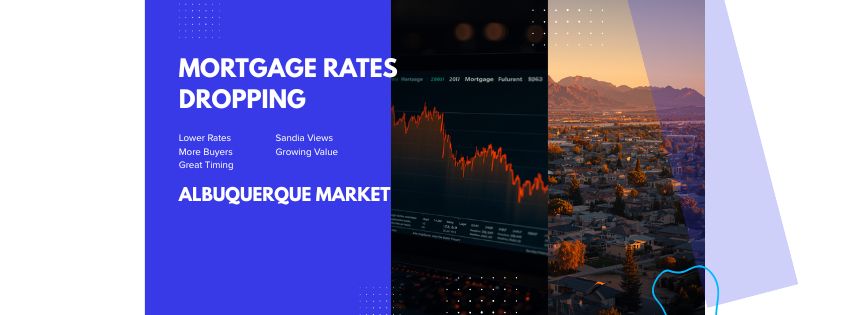
According to U.S. Bank's April 2026 interest rate and housing market analysis, Freddie Mac's survey showed the average 30-year fixed mortgage rate stood at 5.98% on February 26, 2026 — dipping below 6% for the first time in over two years. That rate then rose to 6.30% by April 16. FHA rates during this same period were running in the mid-5% range, making government-backed loan products meaningfully more affordable for buyers who qualify.
Tracy Venturi reported on Episode 571 of the WelcomeHomeABQ podcast in late February 2026 that she heard national radio host Bobby Bones tell listeners that mortgage rates had dipped below 6% — a development that Tego Venturi confirmed was real but characterized as "staying under the radar" rather than producing a dramatic buyer surge. The rate chart from Mortgage News Daily that Tego shared on that episode showed a slow, steady easing rather than a dramatic spike or drop — the kind of gradual movement that shapes market behavior over months rather than days.
The April bounce back to 6.30% — driven by a stronger-than-expected jobs report and the Federal Reserve's maintained policy stance — reminded the market that the path to lower rates is not linear. Every economic data release that signals continued strength in the labor market or inflation persistence extends the timeline for meaningful rate relief.
For Albuquerque buyers and sellers making decisions in 2026, the operative rate environment is: conventional loans in the mid-to-upper 6% range, FHA loans in the mid-5% range, with the trajectory pointing toward gradual further easing if economic conditions cooperate — but no guarantee of dramatic rate reduction on any specific timeline.
What Rates Have Already Done to Albuquerque Prices — The Track Record
The Appreciation Slowdown Was Real and Significant
The rate environment since 2022 has unambiguously slowed Albuquerque's price appreciation pace. The 15% to 25% annual gains that characterized 2020 to 2022 required a specific combination of sub-3% mortgage rates, pandemic-era demand surge, and historically depleted inventory. When rates doubled in 2022 and 2023, that specific combination was broken.
The result: Albuquerque home values appreciated approximately 3% in 2025 — a significant moderation from the peak years, but still positive. The April 2026 spring market data confirmed that detached home prices reached $380,000, up 4.4% year over year. Nationally, the S&P Case-Shiller U.S. National Home Price Index gained only 0.9% year over year in January 2026, down from 4.2% one year earlier — reflecting a broader deceleration that Albuquerque has also experienced, though at a somewhat stronger pace than the national average due to the city's supply constraints.
The rate impact on Albuquerque appreciation has been moderation, not reversal. Rates reduced the pace of price growth from unsustainable peak levels to historically normal levels. That is not a failure of the housing market — it is a normalization that was both inevitable and, for buyers who are entering the market now, genuinely beneficial compared to what a continuation of 2021 conditions would have produced.
The Mortgage Lock-In Effect Has Suppressed Supply More Than Demand
Here is the rate effect that most buyers and sellers are not fully thinking through: elevated rates have suppressed housing supply at least as much as they have suppressed buyer demand — and in Albuquerque, the supply suppression may actually be the more significant effect.
When rates rose from 3% to 7% between 2022 and 2023, two things happened simultaneously. Buyer demand declined as monthly payments increased. But seller supply also declined dramatically — because the homeowners who locked in sub-4% mortgages have no financial incentive to voluntarily trade into a 6.5% rate on their next purchase. This mortgage lock-in effect has kept a large pool of natural move-up sellers in their current homes, and that seller pool is the one that would normally replenish the mid-range inventory that the market depends on.
"High rates lock out many potential first-time buyers and keep existing homeowners from moving, meaning housing supply stays tight, but demand is suppressed. This scenario favors cash buyers and people relocating with large equity positions," confirmed the Norada Real Estate Albuquerque 2026 forecast analysis.
Both effects working simultaneously — suppressed demand AND suppressed supply — produce a market that moves more slowly than the frenzied pace of 2021 but does not produce the price declines that suppressed demand alone would generate. The lock-in effect is why Albuquerque's structural supply deficit has not meaningfully improved despite lower transaction volumes. It is also why any significant rate drop would likely trigger a simultaneous release of both pent-up buyer demand and pent-up seller supply — a dynamic that the market would need to absorb.
What Rates Have Not Done — The Missing Price Decline
The most important thing elevated rates have not done to Albuquerque home prices is produce meaningful sustained declines. Buyers who entered 2023 expecting a rate-driven price correction and have been waiting for it since are now more than two years into that wait — and home prices are higher today than when they started waiting.
The structural reason is the supply deficit. The Albuquerque metro is 13,000 to 28,000 housing units short of meeting current demand, according to Root Policy Research estimates cited in the Albuquerque Journal's March 2026 coverage. Prices fall when supply significantly exceeds demand. In a market where demand exceeds supply by tens of thousands of units, elevated rates slow the pace of transactions and moderate the pace of appreciation — they do not overcome the fundamental imbalance that prevents price declines.
"Buyers shouldn't expect massive price drops, but they can expect more negotiating room. The days of automatic appreciation every month are likely over for a while," noted the Norada Real Estate analysis. That framing — more negotiating room, not lower prices — is the most accurate characterization of what the current rate environment has actually produced in Albuquerque.
How Rates Are Specifically Affecting Albuquerque Buyers Right Now
The Monthly Payment Is the Real Variable, Not the Purchase Price
"Mortgage rates directly impact how much home buyers can afford each month. Even a small change in rates can shift purchasing power by tens of thousands of dollars. For many Albuquerque buyers, the monthly payment matters more than the home's list price," confirmed the BetterWithBaron March 2026 Albuquerque mortgage rate analysis.
This is the operational reality of the current market: buyers are shopping by monthly payment budget, not by purchase price. A buyer who can afford $2,200 per month for principal and interest can purchase approximately $370,000 at a 6.30% rate, or approximately $390,000 at a 5.98% rate. That $20,000 difference in purchasing power — produced by 0.32% of rate movement — is not trivial. It determines whether a buyer can reach into the next price tier, whether they qualify for a specific home, and whether the monthly payment math works with their other financial obligations.
The rate buydown tools that have normalized in the Albuquerque market — seller-funded 2-1 buydowns, permanent buydown points, FHA loans for buyers who qualify — exist precisely because the market has recognized that bridging the payment gap is often more achievable than bridging the price gap. Buyers who are not having a proactive conversation with their lender about rate buydown options are often leaving $200 to $400 per month in monthly savings unrealized.
The FHA Advantage That Many Albuquerque Buyers Are Missing
With conventional 30-year rates in the mid-6% range and FHA rates in the mid-5% range, the spread between loan types has created a meaningful affordability advantage for buyers who qualify for government-backed financing. FHA loans have maximum loan limits, credit score requirements, and mortgage insurance obligations that need to be weighed against the rate advantage — but for many first-time buyers and buyers with moderate credit profiles, the lower rate available on FHA financing is a genuine monthly payment difference.
Albuquerque-specific context: the New Mexico Mortgage Finance Authority's programs for first-time buyers and moderate-income buyers stack additional assistance on top of the base FHA rate advantage. Buyers who have not had a conversation with a local lender about MFA programs — down payment assistance, rate reduction programs, and closing cost assistance — may be qualifying for significantly better financing than they are assuming based on national rate headlines.
Rate-Sensitive Buyers Are Adapting Rather Than Exiting
"Across neighborhoods like the Northeast Heights, Four Hills, and the Westside, many buyers are simply adapting their strategy rather than leaving the market entirely," the BetterWithBaron March 2026 mortgage rate analysis observed. That adaptation is taking several specific forms in Albuquerque.
Buyers are requesting seller-funded rate buydowns as standard deal structure rather than exceptional concessions. They are qualifying at one price point but targeting homes priced slightly below qualification maximum — creating payment buffer. They are choosing adjustable rate mortgages or FHA products rather than conventional fixed rates. And they are evaluating total monthly housing cost — payment plus insurance, taxes, and HOA — rather than looking at rate and purchase price in isolation.
These adaptations are evidence of a market functioning with rate headwinds, not stalling because of them. Albuquerque's transaction volume has declined from peak years, but the market is still processing approximately 220 new contracts per week. Buyers have adapted their approach rather than withdrawing entirely.
The Two Rate Scenarios — What Each One Means for Albuquerque Prices
Scenario A — Rates Stay in the 6% to 7% Range Through Year-End
This is the base-case scenario that most local analysts are forecasting: continued gradual easing with rates moving in and out of the 6% range through the remainder of 2026, with no dramatic drop that would trigger a surge in buyer activity.
Under this scenario, the Norada Real Estate forecast projects continued stabilization with slow price growth of 1% to 2% annually. Local analyst Tego Venturi described this environment as "a slow, steady market with modest price growth. Negotiation stays normal. Homes that are priced right for condition and location and show well still sell in a reasonable timeframe."
For Albuquerque specifically, this scenario produces: the 2% to 4% annual appreciation that most forecasters have been projecting for 2026, ongoing normalization of concessions and inspection contingencies, continued pressure on overpriced listings in the 38% price reduction dynamic, and a market where the buyers and sellers who execute correctly achieve good outcomes without the urgency or the frenzy of the peak years.
This is the most likely scenario based on current Federal Reserve guidance and economic data. It describes a functional, navigable market — not an exciting one, but one where deliberate buyers and well-prepared sellers consistently achieve their goals.
Scenario B — Rates Drop to the 5% to 5.5% Range in H2 2026
If economic conditions shift — a meaningful labor market softening, inflation falling persistently toward the Fed's 2% target, or a policy pivot in response to economic stress — rates could ease more dramatically in the second half of 2026 than the base case projects.
"Rates ease and confidence returns. More buyers show up, and sellers — since most buyers are also sellers — competition increases on the best listings. Sales (transactions) rise faster than prices," forecast Tego Venturi in the WelcomeHomeABQ February 2026 market outlook. "If rates drop to the 5% to 6% range: the market will heat up. All the sidelined buyers will rush back in."
In Albuquerque's supply-constrained environment, a rate drop of this magnitude would trigger a demand surge that the market's limited inventory cannot easily absorb. The approximately 1,500 active listings currently available would face a materially larger pool of newly activated buyers simultaneously. The result: faster absorption, more competitive offers on well-priced listings, potential return of multiple-offer situations in strong neighborhoods, and price appreciation accelerating toward the 4% to 5% annual range.
The buyers waiting for this scenario to purchase at lower rates need to understand the second-order effect: rate drops are price-positive events in supply-constrained markets. Buyers who purchase before rates drop and refinance when they do will almost always outperform buyers who wait for the rate drop and then compete in the resulting demand surge.
Why Albuquerque Is More Rate-Sensitive Than Some Markets and Less Than Others
Albuquerque occupies a middle position in the rate-sensitivity spectrum. More sensitive than high-cash markets like San Francisco, where out-of-state equity buyers dominate and are largely rate-insensitive. Less sensitive than starter-home-heavy markets where first-time buyers — the most rate-sensitive buyer segment — represent the dominant demand driver.
The out-of-state buyer migration from California, Texas, and the Pacific Northwest that sustains Albuquerque demand includes a meaningful segment of equity-rich sellers who are trading large coastal markets for New Mexico at valuations that make Albuquerque rates feel moderate regardless of what they are. A buyer selling a $900,000 Los Angeles condo who is purchasing a $450,000 Albuquerque home has a fundamentally different rate sensitivity than a first-time buyer in Albuquerque stretching for a $350,000 home. Both are in the market. The presence of the equity-rich segment provides demand stability that prevents rate movements from affecting Albuquerque prices as dramatically as they would in a market without that buyer profile.
The Waiting-for-Rates Strategy — What the Evidence Shows
A substantial number of Albuquerque buyers have been deferring purchase decisions specifically because they are waiting for lower rates. The logic seems sound on the surface: wait for rates to drop, then buy with a lower payment. The evidence of how that strategy has actually played out deserves direct examination.
Buyers who adopted the waiting-for-rates strategy in late 2022, when rates first rose above 6%, expected to buy at lower rates within six to twelve months. Rates did not fall meaningfully for over two years. During that period, Albuquerque home prices appreciated approximately 7% to 10% from the point at which the waiting strategy was adopted. The buyers who waited are now purchasing at higher prices — and the rate environment that finally produced some relief in early 2026 is now back above 6% after the February dip.
"If you've been waiting, saying 'I'm waiting for rates to drop to go buy a house' — well, they've dropped," noted Tego Venturi on the WelcomeHomeABQ February 2026 podcast. "Take a look at what's available now, get moving, because the next move is... they come back up a little bit." That prediction proved accurate within two months, as rates bounced from 5.98% in late February to 6.30% by mid-April.
The evidence suggests that the waiting-for-rates strategy has consistently underperformed the buy-at-current-rates-and-refinance strategy in Albuquerque's supply-constrained market. The buyers who acted when good homes were available at prices the market supported — even at 6.5% rates — and who refinanced when rates eased have generally outperformed the buyers who waited for the rate environment to improve before entering.
This is not a permanent principle — there are market conditions where waiting genuinely makes sense. But in a market with a structural supply deficit, a 7.4% year-over-year appreciation trajectory, and a rate environment that has been easing rather than tightening, the mathematical evidence for the waiting strategy is weak.
What This Means for Buyers and Sellers in Albuquerque Right Now
For Buyers — The Rate Conversation You Need to Have Before You Search
The most important pre-purchase conversation for any Albuquerque buyer in 2026 is not with a real estate agent. It is with a local lender — specifically to understand four things: what rate and monthly payment you qualify for on a conventional loan, what rate and monthly payment you qualify for on an FHA loan, what the monthly payment math looks like with a seller-funded 2-1 rate buydown at your target purchase price, and what New Mexico MFA programs you may qualify for.
Those four conversations can change a buyer's understanding of their actual affordability range by $30,000 to $50,000 in purchase price — and can change their monthly payment by $200 to $400 per month through loan product selection and concession structuring. Buyers who enter the search without this information are making decisions on assumptions rather than actual numbers.
The rate environment in 2026 favors buyers who understand the full menu of financing options — not just the conventional 30-year rate that dominates national headlines.
For Sellers — How to Use Rate Sensitivity to Your Advantage
Sellers who understand that their buyers are shopping by monthly payment — not by purchase price — can structure their listing to address that directly. A seller who offers a proactive rate buydown as part of their marketing is doing something most Albuquerque sellers are not: addressing the buyer's actual purchasing constraint rather than competing solely on list price.
A $10,000 seller-funded rate buydown on a $400,000 home reduces the buyer's monthly payment by $250 to $400 in the first year. A $10,000 price reduction at the same property reduces the monthly payment by approximately $55 to $65 per month. For a payment-sensitive buyer, the buydown is worth five to six times as much in the number that actually governs their decision.
Sellers who advertise the rate buydown proactively — in the listing description, in the marketing, as a headline feature rather than a buried negotiating chip — differentiate their listing in the way that matters most to the dominant buyer segment in the current market. The rate environment, properly understood, is a seller tool as much as a buyer concern.
For the complete picture of what the current Albuquerque market means for buyers and sellers across every dimension — inventory, pricing, negotiating leverage, and seasonal timing — our comprehensive Albuquerque housing market update for 2026 covers every current metric in depth. And for buyers trying to understand whether now is the right time to buy or whether waiting makes strategic sense, our post on what the Albuquerque real estate market looks like for the rest of 2026 provides the forward-looking framework.
The Bottom Line — Rates Are the Steering Wheel, Not the Engine
Interest rates will not slow down Albuquerque home prices in 2026 in any meaningful, sustained way — for the same reason they have not produced price declines despite being at multi-decade highs for the past two years. The structural supply deficit of 13,000 to 28,000 units is the engine of Albuquerque's price stability, and that engine is running regardless of what rates are doing.
What rates are doing is acting as the steering wheel — determining the speed and direction of market activity, shaping the monthly payment environment that governs buyer behavior, and setting the terms under which transactions happen. When rates ease, activity accelerates and prices firm. When rates tighten, activity moderates and seller concessions become more common. The price level, however, is anchored by the supply deficit in ways that rate movements alone cannot displace.
Expert analysis points to continued moderate price appreciation of approximately 2.5% during 2026 in the base-case rate scenario. That appreciation is not contingent on rates dropping. It is the expected outcome of a supply-constrained market processing steady demand at current conditions. Rate drops would accelerate it. Rate increases would moderate it. But the floor established by structural undersupply is not going to move because Freddie Mac's weekly survey came in at 6.30% instead of 5.98%.
Buyers and sellers who understand that distinction — who separate the rate-driven activity signals from the structural price fundamentals — consistently make better decisions than those who treat rate movements as the primary driver of Albuquerque home values.
"National headlines are entertainment. Local stats are decision tools," Tego Venturi stated in the WelcomeHomeABQ February 2026 forecast. The local stats say: prices are rising. The supply deficit is real. Rates are the variable, not the verdict.
Have Questions About What Rates Mean for Your Specific Situation?
Jenn & Vinay from The Rodgers Neighborhood Real Estate Group help buyers and sellers understand the real impact of mortgage rates on their specific Albuquerque purchase or sale — not in the abstract, but at the neighborhood and price-range level where the actual decision lives. Whether you are a buyer trying to understand your financing options, a seller trying to position your home to compete in the current rate environment, or a homeowner evaluating your equity position, the conversation starts with a call.
Jenn & Vinay Rodgers are Albuquerque's trusted real estate professionals with The Rodgers Neighborhood Real Estate Group, brokered by Real Broker, LLC, serving buyers and sellers across Albuquerque, Rio Rancho, Corrales, Los Lunas, Tijeras, Cedar Crest, Sandia Park, the East Mountains, Bernalillo County, Sandoval County, and surrounding New Mexico communities.
The Rodgers Neighborhood Real Estate Group
Jenn & Vinay Rodgers
Real Broker, LLC
Albuquerque, NM
📞 505-417-2733
🏠 Browse current Albuquerque listingsCategories
- All Blogs (324)
- 2026 & Beyond for Real Estate (220)
- Doctors and Nurses looking for homes in NM (4)
- Guide to buying a home in NM (146)
- Health Care Heros (7)
- Home Upgrades (38)
- Jenn & Vinay your Local Real Estate Experts! (108)
- Moving to Albuquerque (128)
- Neighborhoods in Albuquerque NM (87)
- Rent or Own (2)
- Sellers Questions for Selling homes (2)
Recent Posts
GET MORE INFORMATION