

The Biggest Pricing Mistakes Albuquerque Sellers Are Making Right Now
There is a statistic sitting in the Albuquerque market data right now that should stop every seller who is considering overpricing their home.
Thirty-eight percent of active listings in Albuquerque have taken a price reduction in the current 90-day period. That means more than one in three homes on the market right now started at a price the market would not pay, sat through showing feedback that consistently said too high, and eventually conceded the reduction that a correct original price would have made unnecessary.
Meanwhile, homes that sold in the same market — same city, same months, same buyer pool — received an average of 98.5% of their list price.
The gap between those two numbers tells the complete story of what pricing correctly versus incorrectly means in the current Albuquerque market. The homes that sold did not sell because the market was generous. They sold because they were priced where the market would transact. The homes taking price reductions are not in a different market. They are in the same market, and they are paying the cost of the decision their sellers made on day one.
"Albuquerque's market favors sellers — but doesn't forgive sloppy pricing," confirmed the April 2026 Yahoo Finance Albuquerque housing market trends analysis. "Price your home right from day one. Overpriced listings sat long enough to go stale — and in a market where price cuts are trending down, needing one is a setback you can avoid."
This guide names every significant pricing mistake that Albuquerque sellers are making right now — with the specific market data behind each one and the specific correction that turns a potential 38-percenter into a 98.5-percenter.
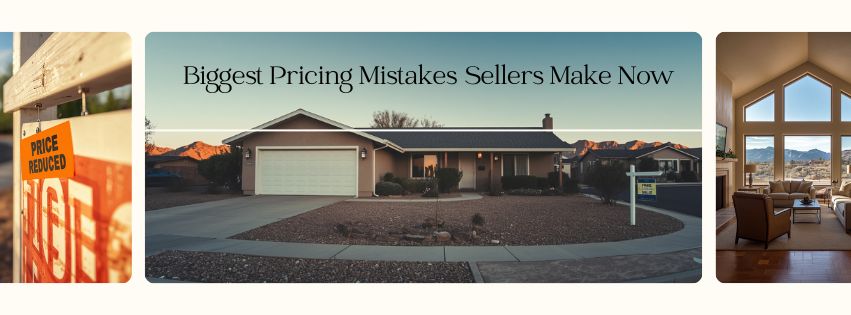
The Market Context — Why Pricing Has Never Mattered More
The specific market conditions that make pricing precision more consequential in 2026 than in 2021 require direct explanation, because the sellers who are making these mistakes are often doing so because they are still operating with a mental model of the market that has not updated since the peak.
In 2021 and 2022, overpriced homes sold anyway. The buyer competition was intense enough that even listings at 10% or 15% above market value attracted offers, because buyers who lost out on correctly priced homes were willing to pay premiums on the next available property simply to secure something. That market absorbed pricing errors that would be fatal in the current environment.
The current data snapshot: Market Action Index at 44.5 (seller's market above 30, so the structural advantage still exists), 4 months of supply (below the 10-year historical average of 4.4), median sold price of $351,000 up 3.3% year over year — these are all genuine seller-market indicators. But the average days on market for active listings is 102 days. Hot homes that are correctly priced are still pending in 14 days. The same market, the same week, the same buyer pool — producing 14-day sales and 102-day stagnations simultaneously, based almost entirely on the pricing decision made before the listing went live.
That is the market Albuquerque sellers are operating in right now. It rewards precision and punishes optimism in a way that the 2021 market did not.
Mistake 1 — Pricing From 2022 Memory
The most common single pricing mistake in the current Albuquerque market is the seller who has been watching their neighbor's sales over the past three years and has formed a price expectation that peaked in 2022 — and has not updated that expectation to reflect where the market actually is in 2026.
The mechanism is understandable. A neighbor sold for $430,000 in April 2022. The seller looks at their own home, which is comparable, and thinks: my home should be worth at least what theirs was. The problem is that the April 2022 sale happened in the most competitive buyer market in recent memory, when multiple-offer situations drove prices to levels that the current market — with more inventory, more buyer deliberation, and different rate mathematics — will not replicate.
"We're not in 2021 or 2022 anymore, and the 'let's try a high number and see what happens' approach usually leads to price reductions and a longer time on market," confirmed the WelcomeHomeABQ 2026 market forecast from Tego and Tracy Venturi. "Overpricing at the start often turns into 'chasing the market,' which can ultimately net you less than if you had priced correctly from the beginning."
The specific harm: a home priced at $430,000 based on 2022 comparables that the current market values at $390,000 will not receive serious offers for six to eight weeks. When the price reduction to $398,000 finally happens, the market has already registered the home as a listing that has been sitting — which introduces the buyer skepticism question that no seller wants raised during negotiations. The final sale at $391,000 is lower than the $395,000 the correctly priced original listing would have produced, because the price reduction history created negotiating weakness.
The correction: the only valid pricing reference for a 2026 Albuquerque home sale is closed comparable sales within the last 60 days in the immediate area. Not 90 days. Not last year. Not what the market will get back to. What it is right now.
Mistake 2 — The 'Test the Market' Strategy
"One of the biggest mistakes sellers make is assuming they can 'test the market.' In 2026, that strategy backfires. In Albuquerque neighborhoods where buyers are watching multiple similar homes, overpriced listings often end up chasing the market — and selling for less than they would have if priced correctly from day one," confirmed the a leading Albuquerque market analysis. The specific failure mechanism of 'testing the market' deserves full explanation because it is the most commonly cited reason for overpricing and the one that sounds most reasonable until its consequences are fully traced.
The logic of test-the-market: list high, and if the market does not respond, reduce the price. It sounds like a low-risk experiment. In practice, it is the specific sequence that produces the worst outcomes in the current market.
Here is what actually happens in the test-the-market sequence in 2026 Albuquerque:
- Week 1-2: The listing goes live at an above-market price. Buyer agents who are actively working in the area immediately recognize the overpricing from their own CMA work. They tell their clients: this one is priced too high.
- Week 2-4: Showings happen — curiosity showings from buyers whose agents think they might make a lowball offer. No offers. Showing feedback consistently says: priced too high.
- Week 4-8: The listing accumulates days on market. Buyers and buyer agents begin to wonder: what's wrong with this home? The stigma question forms not from evidence of any specific defect but from the simple fact of extended market time without a contract.
- Week 8+: The price reduction. The listing gets a brief second surge of interest — the new-reduction visibility on Zillow brings some buyers back. But the reduction history now follows the listing, and any buyer who does the showing history math knows the seller has been sitting. They offer less than the reduced price.
- Final outcome: The property sells below where a correctly-priced listing would have closed. The test cost the seller both time and equity.
The correction: the test-the-market strategy is only useful when there are no comparable sales and genuinely no way to know where the market will respond. In 2026 Albuquerque, where closed comparable sales are available and active competition for the same buyer pool is visible in real time, the market is already telling you where to price before you list. Listening to it before listing costs nothing. Discovering it after 60 days costs significantly.
Mistake 3 — Zestimate and AVM Over-Reliance
Automated valuation models — Zillow's Zestimate, Redfin Estimate, and similar algorithmic tools — are more sophisticated than they were five years ago. They are still not reliable primary pricing tools for an individual home in a specific neighborhood condition.
The specific limitations of AVMs in the Albuquerque market:
- They cannot see inside the home. An AVM prices from tax records, transaction history, and statistical modeling from nearby sales. It does not know that the kitchen was updated last year. It does not know that the roof needs replacement. It does not know that the home office addition was unpermitted. All of those conditions — which buyers will discover during showings and inspections — affect the actual transaction price in ways the algorithm cannot anticipate.
- They lag the market. AVMs are backward-looking. In a market where conditions are changing month over month — as the Albuquerque market has been since late 2022 — an AVM's estimate reflects the market six to twelve months ago as much as it reflects the market today.
- They cannot account for hyper-local variance. The a leading Albuquerque market source analysis is direct on this point: 'In Albuquerque, two homes with the same square footage can perform very differently based on layout, updates, outdoor space, and even street placement.' An AVM averages across a ZIP code. A buyer's agent runs a CMA on the specific block. The buyer is paying for the specific home, not the ZIP code average.
The correction: treat the Zestimate as one data point among several — useful as a rough orientation, not as a pricing anchor. The Comparative Market Analysis from a working Albuquerque agent who has physically seen comparable properties recently is the authoritative pricing tool.
Mistake 4 — Valuing Renovations at Cost, Not Market Premium
The kitchen remodel that cost $45,000 in 2021 does not add $45,000 to the 2026 sale price. The bathroom renovation completed last year does not return its full cost to the seller. The new roof installed in 2023 is not a value-add — it is a maintenance item that a well-functioning home is expected to have.
This disconnect between what sellers spent and what the market will pay for it is the second most common pricing inflation source in the Albuquerque market, behind 2022-memory pricing.
The specific mechanism: a seller calculates what they paid for improvements, adds them to a base value derived from comparable sales, and arrives at a price that reflects their investment rather than the market's valuation of the result. The problem is that the market does not care what you spent. It cares what the home is worth to a buyer who did not make those decisions and is comparing your home to every other available option at your asking price.
The ROI reality for common Albuquerque renovations in 2026:
- Kitchen remodel (full gut): Returns approximately 50-70% of cost in sale price premium. A $45,000 kitchen renovation adds $22,000 to $31,000 in buyer willingness to pay, not $45,000.
- Bathroom update (cosmetic): Returns 70-80% of cost. A $12,000 bath refresh adds $8,400 to $9,600 in premium.
- New roof: Maintains value rather than adding it. A home with a documented new roof does not command a premium over a home with an undisclosed roof condition — it commands a premium over a home with a known bad roof. The correct framing: a new roof removes a negative, not creates a positive.
- Fresh paint and cosmetic updates: These return more than their cost in reduced days on market and in reduced buyer objection — not in premium pricing, but in transaction speed and cleanliness.
The correction: price from comparable sales, then add specific premiums for specific verified upgrades that comparable sales confirm the market recognizes. Not from renovation invoices.
Mistake 5 — Ignoring New Construction Competition
Albuquerque's active new construction market — with DR Horton, Lennar, Pulte, and regional builders delivering homes across the Westside, Mesa del Sol, and Rio Rancho corridors — is a competitive reality that resale sellers in adjacent price ranges must account for in their pricing.
A buyer comparing a 2005 resale home at $385,000 to a new construction home with a builder warranty, modern systems, and a 2-1 rate buydown at $395,000 is facing a genuine choice. The resale seller who is not pricing to account for what the builder is offering will find that their competition is not only the other resale homes on the market — it is also the incentive-equipped new construction.
"New construction will quietly shape the resale market. Steady new-home activity means builders can offer incentives like rate buydowns, so resale sellers must compete on realistic pricing, strong condition, and standout presentation from day one," confirmed the a leading Albuquerque market forecast. The specific implication for resale sellers in neighborhoods adjacent to active new construction: price from the resale comparable sales that reflect what buyers are choosing when they specifically prefer established neighborhood character over new construction — do not price as if new construction does not exist.
Mistake 6 — The Listing Agent Who Buys the Listing
This is the pricing mistake that is caused by the seller's agent rather than the seller directly — but that the seller pays for in full.
The mechanism: a seller meets with three agents, all of whom provide pricing recommendations. Two agents suggest a range of $380,000 to $395,000 based on comparable sales. The third agent suggests $420,000 — a number that appeals to the seller's hope, that creates the impression that this agent sees value the others missed, and that wins the listing because the seller naturally prefers the agent who validates their highest expectation.
The third agent has not discovered hidden value. They have suggested an above-market price to secure the listing — knowing that a price reduction will follow, knowing that the seller will blame the market rather than the pricing recommendation, and knowing that a reduced listing will still generate a commission even if it generates less value for the seller than a correctly priced listing would have.
This behavior — winning a listing with an inflated price suggestion — is known in the industry as "buying the listing." It costs sellers the momentum window, accumulates the days-on-market stigma, and typically produces a final sale price below what a correctly priced listing from a market-honest agent would have achieved.
The correction: ask every agent you interview to justify their price recommendation with specific comparable sales. The agent who can show you three closed sales from the last 60 days that support their suggested price is doing market analysis. The agent who gives you a high number without comparable support is telling you what you want to hear.
Mistake 7 — Missing the Momentum Window
"Momentum sells homes," a leading Albuquerque market guide states directly. "In contrast, homes that linger on the market often end up negotiating from a weaker position — even if they eventually get close to their original price." The momentum window — the first 14 to 21 days of a listing's active status — is the period when buyer interest is highest, showing activity is most concentrated, and the probability of multiple offers is greatest.
During the momentum window, a correctly priced listing competes with every buyer who has been searching in that price range and waiting for the right property. The moment a listing goes live, buyer agents who have been watching the market for their clients immediately recognize a well-priced property and schedule showings within days. The competition among buyers during this window is what produces the 98.5% of list price sale outcomes — not the absence of negotiation, but the presence of competition that limits how far below list price the sale will settle.
Once the momentum window closes — once the listing has been on the market for 30 days without a contract — the buyer dynamic changes. The listing is no longer new. Buyers who passed on it initially are not coming back for a second look unless the price moves. The showing activity drops. The seller's negotiating position weakens.
The sellers who make the test-the-market mistake are not just losing the price reduction — they are losing the momentum window. And the momentum window, once lost, cannot be recovered without the artificial stimulus of a significant price reduction that resets the listing's market debut — at the cost of the stigma that the days-on-market counter has already accumulated.
Mistake 8 — Hyper-Local Variance Blindness
The a leading Albuquerque market source pricing analysis makes a point that sellers in Albuquerque's most competitive neighborhoods frequently miss: two homes with the same square footage in the same neighborhood can perform very differently based on layout, updates, outdoor space, and street placement.
The specific Albuquerque manifestations of this hyper-local variance:
- Street position and views: A home on a cul-de-sac backing to the Sandia Mountain open space commands a specific premium over the identical floor plan one street over backing to another home. The difference in comparable sales for these two positions can be $25,000 to $50,000 in the Northeast Heights foothills. A seller whose home does not have the open-space position but prices from comparables that do is pricing into premium territory their specific address does not support.
- Floor plan functionality: An open floor plan with good natural light commands a premium over a chopped-up floor plan of identical square footage. Albuquerque's buying population in 2026 is specifically comparing floor plan livability, not just square footage counts.
- Outdoor space quality: A covered portal with a functional outdoor living space commands a premium over a backyard that is technically the same square footage but lacks weather protection. New Mexico's buyers value usable outdoor space highly, and 'usable' is specifically defined by shade, privacy, and quality of finish — not by area on the appraisal.
- Interior condition vs. recent renovation: A seller who prices their home as if it has been recently renovated when it has had moderate updating over 15 years is pricing from a condition tier they have not earned. Buyers who see the gap between the listing price and the actual condition at the showing do not make offers. They move on.
The Chasing-the-Market Phenomenon — How All These Mistakes Converge
Every pricing mistake on this list leads to the same outcome: the seller ends up chasing the market.
Chasing the market is the specific dynamic where a seller begins above market value, takes a price reduction, discovers that the reduction was still above where buyers will transact, takes another reduction, and in some cases enters the extended-market-time spiral that produces sales significantly below what a correct initial price would have achieved.
Local market analysts specifically name this dynamic in their 2026 analysis: "Overpricing at the start often turns into 'chasing the market,' which can ultimately net you less than if you had priced correctly from the beginning." The a leading Albuquerque market source team confirms: "In Albuquerque neighborhoods where buyers are watching multiple similar homes, overpriced listings often end up chasing the market — and selling for less than they would have if priced correctly from day one."
The mechanism that makes chasing the market always net less:
- Each reduction signals seller motivation. The buyer who sees a listing that has taken two price reductions over eight weeks reads those reductions as evidence that the seller is under pressure. That reading produces lower initial offers than the seller would have received at a correctly priced new listing.
- The days-on-market counter cannot be reset. Even when Zillow shows a "price reduced" badge, the days-on-market counter keeps running. The buyer who checks the listing history sees 75 days. The question that number raises — why is this home still available — is not answered by the price reduction alone.
- The momentum window is permanently gone. The 38% of active listings with price reductions cannot recapture the showing velocity and competitive offer environment of their first two weeks on market. The best they can achieve is a second, smaller burst of activity from the reduction visibility — against a backdrop of accumulated market fatigue.
What Correct Pricing Actually Looks Like in 2026 Albuquerque
Correct pricing in the current market is not the lowest possible price. It is the price that is supported by the most recent comparable sales for the home's specific position, condition, and feature set — priced at the competitive end of that range rather than the optimistic end.
The specific process:
- Run the CMA from the last 60 days. Pull closed sales of comparable homes within the same neighborhood and within a reasonable square footage range (typically plus or minus 20%). Prioritize the most recent sales.
- Adjust for specific condition and position. Apply honest adjustments for the features of your specific home relative to the comparables: plus for recent renovations, views, or trail adjacency; minus for deferred maintenance, dated finishes, or less favorable street position.
- Price at the competitive end of the range. If the comparable range suggests $380,000 to $405,000, price at $385,000. The lower position in the comparable range generates more showing activity, more competitive buyer interest, and typically produces a final sale closer to the top of the range than a listing at $405,000 that sits without competition.
- Resist the temptation to "leave room to negotiate." The strategy of pricing high to leave negotiating room only works when the overpricing is small enough (1-3%) that buyers still engage. When sellers leave significant room (5-10% above market), the buyers most motivated to purchase at market value simply do not offer — they wait for the reduction instead.
For sellers who want the complete preparation picture alongside the pricing strategy, our guide to how to sell your Albuquerque home fast in 2026 covers preparation, presentation, and the concession structure that produces fast, clean sales. And our Albuquerque housing market update for 2026 provides the full market context that makes these pricing decisions most accurate.
The Bottom Line — Right Beats High Every Time
The Sandi Pressley team's pricing guide says it in four words that are the most useful summary of everything in this post: right beats high every time.
Not right is better sometimes. Not right is usually better. Right beats high every time.
In the current Albuquerque market, where 38% of active listings have taken price reductions and sold homes are getting 98.5% of their correctly-set list prices, that principle is not a platitude — it is the specific, measurable difference between a 14-day sale and a 102-day market time that ends with a price below where the seller started.
The sellers who understand this principle — who price from current comparable data, who account for hyper-local variance rather than neighborhood averages, who choose a market-honest agent over the one with the highest suggested price — are the ones whose homes go under contract in the momentum window, sell near list price, and close without the negotiating weakness that accumulated days on market and price reductions create.
The market in 2026 Albuquerque is genuinely favorable for sellers who price correctly. It is significantly less favorable for sellers who do not. The difference between those two outcomes begins with the pricing decision made before the listing goes live.
Ready to Price Your Home Right the First Time?
Jenn & Vinay from The Rodgers Neighborhood Real Estate Group provide sellers with the specific, hyper-local comparative market analysis — built from the most recent closed sales in your specific neighborhood — that produces correctly priced listings and momentum-window results. We do not buy listings with inflated price suggestions. We provide the data-backed pricing recommendation that gives your home the best possible opportunity in the current market. The conversation, and the free valuation, starts with a call.
Jenn & Vinay Rodgers are Albuquerque's trusted real estate professionals with The Rodgers Neighborhood Real Estate Group, brokered by Real Broker, LLC, serving buyers and sellers across Albuquerque, Rio Rancho, Corrales, Los Lunas, Tijeras, Cedar Crest, Sandia Park, the East Mountains, Bernalillo County, Sandoval County, and surrounding New Mexico communities.
The Rodgers Neighborhood Real Estate Group
Jenn & Vinay Rodgers
Real Broker, LLC
Albuquerque, NM
📞 505-417-2733
🏠 Get your free Albuquerque home valuation
Categories
- All Blogs (326)
- 2026 & Beyond for Real Estate (222)
- Doctors and Nurses looking for homes in NM (4)
- Guide to buying a home in NM (146)
- Health Care Heros (7)
- Home Upgrades (38)
- Jenn & Vinay your Local Real Estate Experts! (110)
- Moving to Albuquerque (129)
- Neighborhoods in Albuquerque NM (87)
- Rent or Own (2)
- Sellers Questions for Selling homes (2)
Recent Posts


GET MORE INFORMATION