
Most Walkable Neighborhoods in Albuquerque — The Honest 2026 Guide
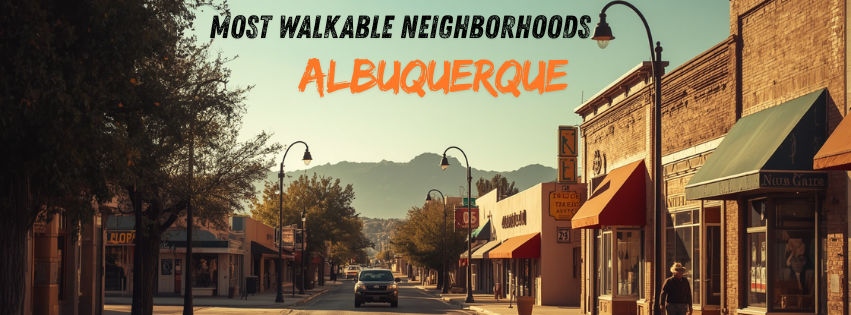
The walkability question about Albuquerque has two honest answers depending on which part of the city you are asking about. The citywide answer — Walk Score 43, 28th most walkable large city in the United States, most errands require a car — is accurate for the majority of Albuquerque's residential neighborhoods. The neighborhood-level answer — Nob Hill Walk Score 85, Huning Highland 85, University Heights 78 — describes a genuinely different city where car-optional living is available and meaningfully practiced.
This guide covers the most walkable Albuquerque neighborhoods with the specific Walk Score data, the specific amenities that make each walkable, the lifestyle that the walkability enables, and the honest limitations that even the most walkable Albuquerque neighborhoods carry relative to the walkable urban neighborhoods in larger American cities. It also covers the price premium that walkability commands in a city where walkability is the exception rather than the rule.
The Honest Citywide Context — Albuquerque Is Primarily a Car City
"Albuquerque is the 28th most walkable large city in the US with 545,852 residents. Albuquerque has some public transportation and is somewhat bikeable. The most walkable Albuquerque neighborhoods are Nob Hill, Huning Highland Historic District and University Heights... Most errands require a car," confirmed Walk Score's official Albuquerque walkability data.
The 43/100 citywide Walk Score is the foundation for any honest Albuquerque walkability conversation. Most of the city's residential neighborhoods — the Northeast Heights, the Westside, Rio Rancho, the South Valley, the East Mountains — were designed around and for the automobile. The street grid is wide, the setbacks are deep, and the commercial development is concentrated in corridors and strip malls rather than in the pedestrian-accessible mixed-use patterns that produce walkable neighborhoods.
This is not a critique — it is a description of a city whose development pattern reflects the realities of its climate (no one designed Albuquerque for walking in 95-degree July afternoons), its geography (the horizontal Rio Grande valley rewards driving), and its development era (most Albuquerque growth occurred during the post-World War II car-dependent suburban era). The walkable neighborhoods described in this guide are exceptions to the dominant pattern — and they are genuinely good exceptions.
The Walk Score scale for reference:
- 90-100: Walker's Paradise — daily errands do not require a car
- 70-89: Very Walkable — most errands can be accomplished on foot
- 50-69: Somewhat Walkable — some errands can be accomplished on foot
- 25-49: Car-Dependent — most errands require a car
- 0-24: Almost All Errands Require a Car
Albuquerque's top neighborhoods at 85 fall squarely in the "Very Walkable" category — a meaningful designation that reflects a genuinely different daily experience from the city's car-dependent norm.
The Most Walkable Neighborhoods — The Walk Score Leaderboard
1. Nob Hill — Walk Score 85 — The Undisputed Leader
Walk Score: 85 | Transit Score: approximately 45 | Bike Score: approximately 65 | Price range: $230,000 to $500,000+
"Nob Hill is the most walkable neighborhood in Albuquerque, with a Walk Score of 85. Known for its vibrant nightlife and unique boutiques, residents and visitors alike can explore the area and take advantage of its walkable layout," confirmed ApartmentGuide's most walkable Albuquerque neighborhoods analysis. Notable attractions include the historic Lobo Theater and Central Avenue's full range of independent businesses.
Nob Hill is Albuquerque's most walkable neighborhood by a comfortable margin — and the gap between its Walk Score and the next tier of neighborhoods reflects the specific concentration of amenities that the Central Avenue corridor provides. The stretch of Central Avenue between Juan Tabo Boulevard and I-25 is the most densely commercially varied street in Albuquerque, with:
- Restaurants: Flying Star Café, Vinaigrette, Scalo Northern Italian Grill, Humble Coffee, and dozens of independent restaurants across every cuisine category and price point — accessible by a 5-to-15-minute walk from any Nob Hill residential address.
- Coffee shops: Multiple independently owned coffee shops within the corridor, including the work-from-cafe options that Nob Hill specifically serves well for remote workers.
- Grocery access: The Trader Joe's on Carlisle (adjacent to Nob Hill), the Whole Foods in the Uptown corridor nearby, and the smaller grocers along Central provide the food shopping that the Walk Score captures.
- Entertainment and culture: The Lobo Theater (historic movie house), the Nob Hill galleries on the First Friday ARTScrawl route, the independent bookstore, and the music venues that animate Central Avenue evenings.
- Healthcare access: The Presbyterian Kaseman Hospital is within a reasonable drive (not walkable), but multiple medical offices and pharmacies are within walking distance along the Central Avenue corridor.
The Nob Hill walkable lifestyle: a resident of Nob Hill can realistically go days without needing their car. The weekly grocery run, the daily coffee, the dinner out, the movie, the Sunday morning gallery walk, the pharmacy errand — all accessible on foot from a central Nob Hill address. This is the definition of Very Walkable in practice, and it is the specific lifestyle that Nob Hill provides that no other Albuquerque neighborhood quite replicates at this density.
The walkability premium: Nob Hill homes trade at a premium over comparable homes in the surrounding areas. The price per square foot in Nob Hill reflects both the neighborhood's character and the walkability that buyers specifically pay for — particularly buyers who are relocating from larger, more walkable cities and who are unwilling to give up car-optional living entirely.
2. Huning Highland Historic District — Walk Score 85 — The Victorian Walker's Paradise
Walk Score: 85 | Price range: $200,000 to $380,000
Huning Highland Historic District ties Nob Hill's Walk Score of 85 and earns its score through a different mechanism — proximity to the Old Town/ABQ BioPark corridor rather than the Central Avenue commercial density. Huning Highland's walkability is more culturally and naturally oriented, with the ABQ BioPark Botanic Garden, the Zoo, and the Aquarium all walkable or bikeable from the neighborhood's Victorian-era residential streets.
The Huning Highland walkable experience:
- ABQ BioPark access: The Botanical Garden, the Zoo, and the Aquarium are all walkable from Huning Highland addresses — a specific walkable amenity that no other Albuquerque neighborhood provides. A Sunday morning walk to the Botanic Garden followed by brunch on Central Avenue is a genuinely appealing Huning Highland weekend.
- Old Town adjacency: Old Town Albuquerque's restaurants, galleries, and historic plaza are walkable or a short bike ride from the neighborhood's northern edge.
- Bosque trail access: The Paseo del Bosque Trail's Tingley Beach access point is within walking or cycling distance — adding outdoor walkable access to the neighborhood's urban walkability score.
- Central Avenue access: The Central Avenue corridor provides commercial amenity access from the neighborhood's southern boundary.
The specific Huning Highland advantage over Nob Hill: it pairs the same Walk Score with a significantly lower price range. The $200,000 to $380,000 price range for Huning Highland homes — with their Victorian and territorial architecture — represents the most affordable access to an 85 Walk Score address in Albuquerque.
3. University Heights — Walk Score 78 — The Academic Walkable
Walk Score: 78 | Price range: $190,000 to $380,000
University Heights sits between UNM and Nob Hill, and its walkability reflects the combined influence of the university campus (which provides walkable cultural, athletic, and educational amenities from the neighborhood's eastern edge) and the Central Avenue corridor (which provides commercial walkability from the neighborhood's main street).
The University Heights walkable experience:
- UNM campus walking access: Johnson Center athletic facilities, Popejoy Hall performances, the Lobo stadium, the UNM Museum of Art, the duck pond — all walkable from University Heights residential streets. The university's cultural programming is available without a car.
- Central Avenue commercial access: The University Avenue stretch of Central Avenue has coffee shops, restaurants, and the specific student-oriented commercial mix that serves the neighborhood's population.
- Library and services: The UNM Library, the Student Union Building, and university health services are walkable for UNM-affiliated residents.
University Heights' Walk Score of 78 is slightly below Nob Hill and Huning Highland because the commercial density along its Central Avenue stretch is lower, with more student-oriented businesses and fewer of the upscale restaurant and boutique categories that drive Nob Hill's score. The neighborhood works best for residents with a connection to UNM — students, faculty, staff, and adjacent professionals — whose walkable lifestyle naturally includes the campus.
4. Downtown Albuquerque and EDo — The Emerging Urban Core
Walk Score: approximately 60-75 (varies significantly by block) | Price range: $180,000 to $450,000
Downtown Albuquerque and the adjacent East Downtown (EDo) neighborhood represent the most concentrated urban walkability environment in the city — where the density of employers, government offices, entertainment venues, and transit access creates a walkable environment that is specifically suited to the weekday urban professional.
- KiMo Theatre and performing arts: The historic KiMo Theatre, the Kiva Auditorium, and the Convention Center are all walkable from Downtown residential addresses.
- Government and employment access: The City of Albuquerque's administrative buildings, Bernalillo County offices, and the Downtown business corridor create the employment-adjacent walkability that office workers specifically value.
- Transit connectivity: The Alvarado Transportation Center — Albuquerque's primary transit hub for bus and rail services — is in Downtown. For residents who use public transit rather than a car, Downtown provides the best transit access in the city.
- EDo's emerging character: East Downtown's craft breweries, independent restaurants, and boutique residential development are creating a pedestrian-oriented evening destination that is still developing but is increasingly walking-friendly.
The Downtown/EDo walkability caveat: Downtown Albuquerque's walkability is specifically weekday-daytime in character. The after-hours activity that makes urban neighborhoods fully walkable has been slower to develop in Downtown Albuquerque than in comparable downtowns. The evening and weekend walkable experience is improving but not yet at the density that produces the 24-hour walkable urban neighborhood.
5. Old Town Albuquerque — Cultural Walkability in a Historic Setting
Walk Score: approximately 65-72 | Price range (residential streets): $250,000 to $600,000
Old Town Albuquerque's walkability is specific and bounded — the historic plaza district's 300-year-old street grid creates a compact pedestrian environment where over 100 shops, galleries, and restaurants are accessible within a quarter-mile walk. For residents of the residential streets immediately surrounding Old Town, this produces a unique walkable lifestyle anchored in the city's oldest district rather than in a contemporary commercial corridor.
- The Old Town plaza network: San Felipe de Neri Church (1706), the Old Town Plaza, the surrounding gallery and shop buildings, and the Church Street Cafe are all within the compact walkable core.
- Museum access: The Albuquerque Museum, the New Mexico Museum of Natural History, and the American International Rattlesnake Museum are all in the Old Town district — walkable from the immediate neighborhood.
- BioPark proximity: The ABQ BioPark and the Tingley Beach access to the Paseo del Bosque Trail are within cycling distance of the Old Town neighborhood.
The Old Town walkability limitation: Old Town's commercial character is oriented toward gallery visitors and tourists rather than neighborhood daily-needs retail. Grocery stores, pharmacies, and the specific daily-life commercial infrastructure that Walk Score measures are not concentrated in the Old Town district — they are a short drive away. The Walk Score reflects this balance between cultural walkability and daily-needs walkability.
6. Uptown — The Mall-Centric Walkable District
Walk Score: approximately 60-70 | Price range: Condos $150,000 to $280,000; single-family $300,000 to $450,000
Uptown — the district around Coronado Center mall at Louisiana Boulevard and Indian School — provides a different type of walkability than Nob Hill or Huning Highland: a mall-centric model where the retail, restaurant, and service concentration around the mall creates walkable access to everyday commercial needs.
- Coronado Center and surrounding retail: The Uptown commercial district around Coronado Center concentrates national retail, restaurants, the movie theater, and service businesses within a walkable cluster.
- Healthcare cluster: The Presbyterian Hospital's Kaseman facility, multiple medical office buildings, and the density of healthcare services in the Uptown-adjacent area create walkable healthcare access that is specifically relevant for retired buyers.
- Condo concentration: Uptown has a higher concentration of condominium units than any other Albuquerque neighborhood outside of Downtown, providing the lower-maintenance housing type that walkable urban living typically pairs with.
The Uptown honest assessment: mall-centric walkability is walkability, but it is a specific type that differs significantly from the independently-owned-business walkability of Nob Hill. The pedestrian environment in Uptown is optimized for reaching commercial destinations rather than for the casual street life that makes the most walkable urban neighborhoods feel vibrant.
The Walkability-to-Price Relationship in Albuquerque
In a car-dependent city, walkability is a scarce resource — which means it commands a price premium that is measurable and consistent. The Albuquerque walkability premium reflects this scarcity:
- Nob Hill premium: Comparable homes in Nob Hill trade at approximately $50,000 to $100,000 above comparable homes in walkability-adjacent but less walkable neighborhoods. The premium reflects both the neighborhood's character and the specific scarcity of the Walk Score 85 address in a 43/100 city.
- Huning Highland opportunity: The same Walk Score of 85 at Huning Highland prices ($200,000-$380,000) represents the most affordable access to "Very Walkable" in Albuquerque. The price-to-walkability ratio at Huning Highland is the best available in the city.
- University Heights value: Walk Score 78 at prices that consistently run below comparable Nob Hill addresses — the university-adjacent walkability discount that produces meaningful value for buyers who specifically want walkability without the Nob Hill price.
The investor implication: in markets where walkability is correlated with home value appreciation (a relationship that national real estate research consistently finds), Albuquerque's walkable neighborhoods have an appreciation advantage over the car-dependent average. The buyer who purchases in a walkable Albuquerque neighborhood is positioned on the right side of a scarcity curve that is unlikely to reverse as the city grows.
The Bike Score Supplement — Cycling as Alternative Mobility
For residents whose definition of walkability includes cycling — the 15-minute city concept where most daily destinations are reachable by a short bicycle ride — Albuquerque's Bike Score data supplements the Walk Score picture meaningfully.
- Paseo del Bosque Trail: The 16-mile paved bosque trail — connecting the North Valley to Barelas and beyond — creates a cycling infrastructure that allows North Valley and Corrales residents to reach Downtown and the University area by bike. The residents of bosque-adjacent neighborhoods who cycle regularly experience a very different urban mobility than the car-dependency statistics suggest.
- The 50-Mile Loop: Albuquerque's designated 50-mile cycling loop connects three north-south trails via east-west bicycle paths and lanes — creating a cross-city cycling infrastructure that rewards neighborhoods positioned along the route.
- ABQ Ride Transit Supplement: The Rapid Ride (BRT-style) bus on Central Avenue connects Nob Hill, University Heights, Downtown, and Old Town in a transit corridor that supplements walking for trips beyond walking distance. For car-free residents in these neighborhoods, the Central Avenue Rapid Ride is the car-free mobility option that makes the lifestyle genuinely feasible.
What Walkability Actually Means for Daily Life in Albuquerque
The practical daily-life differences between Albuquerque's walkable neighborhoods and its car-dependent norm are more significant than the Walk Score differential suggests:
- The morning coffee: A Nob Hill resident walks 3 minutes to a coffee shop. A Northeast Heights resident drives 8 minutes. Over 260 workday mornings per year, that difference is 260 drives that the Nob Hill resident doesn't make.
- The spontaneous dinner: A Nob Hill resident can decide at 6:30pm to have dinner at any of 20 restaurants within a 10-minute walk. A Westside resident needs to decide which commercial corridor to drive to, park at, and return from.
- The Saturday routine: A University Heights resident walks to the Saturday farmers market, walks to the coffee shop, walks to the bookstore, and walks to lunch. A Rio Rancho resident drives to each destination separately.
- The fitness dividend: Walkable neighborhood residents accumulate significantly more daily physical movement than car-dependent residents — studies consistently find that walkable neighborhood residents walk more, weigh less, and have lower rates of cardiovascular risk than comparable-income residents of car-dependent neighborhoods.
These differences are real and they compound over the years of a residence. The buyer who values walkability should not underestimate the quality-of-life difference between a Walk Score 85 address and a Walk Score 43 address in daily practice.
For the broader lifestyle picture of what Albuquerque's walkable neighborhoods offer beyond their Walk Scores — the restaurants, galleries, and community events that the walkable lifestyle enables — our complete guide to things to do in Albuquerque covers the full experience. And for the remote worker buyers for whom walkable coffee shop access is specifically a professional consideration, our guide to the best Albuquerque coffee shops for remote workers covers the specific remote-work infrastructure of each walkable neighborhood.
The Walkability Quick Reference — Albuquerque's Top Neighborhoods by Score
- Nob Hill: Walk Score 85 | Price $230K-$500K+ | Best for: car-free lifestyle, restaurant culture, arts, remote workers
- Huning Highland Historic District: Walk Score 85 | Price $200K-$380K | Best for: affordable walkability, BioPark, Victorian architecture, dual-language school
- University Heights: Walk Score 78 | Price $190K-$380K | Best for: UNM-affiliated residents, Central Avenue access, below-Nob-Hill pricing
- Downtown / EDo: Walk Score 60-75 | Price $180K-$450K | Best for: urban professionals, transit users, arts and culture access
- Old Town Area: Walk Score 65-72 | Price $250K-$600K | Best for: cultural walkability, historic character, BioPark access
- Uptown: Walk Score 60-70 | Price $150K-$450K | Best for: healthcare access, condo lifestyle, mall-adjacent retail convenience
The Bottom Line — Walkability Is Available in Albuquerque, If You Choose It
Albuquerque is not a walkable city in the way that Portland, Denver, or Chicago are walkable cities — places where walkability is distributed across the residential landscape rather than concentrated in specific corridors. It is a city where walkability is available if you specifically choose the neighborhoods that provide it and are willing to pay the premium that scarcity commands.
The buyer who specifically values walkability and who finds a home in Nob Hill, Huning Highland, or University Heights is accessing a quality of life that no amount of money can provide in the Northeast Heights or the Westside — not because those neighborhoods are inferior, but because they were designed for the car and the walkable lifestyle is simply not part of their infrastructure.
The buyer who is honest about their need for walkability — who knows that they will be frustrated by a car-dependent lifestyle and who is not willing to accept the gradual car-dependency that suburban Albuquerque's infrastructure encourages — should let the Walk Score drive a significant part of the neighborhood selection. For that buyer, Albuquerque's walkable pockets are genuinely excellent, and the neighborhoods that provide them are among the most rewarding residential addresses in the city.
Looking for a Walkable Albuquerque Neighborhood?
Jenn & Vinay from The Rodgers Neighborhood Real Estate Group help buyers who specifically value walkability find the Albuquerque neighborhoods and the specific addresses within those neighborhoods where the Walk Score data translates into a genuinely car-optional daily life. We know which Nob Hill blocks are within walking distance of which specific amenities, which Huning Highland streets provide the best BioPark access, and how the University Heights walkable experience compares in practice to its Walk Score on paper. The conversation about living carlessly in Albuquerque starts with a call.
Jenn & Vinay Rodgers are Albuquerque's trusted real estate professionals with The Rodgers Neighborhood Real Estate Group, brokered by Real Broker, LLC, serving buyers and sellers across Albuquerque, Rio Rancho, Corrales, Los Lunas, Tijeras, Cedar Crest, Sandia Park, the East Mountains, Bernalillo County, Sandoval County, and surrounding New Mexico communities.
The Rodgers Neighborhood Real Estate Group
Jenn & Vinay Rodgers
Real Broker, LLC
Albuquerque, NM
📞 505-417-2733
🏠 Browse homes in Albuquerque's most walkable neighborhoodsb
Categories
- All Blogs (352)
- 2026 & Beyond for Real Estate (246)
- Doctors and Nurses looking for homes in NM (4)
- Guide to buying a home in NM (158)
- Health Care Heros (7)
- Home Upgrades (40)
- Jenn & Vinay your Local Real Estate Experts! (120)
- Moving to Albuquerque (135)
- Neighborhoods in Albuquerque NM (93)
- Rent or Own (2)
- Sellers Questions for Selling homes (2)
Recent Posts







GET MORE INFORMATION