

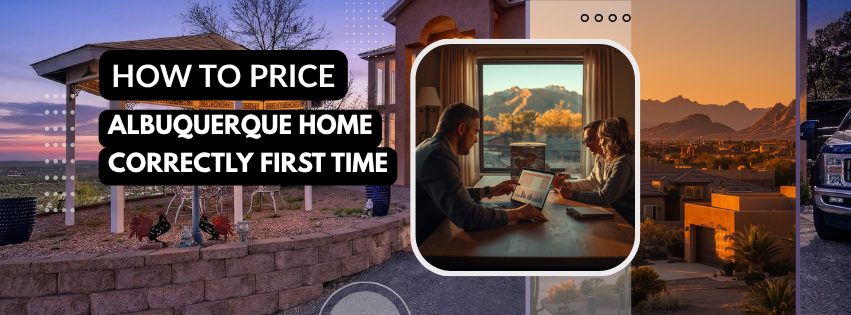
How to Price Your Albuquerque New Mexico Home Correctly the First Time
The price you set on your Albuquerque home on day one is the most consequential single decision in your entire selling process.
Not the staging. Not the photography. Not the marketing. Not the timing. All of those matter — but the price is the variable that determines whether your listing joins the 14-day under-contract group or the 107-day sitting-with-price-reductions group. The 2026 Albuquerque market is running both outcomes simultaneously. The difference between them almost always traces back to the pricing decision made before the listing went live.
This guide explains exactly how to make that decision correctly — with the specific methodology, the Albuquerque market data, and the New Mexico-specific knowledge that makes pricing here different from pricing in most other American markets.
The Albuquerque Market Numbers Every Seller Needs in 2026
- Median sale price (Redfin, April 2026 3-month period): $351,000, up 3.3% year over year. Appreciating but moderately — not the 15-20% annual gains of 2021.
- Median sale price per square foot: $214 (Redfin), up 1.4% year over year. The baseline price-per-square-foot reference for condition and feature adjustments.
- Average days on market: Approximately 40 days overall. Correctly priced, well-prepared homes still go under contract in 14 days. Overpriced listings accumulate 90-plus days.
- Sale-to-list price ratio:5% for sold homes — correctly priced homes are selling at essentially full list price.
- Price reduction rate: 38% of active listings have taken at least one price reduction — a direct measure of how many sellers are discovering after listing that their initial price exceeded what buyers would pay.
- Market Action Index:5 (week ending May 15, 2026) — a seller's market. The structural advantage is there for sellers who price correctly.
The critical insight: the market is genuinely favorable for sellers who price correctly, and genuinely penalizing for sellers who do not. The 38% taking price reductions are not in a different market from the sellers receiving 98.5% of list price. They are in the same market, making different pricing decisions.
The New Mexico Non-Disclosure Law — Why Pricing Here Is Different
Here is the Albuquerque-specific fact that most sellers discover too late: New Mexico is a non-disclosure state.
In non-disclosure states, sold prices are not publicly recorded in a way that is accessible to real estate websites, tax databases, or the general public. When Zillow, Redfin, or any automated valuation model estimates your home's value in New Mexico, it is working with incomplete information — because the actual sold prices that form the foundation of an accurate valuation are not available to those platforms the way they are in disclosure states.
"For New Mexico homeowners, especially those in Albuquerque and surrounding markets, understanding how CMAs work becomes even more critical. Our state's unique non-disclosure laws mean that the online tools most people rely on are working with incomplete information. These sites often lack sold price and tax records, which makes it harder to determine true fair market value," confirmed the New Mexico CMA and home valuation guide at my505home.com.
The practical implication: the only accurate pricing tool for your Albuquerque home is a Comparative Market Analysis built by a licensed agent with direct MLS access to actual sold prices — not a public database, not an algorithm, not an estimate generated from tax records that do not include the sold price.
When your Zestimate looks either high or low compared to what homes in your neighborhood are actually selling for, you are probably right to be skeptical. The Zestimate does not know what your neighbors' homes actually sold for. Your agent does.
What a Comparative Market Analysis Is — and Is Not
The Comparative Market Analysis (CMA) is the specific tool your listing agent uses to determine where your home should be priced. Understanding what goes into it and what its limitations are is the foundation of a correct first-price decision.
"A comparative market analysis (CMA) puts your home side-by-side against other recently sold properties that are similar in location, condition, and size," confirmed the HomeLight March 2026 house pricing strategies guide. "A deep dive into the subject property, including any recent photos and new features" combined with a pool of 10 to 12 comparables within a geographic radius gives the most reliable picture of current market value. The agent's expertise regarding which features add value — a well-maintained patio, a new bathroom — or adjust value down — an older roof, dated finishes — is specific to the neighborhood and depends on how nearby homes measure up.
What a CMA Includes
- Sold comparables within 60 to 90 days: Homes that have actually transacted — not listed, not expired — in your immediate area within a reasonable square footage range. In a changing market, tighten the window to 60 days to ensure the data reflects current conditions.
- Active listings in your price range: Your competition. Active listings sitting with 45-plus days on market without a contract are evidence of overpricing — they define the ceiling above which buyers are not engaging.
- Pending sales: The most current market signal available. Homes under contract but not yet closed reflect decisions made in the last few weeks — more current than closed sales. Your agent's MLS access provides this data.
- Price per square foot and condition adjustments: Once the per-square-foot range is established, condition and feature differences are adjusted — updated kitchen, mountain view, covered portal, school zone, lot size, and the age of Albuquerque-specific systems like roofing and evaporative cooling.
What a CMA Is NOT
- Not a Zestimate or AVM: In New Mexico specifically, automated valuations lack the sold price data that makes them reliable. A CMA from actual MLS data is categorically more accurate.
- Not what you need to net: What you need to pay off your mortgage or fund your next purchase is separate from what your home is worth to the current buyer pool. Pricing from need rather than market data is the specific mechanism that produces overpriced listings.
- Not what the home sold for in 2022: Historical sale prices are context, not current references. The 2022 price reflected the 2022 market — multiple offers, compressed timelines, appreciation-driven urgency. The 2026 price reflects today.
- Not the highest number any agent suggests: The agent who gives you the highest suggested price to win the listing is not necessarily the agent who will sell your home for the most money. A correctly priced listing produces faster, cleaner sales at data-supported prices.
The CMA Process — Step by Step
"Start by analyzing the subject property's historical value. Look at what it last sold for, when that occurred, and how the broader market has moved since then. Next, compare the sold prices of your comps line by line and note the price per square foot for each. If the market has been volatile, tighten your comp window to three to six months to avoid stale data. Then assess active and pending listings — how are similar properties priced right now, and how long have they been on the market?" confirmed the Luxury Presence April 2026 CMA methodology guide. The agent's local knowledge is what separates a CMA from an automated estimate: knowing that a property commands a premium because of the school district, a trail, or a view that is not captured in the comp data.
Step 1: Establish the Comparable Pool
The comparable pool starts with sold homes in your neighborhood within the past 60 to 90 days, within a reasonable square footage range (typically plus or minus 20%), and within a geographic boundary that reflects the specific micro-market where your home competes.
The geographic boundary matters more in Albuquerque than in markets with more uniform neighborhood character. A CMA for a home in the Bear Canyon corridor should not include comparables from Taylor Ranch — different school zones, different buyer pool, different character. A CMA for a Nob Hill bungalow should not include comparables from a Northeast Heights foothills home — different walkability, different buyer priorities, different premium structure. The right comparable is the home a buyer would seriously consider as an alternative to yours.
Step 2: Adjust for Differences
No two homes are identical. Once the comparable pool is established, each comparable is adjusted for specific differences:
- Square footage: Multiply the price-per-square-foot difference by the square footage difference.
- Kitchen and bathroom condition: An updated kitchen or bath commands a premium over dated equivalents. A reasonable adjustment range is $10,000 to $25,000 per room depending on quality and price range.
- Outdoor space: A covered portal with mountain views in the Northeast Heights is a significant premium feature. Albuquerque's climate makes covered outdoor space genuinely functional year-round — not a seasonal amenity.
- Albuquerque-specific system age: Documented new roof and recently serviced HVAC and evaporative cooler command a premium over homes with aging undocumented systems. The buyer who understands the cost of these replacements adjusts their offer accordingly — and the CMA should too.
Step 3: Identify the Range and Choose Your Position
Once adjustments are complete, a range emerges. The positioning decision within that range determines both speed and final price:
- Lower end of the comparable range: Generates the most showing activity in the first week. Increases the probability of multiple offers, which produces competing buyer behavior — often driving the final sale price higher through competition than an upper-range list price would have achieved sitting without offers.
- Middle of the range: Standard positioning. Good activity without the competition spike. Appropriate for well-prepared homes with consistent comparable data.
- Upper end of the range: Appropriate only when the home has a specific premium feature not captured by available comparables — a unique mountain view, permanent open space adjacency, a specific attribute the comp pool does not contain. Without that justification, upper-range pricing typically produces days-on-market accumulation and price reductions.
Albuquerque's Hyper-Local Price Variance — Why ZIP Code and Street Position Matter
Albuquerque is a market of micro-climates. The price per square foot in the 87122 ZIP code (North Northeast Heights) runs near $400 for premium properties. The price per square foot in the 87121 ZIP code (Southwest Mesa) runs closer to $135 to $155. The same square footage in these two ZIP codes commands prices that differ by a factor of nearly three.
More importantly: variation within a ZIP code is also significant. In the Northeast Heights foothills, a home backing to Cibola National Forest wilderness commands a premium over a comparable home four streets closer to the valley floor — because the wilderness adjacency is permanent. A CMA that does not account for this specific positional difference is not fully capturing relevant market value.
The specific Albuquerque pricing variables most frequently under-weighted in CMAs without deep local knowledge:
- School zone boundaries: The line between the La Cueva and non-La Cueva school zones is not visible from the street. Two homes a short distance apart can command meaningfully different prices based on school zone assignment alone.
- Mountain view orientation and quality: An unobstructed east-facing Sandia view from the main living areas commands a premium over a partially obstructed or north-facing orientation in the same subdivision.
- Trail and open space adjacency: Homes adjacent to Sandia foothills open space or the Elena Gallegos trail system command premiums that homes in the same neighborhood without that adjacency do not — and the CMA must include or exclude comparables based on whether they share this positional feature.
- Cul-de-sac versus through-traffic street: In family-oriented neighborhoods, a cul-de-sac position commands a safety and quiet premium. This real value difference requires an explicit adjustment when comparables are on different street types.
The Online Price Filter Effect — Pricing for How Buyers Actually Search
A practical consideration most sellers overlook: Zillow, Redfin, and Realtor.com present search results filtered by price range. Buyers search with maximum price thresholds in round numbers — $350,000, $400,000, $450,000. Where your price sits relative to these filter ceilings determines which buyer pool sees your listing.
A home priced at $402,000 does not appear in searches with a $400,000 maximum. The same home at $399,900 appears in both the $300,000-$400,000 and the $400,000-$450,000 search ranges — twice as much exposure from the same essential price point. The additional showing activity that filter-optimized pricing generates frequently produces a higher final sale price than the slightly-above-filter price achieves with a narrower audience.
Practical guidance: for homes in the $300,000 to $600,000 range, price at or just below the round number that captures the widest buyer pool rather than just above it to preserve a slightly higher asking number.
The 2026 Albuquerque Pricing Decision Checklist
Before setting your list price, confirm that each of the following has been answered from current data:
- Have you reviewed closed MLS sales within 60 days? Not a Zestimate, not a tax record — actual sold prices from your agent's MLS access.
- Are your comparables in the same school zone? Cross-zone comparisons without a school zone adjustment are a common source of pricing error in Albuquerque.
- Do your comparables share the same view orientation and open space adjacency? Positional features produce premiums that must be reflected in the comparable selection or the adjustment.
- Have you adjusted for roof, HVAC, and evaporative cooler age and condition? These Albuquerque-specific systems are the most common source of post-inspection renegotiation — price them in rather than discover them under contract.
- Is the price just below the relevant online search filter ceiling? The filter effect is real and produces measurable differences in showing activity.
- Are there active listings above your price that have been sitting 45-plus days? Those extended-market-time listings show exactly where buyer behavior stops engaging — your pricing ceiling reference.
- Does the price reflect what the market will pay, not what you need to net? Your financial needs are a planning input. The market data is the pricing input.
What Correct First-Time Pricing Produces
The specific sequence that correct first-price produces in the 2026 Albuquerque market:
- Week 1 — the momentum window: Buyer agents who have been tracking the market recognize a correctly priced listing immediately. Their clients schedule showings within the first several days. The listing generates the showing activity its preparation and price justify.
- Days 7 to 14: If the home's preparation matches its pricing — the combination that produces the best outcome — offers arrive in the first two weeks. The seller negotiates from a position of fresh market activity, no stigma, and genuine buyer interest.
- At contract: The correctly priced listing negotiates from strength. The sellers receiving 98.5% of list price in the current market are in this category.
- At inspection: A correctly priced listing that has disclosed known conditions arrives at the inspection phase without the renegotiation triggers that overpriced listings accumulate alongside their days-on-market count.
For sellers who want to understand the specific mistakes that produce overpricing in detail, our guide to the biggest pricing mistakes Albuquerque sellers make covers every mechanism. And for the complete preparation and marketing strategy that makes a correctly priced home sell as fast as the data suggests it should, our guide to how to sell your Albuquerque home fast in 2026 provides the full framework.
The Bottom Line — The First Price Is the Best Price, If It Is the Right Price
The goal is not to leave room to negotiate. The goal is not to test the market. The goal is to be the obvious choice in your price range on day one — correctly priced, well-prepared, and presented with the marketing that reaches the buyer who will recognize your home as the value it represents.
In New Mexico specifically, with non-disclosure law making online estimates less reliable than anywhere else in the country, the correct first price is the one built from MLS data by an agent who knows which comparable is truly comparable for your specific address. Not an algorithm. Not what you hope. The data, applied by someone who knows this specific market at the street level.
That is how you price your Albuquerque home correctly the first time. And pricing it correctly the first time is how you protect the equity you have spent years building.
Ready to Find Your Home's Correct Price?
Jenn & Vinay from The Rodgers Neighborhood Real Estate Group build data-driven CMAs for Albuquerque sellers from actual MLS sold data — accounting for school zone boundaries, mountain view orientation, trail adjacency, system age, and every hyper-local factor that determines where your specific home falls in the current market's range. If you want the right number, built from the right data, the conversation starts with a free valuation call.
Jenn & Vinay Rodgers are Albuquerque's trusted real estate professionals with The Rodgers Neighborhood Real Estate Group, brokered by Real Broker, LLC, serving buyers and sellers across Albuquerque, Rio Rancho, Corrales, Los Lunas, Tijeras, Cedar Crest, Sandia Park, the East Mountains, Bernalillo County, Sandoval County, and surrounding New Mexico communities.
The Rodgers Neighborhood Real Estate Group
Jenn & Vinay Rodgers
Real Broker, LLC
Albuquerque, NM
📞 505-417-2733
🏠 Get your free Albuquerque home valuationCategories
- All Blogs (331)
- 2026 & Beyond for Real Estate (227)
- Doctors and Nurses looking for homes in NM (4)
- Guide to buying a home in NM (146)
- Health Care Heros (7)
- Home Upgrades (40)
- Jenn & Vinay your Local Real Estate Experts! (112)
- Moving to Albuquerque (130)
- Neighborhoods in Albuquerque NM (89)
- Rent or Own (2)
- Sellers Questions for Selling homes (2)
Recent Posts



GET MORE INFORMATION