
Pros and Cons of Living in Albuquerque Before You Relocate
The most useful relocation guide is the honest one. A guide that only tells you about the Sandia Mountains at sunset, the green chile, and the Balloon Fiesta is a promotional piece. A guide that opens with the crime statistics and the public school rankings without the context that makes those statistics meaningful is incomplete in the other direction. This guide is neither.
Jenn and Vinay have been helping people relocate to Albuquerque for years. The people who thrive here are consistently the ones who understood the trade-offs before they arrived — who chose Albuquerque because of its specific combination of qualities, with clear eyes about the things it does not yet do well. The people who struggle are often the ones who arrived with expectations that the city as a whole cannot currently meet.
This guide covers both sides fully. Read it as someone who wants the city to succeed, because it deserves honest advocates more than it needs promotional cheerleaders.
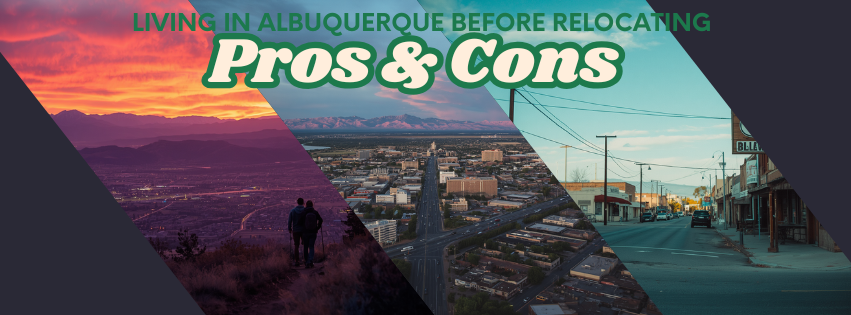
The Pros — What Albuquerque Does Genuinely Well
Pro 1 — Affordability That Is Transformative for Buyers From High-Cost Markets
Albuquerque's affordability is the most commonly cited relocation driver, and the data supports the enthusiasm: the cost of living runs approximately 4-8% below the national average. "New Mexico is the second most affordable state in the western half of the United States. Housing is way below the national average, utilities are less expensive here, as are groceries, and most everyday items," confirmed The Honest Local's New Mexico pros and cons guide (April 2026).
The affordability advantage is most meaningful for buyers arriving from higher-cost markets. At Albuquerque's $351,000 median home price, the buyer leaving Los Angeles ($850,000+ median), Denver ($580,000+ median), or Seattle ($750,000+) is not simply saving money — they are accessing a category of homeownership (single-family, yard, covered portal, mountain view) that their origin market price point makes impossible. The financial transformation of the high-cost-to-Albuquerque move is one of the most consistently positive relocation outcomes in the current American housing market.
Pro 2 — 310 Days of Sunshine and a High-Altitude Desert Climate
Albuquerque averages 310 days of sunshine per year — the second-sunniest state in America. "Having lived on the east coast as well as the pacific northwest, I did not realize the effect that sun really plays on your mood until leaving New Mexico and then coming back. What a game changer! Just knowing the sun will come out tomorrow makes all the difference," confirmed The Honest Local's New Mexico guide. The city's 5,280-foot altitude produces cooler summers than Phoenix and milder winters than Denver — a climate that many residents describe as the most consistently pleasant they have lived in.
The climate specifics that matter for relocation planning:
- Summers: July and August reach 90-95 degrees in the afternoon. The high altitude makes the heat more tolerable than equivalent temperatures at sea level, and the monsoon season (July-September) produces afternoon thunderstorms that break the heat and produce the dramatic electrical sky that New Mexico is photographed for. Morning temperatures even in summer are often comfortable for outdoor activity.
- Winters: Average January highs in the mid-40s to low 50s. Snow falls occasionally in the valley and melts quickly. The mild winter that does not confine residents indoors is a specific quality-of-life advantage over northern markets.
- Spring: Beautiful but windy — addressed in the cons section.
- Fall: Albuquerque's best season. The temperature moderation, the balloon festival in October, and the cottonwood color in the bosque produce the specific New Mexico fall experience that long-term residents most consistently cite as why they stay.
Pro 3 — The Sandia Mountain Outdoor Lifestyle
The Sandia Mountains rising 5,000 feet above the valley floor within the city limits is not a metaphor for Albuquerque's outdoor access — it is the literal description of the outdoor access available to Northeast Heights residents from their neighborhood streets. The 200+ miles of foothills trails, the Sandia Peak Aerial Tramway (3.5 miles, the longest in North America), the ski area accessible in 30-45 minutes, and the wilderness hiking within 15 minutes of residential streets produce an outdoor lifestyle that is in practice rather than aspiration.
Combined with the 16-mile Paseo del Bosque Trail through the Rio Grande cottonwood forest, the volcanic petroglyph escarpment, and the regional access to White Sands, Carlsbad Caverns, and the Jemez Mountains within 1-3 hours, Albuquerque's outdoor lifestyle rivals any American city of comparable size.
Pro 4 — Cultural Richness That Is Genuine, Not Performed
Albuquerque is rated highly for diversity and cultural richness. "You should move to Albuquerque if you value an affordable cost of living, easy access to outdoor recreation, or are looking for jobs in entertainment... ABQ is often best for outdoor enthusiasts, young professionals breaking into the film industry, families, and retirees," confirmed Extra Space Storage's pros and cons of living in Albuquerque guide (March 2026). More than 70 different ethnicities call Albuquerque home.
The city's cultural character is built on 700 years of continuous occupation by Pueblo peoples, Spanish colonial settlement since 1706, and the Route 66 frontier American culture that overlaid both. The result is a cultural depth that is specifically not manufactured for tourism — the Indian Pueblo Cultural Center is owned by the 19 Pueblos, the New Mexican cuisine took 500 years to develop, and the Old Town plaza has been the city's center since 1706. This authentic character is what most relocation guides mean when they describe Albuquerque as having "something different."
Pro 5 — New Mexican Cuisine Is Genuinely Irreplaceable
New Mexican food is not a variant of Mexican food or Southwestern food. It is a specific culinary tradition — 500 years of indigenous, Spanish, and settler cooking in a cuisine that exists nowhere else. The Hatch green chile, the blue corn tortillas, the red chile stew, the sopapilla, the Christmas order (red and green both) — these are the specific tastes that long-term Albuquerque residents most consistently miss when they leave.
The restaurant quality at the affordable end — the Frontier's breakfast burrito, Sadie's enchiladas, Garcia's Kitchen, El Pinto's covered portal — is among the best value in American dining. The price for a genuinely excellent, culturally specific meal in Albuquerque is substantially below what comparable quality costs in coastal markets.
Pro 6 — Major Institutional Employment Anchors
Sandia National Laboratories (12,000+ employees), Kirtland Air Force Base, Intel's $3.5 billion expanding Rio Rancho facility, UNM Health Sciences Center, and Presbyterian Healthcare provide stable, well-compensated professional employment that is specifically resistant to the private sector volatility affecting other Sun Belt markets. The Sandia/Kirtland/Intel employment ecosystem is one of the highest average-salary employment clusters in the American Southwest.
Pro 7 — The Balloon Fiesta and the Annual Event Calendar
The Albuquerque International Balloon Fiesta is the world's largest hot air balloon festival — 700+ balloons, nine days in October, the Albuquerque Box atmospheric phenomenon that makes the event specifically possible here and nowhere else at this scale. For residents, October in Albuquerque is the month that confirms everything they decided when they moved here.
The broader annual calendar — the State Fair, the Route 66 Summerfest, the First Friday ARTScrawl every month, the December luminaria walk in Old Town, the bosque cottonwood color in October — produces a community event rhythm that is consistently cited by long-term residents as one of the things that made Albuquerque feel like home.
Pro 8 — The Film Industry and Creative Economy
Albuquerque is one of the top five film production cities in the United States, with ABQ Studios, Netflix's major local facility, and the state's competitive film incentive program drawing major productions including Breaking Bad, Better Call Saul, The Avengers, and hundreds of others. For professionals in the creative industries — film, television, photography, music — Albuquerque provides a genuinely productive working environment with significantly lower cost of living than Los Angeles.
Pro 9 — The Community Character: Small Town Warmth in a City of 560,000
Multiple relocation guides cite Albuquerque's community warmth as one of the most pleasant surprises — a city of more than half a million people where neighbors know each other, where strangers greet on trails, and where the social character of a community that is genuinely invested in its place is consistently available. This is not a universal experience — it reflects the specific neighborhoods where this character is most present — but it is real and it is one of the qualities that makes long-term residents most reluctant to leave.
The Cons — What Albuquerque Does Not Do Well (Yet)
Con 1 — Crime: The Most Significant Concern, With Essential Context
The honest answer: Albuquerque's crime statistics are real. The city has consistently ranked among the higher-crime American cities in national comparisons, with property crime (vehicle theft, burglary) and some categories of violent crime above the national average. This is not inflated or manufactured concern — it is accurate citywide data.
The essential context that most national rankings omit: the citywide statistics mask dramatic neighborhood-level variation. The Northeast Heights neighborhoods where most professional and family buyers settle — the La Cueva zone, the foothills area, the Ventana Ranch and Nob Hill communities — have crime rates that are well below the national average and that do not resemble the citywide numbers. The Bear Canyon neighborhood, for example, is specifically cited as low-crime and community-focused even in guides that acknowledge the citywide concern.
The improvement trend: the city has implemented the Metro Crime Initiative, the Albuquerque Community Safety program (civilian-led crisis response), the Violence Intervention Program, and the Rapid Accountability Diversion program. The trend line on multiple crime categories has moved in the right direction in recent years, though from a high base.
The practical implication for relocating buyers: choose neighborhoods with specific crime data research using tools like CrimeGrade.org for the specific address rather than relying on citywide statistics. The citywide number describes a city that includes high-crime areas where most professional buyers do not choose to live.
Con 2 — Car Dependence: A City Without Meaningful Transit
Albuquerque's Transit Score of 29 is the most straightforward single number in the pros and cons analysis. The city was built for and around the automobile, and its transportation infrastructure reflects that design choice. The public bus system (ABQ Ride) operates on limited schedules with limited coverage. The New Mexico Rail Runner commuter train connects Albuquerque to Santa Fe and Belen but does not serve most of the city's residential neighborhoods.
The practical consequence: a person who cannot drive, who prefers not to drive, or who is planning for a future in which driving becomes difficult will find Albuquerque's transit infrastructure frustrating. A car is not optional for most daily life in most Albuquerque neighborhoods. The exceptions — Nob Hill's Walk Score 85 provides limited car-optional living, the Central Avenue Rapid Ride connects a few walkable neighborhoods — are real but limited.
For buyers who are specifically anticipating a car-free or car-light future, this is a genuine limitation that should factor into the neighborhood selection decision.
Con 3 — The Private Sector Job Market Is More Limited Than Comparable Sun Belt Cities
Albuquerque's economy is heavily weighted toward government, military, research, and healthcare — stable and well-compensated sectors, but a narrower private sector ecosystem than Denver, Phoenix, or Austin. The variety of tech companies, corporate headquarters, and startups that produce the career optionality of those markets is more limited here.
The specific consequence: Albuquerque retains its UNM graduates at lower rates than its competitors because the private sector job market does not produce the early-career opportunities that a newly graduated professional needs to advance. Young professionals who have built a career in the Sandia/Kirtland/Intel/UNM ecosystem have excellent opportunities; young professionals who need a diverse private sector job market to build a career may find Albuquerque limiting.
This is the honest context for the outbound migration among young adults that exists alongside the inbound migration from higher-cost markets.
Con 4 — Spring Wind: The Persistent Seasonal Challenge
"The wind in spring is relentless," confirmed The Honest Local's New Mexico guide. March through May in Albuquerque brings persistent, sometimes fierce wind from the west and southwest — gusts of 25-40 mph are common, with occasional gusts exceeding 60 mph. Dust storms reduce visibility. Outdoor plans are disrupted. The beautiful spring wildflower season that follows is genuinely worth it, but the spring wind is the Albuquerque weather challenge that most visitors are unprepared for.
The specific advice: visit Albuquerque in March or April, not just in October or April's pleasant weeks. If the spring wind is something you cannot tolerate — if it genuinely affects your mood and your outdoor enjoyment rather than being a manageable inconvenience — that is important information to have before committing to a move.
Con 5 — Public Schools: The State Context Matters
New Mexico public schools rank near the bottom nationally on standardized measures of educational outcome. The state's education system is a genuine challenge that affects the experience of families with school-age children and that reflects structural underfunding and educational governance issues that the city and state are working to address.
The essential neighborhood-level context: within Albuquerque, the school quality varies dramatically. La Cueva High School (GreatSchools 8/10), Eldorado High School (GreatSchools 8/10), and Desert Ridge Middle School (GreatSchools 9/10) are well-rated by national standards — not just by New Mexico standards. The family buyer who chooses the Northeast Heights La Cueva zone is accessing schools that compare favorably to suburban schools in most American markets, despite the state's overall ranking.
The bottom line: the state average does not describe the experience of a family in the La Cueva zone. But it does describe the experience of a family in many other Albuquerque neighborhoods. School zone research for any specific property is essential, not optional.
Con 6 — Air Quality: Seasonal Challenges in a Valley Location
Albuquerque sits in the Rio Grande valley, and on days when the atmospheric conditions produce temperature inversions, air pollutants and smoke can become trapped in the valley. Wildfire season (typically late spring through early fall) produces smoke events from fires in New Mexico and neighboring states that can significantly reduce air quality for days at a time.
Seasonal allergens are an additional challenge: juniper, mulberry, and elm trees produce high pollen counts in late winter and spring. Residents with respiratory conditions or severe allergies should specifically research Albuquerque's air quality data for the months most relevant to their sensitivity.
The practical preparation: AQI monitoring apps provide real-time air quality data. The majority of Albuquerque's days — particularly outside of wildfire season — produce excellent air quality at high altitude with low humidity. The challenge is specific to wildfire smoke events and spring pollen season rather than chronic.
Con 7 — Limited Late-Night Economy and Downtown Activation
Albuquerque's nightlife and downtown activation are the dimensions of urban life where the city's size most limits the experience relative to larger markets. Restaurants close earlier than in coastal cities. Downtown's after-hours energy has been improving but is not yet at the density that makes it a consistently vibrant evening destination across the week.
The Nob Hill and Central Avenue corridor provides the most concentrated evening dining and entertainment in the city, but it is a neighborhood corridor rather than a city-wide nightlife ecosystem. For residents who value a rich 11pm-2am city environment, Albuquerque's current late-night offering is limited.
Con 8 — The Dry Climate's Physical Demands
Low humidity produces specific physical challenges that residents from more humid climates consistently mention: dry skin, chapped lips, nosebleeds, and dehydration that occurs more rapidly than in humid environments. The first weeks in Albuquerque for arrivals from the Midwest or East Coast often include a period of physical adjustment to the dry air.
The long-term adaptation: most residents adjust within weeks to months, develop habits (water intake, moisturizing, humidifiers in homes) that manage the dry climate effectively, and eventually come to find the low humidity specifically preferable to the heavy air of humid climates. The initial adjustment is real and worth anticipating.
The Decision Framework — Is Albuquerque Right for You?
Based on the pros and cons in this guide, Albuquerque is likely an excellent fit if:
- You are moving from a high-cost market and the housing price differential is genuinely transformative for your household's financial situation
- Your outdoor lifestyle centers on hiking, trail running, mountain biking, skiing, or cycling, and you want daily access rather than weekend access
- You work at or are hired by Sandia National Laboratories, Kirtland AFB, Intel, UNM, or the healthcare systems — the institutional employment that anchors the city's professional economy
- You specifically value authentic cultural character over manufactured urban amenities, and the Native American and Hispanic cultural depth of the city appeals to you
- You are a retiree whose specific combination of needs — sunshine, mild winters, Social Security tax exemption, active outdoor lifestyle, affordable housing — is served by the city's package
- You are a remote worker whose income is calibrated to a higher-cost market and who wants to maximize what that income purchases in quality of life
Albuquerque may not be the right fit if:
- Your career requires a diverse, dynamic private sector job market and early-career opportunity that Albuquerque's government-and-research-heavy economy does not currently provide at comparable depth
- You specifically need car-free or car-light daily living and cannot tolerate the city's car-dependent infrastructure
- The spring wind is something you cannot tolerate — visit in March before committing
- You have significant respiratory conditions that would be affected by periodic poor air quality during wildfire season
- You require a late-night urban entertainment ecosystem as part of your daily quality of life
For the complete cost-of-living picture that underlies the affordability pro — the specific category-by-category breakdown and the comparison to the markets most relocating buyers are leaving — our Albuquerque cost of living guide for 2026 covers the full analysis. And for family buyers who are evaluating the school quality con in specific terms — which Albuquerque neighborhoods have the strongest public schools — our guide to the best family-friendly neighborhoods near Albuquerque schools covers the La Cueva zone and the full neighborhood-school matrix.
The Honest Summary — A Genuinely Good City With Genuine Limitations
Albuquerque is not the perfect city. No city is. It has a crime challenge that requires neighborhood-specific research. It has a public school system whose state-level ranking understates the quality available in specific zones but accurately describes the experience in others. It has a car-dependent infrastructure that limits mobility options. It has a private sector job market that is more limited than comparable Sun Belt cities.
It also has 310 days of sunshine. A mountain you can Tramway to from the city. A cuisine that does not exist anywhere else. An authentic cultural heritage that 700 years of continuous occupation produces and that no marketing campaign can manufacture. A housing price that still, in 2026, allows a professional household to own a single-family home with a yard and a covered portal and a view of the Sandia Mountains at a price that produces genuine financial freedom rather than financial stress.
The people who move here and thrive are the ones who read both columns in the pros and cons list, made the decision with clear eyes, and arrived knowing what they chose and why. Those people tend to stay. They tend to stop asking whether they made the right choice. The mountain at sunset, every evening, answers the question without being asked.
Thinking About Relocating to Albuquerque?
Jenn & Vinay from The Rodgers Neighborhood Real Estate Group have guided hundreds of buyers through the relocation decision with the honest, neighborhood-specific knowledge that generic pros and cons guides cannot provide — including which specific neighborhoods have the crime rates that the citywide statistics obscure, which school zone assignments matter for which family priorities, and which community character best matches each buyer's specific lifestyle. The conversation about whether Albuquerque is right for you starts with a call.
Jenn & Vinay Rodgers are Albuquerque's trusted real estate professionals with The Rodgers Neighborhood Real Estate Group, brokered by Real Broker, LLC, serving buyers and sellers across Albuquerque, Rio Rancho, Corrales, Los Lunas, Tijeras, Cedar Crest, Sandia Park, the East Mountains, Bernalillo County, Sandoval County, and surrounding New Mexico communities.
The Rodgers Neighborhood Real Estate Group
Jenn & Vinay Rodgers
Real Broker, LLC
Albuquerque, NM
📞 505-417-2733
🏠 Browse Albuquerque homes — see the city that might be your next chapterCategories
- All Blogs (352)
- 2026 & Beyond for Real Estate (246)
- Doctors and Nurses looking for homes in NM (4)
- Guide to buying a home in NM (158)
- Health Care Heros (7)
- Home Upgrades (40)
- Jenn & Vinay your Local Real Estate Experts! (120)
- Moving to Albuquerque (135)
- Neighborhoods in Albuquerque NM (93)
- Rent or Own (2)
- Sellers Questions for Selling homes (2)
Recent Posts




GET MORE INFORMATION