

Common Pitfalls That Can Delay Selling Your Albuquerque Home
DISCLAIMER: This guide covers common seller pitfalls based on Albuquerque market experience and industry research. Every transaction is different. This is informational content only — always consult with your licensed real estate agent and legal/financial professionals before making decisions about selling your home.
Selling delays in Albuquerque's 2026 market almost never come from the market itself — the city's 2.25 months of supply, the MAI of 43 (seller's market), and the consistent buyer demand from out-of-state relocation are structural supports that sustain transaction volume. The delays come from seller decisions — mostly preventable decisions — that extend time-on-market, trigger buyer concession requests, or in the worst cases cause transactions to fail at closing. This guide covers the 15 most common.
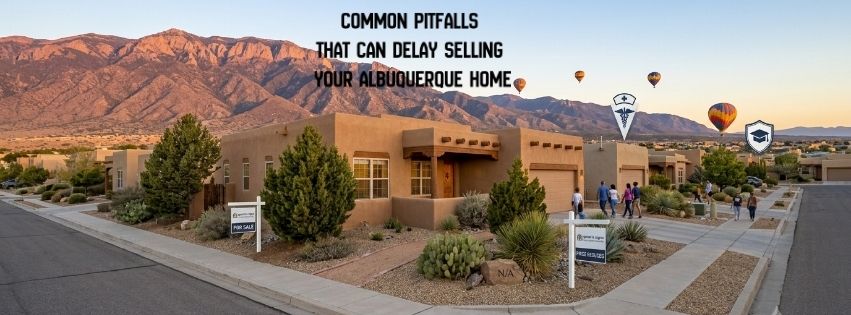
The 2026 Albuquerque Market Context — Why These Pitfalls Matter More Now Than in 2021-2022
"Today's buyers compare closely and negotiate more. Homes that miss the mark on price, condition or flexibility risk losing interest quickly. Sellers making moves today have adjusted their mindset and selling strategy to match the current real estate market. Inventory has increased and is expected to do so throughout 2026," confirmed a March 2026 seller guide to common mistakes in the current market.
The numbers that define why these pitfalls matter in 2026:
- 51% of Albuquerque homes closed below asking price (June 2026, SWMLS): The market is not automatically forgiving of seller mistakes the way 2021-2022 was. Buyers negotiate.
- 38-40% of active listings have price reductions: Most price reductions are the consequence of the first pitfall on this list — overpricing at launch.
- Correctly priced homes go pending in 12-19 days: The seller who avoids all 15 pitfalls achieves a 12-19 day sale. The seller who falls into multiple pitfalls adds weeks or months to that timeline.
- The stigma of time-on-market: In Albuquerque's 2026 market, a home that has been listed for 45 days with no offer has acquired a visible history. Buyers ask why. Price reductions are noticed. The longer the home sits, the more the seller's negotiating leverage deteriorates.
Pre-Listing Pitfalls — Decisions Made Before the Home Goes on the Market
Pitfall 1 — Overpricing at Launch (The Most Costly Single Mistake)
DELAY RISK: 30-60+ additional days on market; 5-15% lower final sale price than correct launch pricing.
The most consistently damaging seller decision in any Albuquerque market cycle: launching the listing at a price that is above what the current buyer pool will support. In 2026, overpriced homes in Albuquerque average 60-90 days on market before price reductions produce an offer — versus the 12-19 day timeline for correctly priced homes. The mathematics are specific: a home that launches at $385,000 when $355,000 is the correct market price and reduces to $360,000 after 45 days of no activity achieves a lower final price ($350,000-$355,000 after negotiation) and more time on market than a home that launched at $355,000 and sold in 18 days.
- The Zestimate problem: New Mexico is a non-disclosure state — sale prices are not automatically public record. Zillow's Zestimate, which depends on transaction data, is specifically less accurate in Albuquerque than in disclosure states. An Albuquerque seller who prices based on their Zestimate is pricing on incomplete data. MLS-based comparable sales — which are available to licensed agents and reflect actual closed transactions — are the correct basis for Albuquerque pricing.
- The 2021-2022 peak expectation problem: Sellers who purchased in 2019-2020 and remember the 2021-2022 appreciation surge often hold a mental price that was achievable then and is not achievable now. The Albuquerque market in 2026 is a seller's market — but not the frenzied 2021-2022 seller's market. The $430,000 that the home down the street "got" in 2022 is not the comp that defines 2026 value.
Pitfall 2 — Not Ordering a Pre-Listing Inspection
DELAY RISK: 7-21 day renegotiation or deal collapse at inspection; $5,000-$20,000 in unexpected concessions.
The home inspection is the single transaction event most likely to produce a delay, a price renegotiation, or a deal collapse — and it is also the event whose findings the seller could have addressed proactively before listing. A seller who orders a pre-listing inspection discovers what the buyer's inspector will find, addresses the items before the buyer engages, and lists with a clean inspection report as a marketing tool rather than a liability. A seller who skips the pre-listing inspection discovers the same items 30 days into the contract during the buyer's inspection — from the weakest negotiating position in the transaction.
Pitfall 3 — Deferred Maintenance That Buyers Read as an Iceberg Signal
"Avoid common appraisal and closing delays: problems like missing stair handrails, broken windows, plumbing leaks, and missing smoke detectors are frequent red flags. When these hazards are identified, the lender will likely mandate that repairs be completed before they approve the buyer's mortgage loan, delaying the closing by days or even weeks," confirmed The Pinnacle List's guide to common appraisal mistakes that delay home sales.
The deferred maintenance issue is not primarily about the repairs themselves — it is about what buyers conclude when they see evidence of deferred maintenance. A dripping faucet, a loose doorknob, a broken window screen, a burned-out porch light, and scuffed baseboards are each individually minor. Together, they communicate that the home has not been cared for — and that the problems the buyer can see are probably not the only ones. Every visible deferred maintenance item gives buyers permission to negotiate more aggressively and to scrutinize the home more skeptically.
The Albuquerque-specific deferred maintenance items that buyers consistently flag: the swamp cooler that has not been serviced or winterized in years, the flat roof with visible aging or cracking in the elastomeric coating, the HVAC filter that has not been replaced (visible at inspection), and the weatherstripping that is missing on the portal door. Each of these is a $50-$500 repair that produces a $1,000-$5,000 buyer credit request if not addressed.
Pitfall 4 — The Swamp Cooler at Premium Price Points ($350,000+)
DELAY RISK: 10-20 additional days on market; $5,000-$15,000 in conversion credits or price reduction.
This is the most specifically Albuquerque pitfall on this list. At the $350,000-$500,000+ price tier, the swamp cooler is the most consistent single buyer objection — specifically from relocation buyers arriving from California and Texas where evaporative cooling is uncommon or unknown. The buyer who encounters a swamp cooler in a $400,000 Northeast Heights home often responds with one of three outcomes: lower offer to account for the conversion, credit request, or withdrawal of interest.
The seller who lists a $400,000 Northeast Heights home with a swamp cooler and assumes buyers will accept it is specifically misreading the 2026 buyer demographic — the out-of-state buyers who are specifically driving demand in the Northeast Heights premium tier and who specifically do not know how to use or maintain evaporative cooling. The $8,000-$12,000 swamp cooler conversion before listing typically produces a $10,000-$15,000 price premium and faster sale at the premium tier.
Pitfall 5 — Poor or Inadequate Listing Photography
DELAY RISK: Fewer showings scheduled; longer time-on-market before an offer.
Ninety-five percent of Albuquerque buyers see the listing photos before they schedule a showing. Poor listing photography — dark rooms, cluttered surfaces, amateur-level composition, no staging — eliminates the home from consideration before the buyer ever drives to the address. A home that is photographed with a smartphone in poor lighting looks like a less desirable home than the same property photographed by a professional photographer with proper lighting and staging, regardless of the actual condition.
- The standard for Albuquerque's 2026 market: Professional photography ($150-$350) with drone exterior shots ($100-$200 additional) is the baseline expectation for listings at or above $250,000. Virtual tours and 3D walkthroughs are increasingly expected at $400,000+. A home listed without professional photography in a price tier where every comparable listing has professional photography is specifically at a disadvantage before a single buyer views the listing.
Pitfall 6 — Listing on the Wrong Day
DELAY RISK: Missing the peak showing window; lower initial view count.
Real estate data consistently shows that listings launched on Thursday or Friday achieve the highest first-weekend showing traffic — because buyers typically schedule weekend showings on Thursday and Friday evenings. A listing launched on Monday morning misses four days of the pre-weekend scheduling window. A listing launched on Thursday generates Friday scheduling activity and full-weekend showing traffic. In Albuquerque's market where the first 10-14 days are the most critical for generating offers, launching on the optimal day produces meaningful advantage.
Transaction Pitfalls — Delays That Occur After Going Under Contract
Pitfall 7 — The Flat Roof Inspection Finding
DELAY RISK: 7-21 day renegotiation; $5,000-$15,000 credit request or price reduction.
The flat roof inspection finding is the most consistently Albuquerque-specific transaction delay cause. Pre-2000 Pueblo Revival and Southwest-style homes throughout the city have flat or low-slope roofs that require periodic elastomeric coating — typically every 5-7 years. An aging or cracked flat roof coating consistently appears as a major finding in buyer inspections, producing credit requests that range from $5,000 (minor recoating needed) to $15,000+ (significant moisture penetration visible from inside).
The seller who recoated the flat roof before listing for $2,000-$8,000 presents a clean roof inspection and eliminates the buyer's most significant negotiating point. The seller who did not recoat discovers the issue at the buyer's inspection and negotiates from the weakest possible position — in contract, with the buyer's leverage maximized.
Pitfall 8 — Missing or Non-Compliant Smoke and CO Detectors
DELAY RISK: 3-14 day delay for FHA or VA financing; potential deal collapse.
FHA and VA loan programs — which serve a significant portion of Albuquerque's buyer market, especially first-time buyers and military families — specifically require operational smoke detectors on every level of the home and carbon monoxide detectors where applicable. An appraiser working an FHA or VA appraisal who identifies missing or non-functional smoke detectors will condition the appraisal on repair before loan approval — meaning the sale cannot close until the seller replaces the detectors, provides evidence of replacement to the lender, and the lender re-reviews the compliance documentation.
The fix: $15-$30 per smoke/CO detector. The delay: 5-14 days while the lender processes the compliance documentation. The Albuquerque-specific context: the Kirtland AFB buyer demographic specifically uses VA financing at high rates. A home that triggers a VA appraisal condition for missing smoke detectors has specifically chosen the most common buyer demographic's loan type to delay.
Pitfall 9 — Unpermitted Improvements
DELAY RISK: Transaction collapse; 30-90 day delay while permits are obtained; sometimes permanent title issues.
Albuquerque's median housing stock was built in 1977 — meaning the average home has been owned by 3-4 different parties, each of whom may have made improvements, additions, or modifications to the property. Improvements made without building permits — a converted garage, an added bedroom, a deck or portal extension, a room addition — create specific title and financing issues when they surface during the transaction.
- How unpermitted work is discovered: Title companies research permit records as part of the title examination. Lenders order appraisals that compare the appraised square footage to the county assessor records. A discrepancy between the listed square footage and the assessor's permitted square footage triggers investigation. An unpermitted room addition that adds 400 square feet to the assessed living area is a significant discrepancy that the appraiser must note.
- The resolution options: Retroactive permitting (available for some improvements, not others, through the City of Albuquerque Development Services) or disclosure and price adjustment. Neither is quick. A 30-90 day retroactive permitting process while the property is in contract is not a comfortable situation for buyer or seller.
- The prevention: Order a pre-listing title search and verify that all improvements on the property have been disclosed in the seller's property disclosure statement. If unpermitted improvements exist, address them before listing rather than after a buyer discovers them.
Pitfall 10 — The Appraisal Gap in New Mexico's Non-Disclosure Environment
DELAY RISK: Deal collapse if buyer cannot finance the gap; 7-21 day renegotiation delay.
The most specifically New Mexico pitfall in the transaction: the appraisal that comes in below the contract price. New Mexico's non-disclosure status means that the appraiser uses MLS data (accessible to licensed appraisers) rather than public records — but the AVM tools that sellers may have used to price their home (Zillow, Redfin, Realtor.com) are working with less complete data than the appraiser. A seller who priced based on an AVM estimate rather than MLS-based comps is at specific risk of the appraisal not supporting the contract price.
- The outcome when the appraisal gap occurs: The lender will only finance the appraised value. If the contract price is $380,000 and the appraisal comes in at $355,000, the buyer's lender will only finance against $355,000. The buyer must either: (1) make up the $25,000 gap in cash; (2) negotiate the seller down to the appraised value; or (3) exercise the appraisal contingency and walk away. Most buyers without significant cash reserves choose option 2 or 3 — both of which delay or kill the transaction.
Pitfall 11 — The NM Purchase Contract Independent Consideration Deadline
DELAY RISK: Automatic contract void if missed; lost earnest money for the buyer; transaction must restart from scratch.
The New Mexico residential purchase contract requires the buyer to deliver a small payment (the Independent Consideration — typically $100-$500 as specified in the contract) to the seller within 3 business days of the contract being executed. If this payment is not delivered within the specified window, the contract automatically voids — no notice required from either party. The seller loses the contract and must relist; the buyer loses their earnest money.
The seller's role: confirm with your agent on the day the contract is executed that both parties understand the Independent Consideration deadline and that the buyer's agent has been made aware of it. This is a New Mexico-specific contract provision that agents from other states may not be familiar with, and buyers arriving from California and Texas specifically may not have encountered it.
Pitfall 12 — Seller Unavailability During the Critical Offer Window
DELAY RISK: Lost offers; reduction in multiple-offer potential.
Correctly priced Albuquerque homes in desirable neighborhoods go pending in 12-19 days. During those 12-19 days, the seller must be available to receive offers, review them promptly, and make counter-offer decisions within reasonable timeframes. A seller who is traveling internationally and unreachable for 72 hours after an offer is submitted has given the buyer — whose rate lock is ticking and whose patience has limits — 72 hours to reconsider and potentially withdraw.
The prevention: before listing, ensure your agent has clear instructions for offer communication and that you have made arrangements to be reachable during the first 2-3 weeks of the listing. For sellers who are difficult to reach, grant your agent clear guidance on acceptable terms so that response times do not cost offers.
Post-Contract Pitfalls — Decisions That Affect Closing
Pitfall 13 — Not Disclosing Known Material Defects
DELAY RISK: Post-closing legal liability; deal collapse if discovered during inspection; potential fraud claim.
New Mexico's seller disclosure law requires sellers to disclose all known material defects on the Residential Real Property Disclosure Statement. A seller who knows the flat roof leaks into the back bedroom and does not disclose it has created legal exposure that survives the closing. If the buyer discovers the undisclosed defect after closing — through water damage, through inspection of their own, or through conversation with a neighbor — the seller faces potential legal action for non-disclosure.
In addition to the legal exposure, undisclosed defects discovered during the buyer's inspection — after the seller's disclosure indicated "no known issues" — create the most adversarial negotiating environment available. A buyer who discovers that the seller knew about a problem and did not disclose it is in the mindset of maximum concession demand or walking away, not cooperative resolution.
Pitfall 14 — Not Having the Next Move Planned Before Listing
DELAY RISK: Closing extension request jeopardizes buyer's rate lock; buyer walks.
The seller who accepts an offer without having a destination lined up — a purchase in process, a rental secured, or a temporary housing arrangement made — is creating a closing extension scenario that the buyer did not agree to. A buyer whose rate lock expires 45 days from the contract date needs to close on day 45. If the seller's new home closes on day 60, the seller needs a 15-day extension from a buyer who cannot extend without risking their rate.
The prevention: before listing, confirm your next move. If you are buying your next home simultaneously, work with your agent on the contract language that protects both transactions. If you are renting temporarily, secure the rental before you accept an offer so that closing can proceed on schedule.
Pitfall 15 — Overreacting to the First Low Offer
DELAY RISK: Loss of the transaction that could have been successfully negotiated.
"If you want to sell your home fast and for the right price, avoid these pitfalls. The housing market is cooling in many areas of the country, and it could take weeks or months to sell a home. Using a real estate agent can ensure that your home is priced and marketed appropriately," confirmed U.S. News Real Estate's July 2026 seller mistakes guide.
In Albuquerque's 2026 market where 51% of homes close below asking price, the first offer a seller receives is rarely the offer they want — it is the opening of a negotiation. The seller who rejects rather than counters a below-asking offer has not ended the negotiation; they have potentially ended the relationship with the only buyer who chose to engage with their property. A low offer countered professionally and calmly is the foundation of a successful transaction. A low offer rejected without a counter is a buyer walking.
The seller's perspective: an offer below asking price in a market where 51% of closings are below asking is not an insult. It is the market speaking. The correct response is a counter-offer that expresses the seller's terms clearly and professionally, leaving the buyer with an invitation to continue negotiating rather than a rejection that ends the conversation.
The 15 Pitfalls — Quick Reference by Stage
- Pre-listing: Overpricing at launch | No pre-listing inspection | Deferred maintenance unaddressed | Swamp cooler at premium tier | Poor listing photography | Wrong listing day
- In-transaction: Flat roof inspection finding | Missing smoke/CO detectors (FHA/VA) | Unpermitted improvements | Appraisal gap from AVM pricing | NM Independent Consideration deadline missed | Seller unavailable during offer window
- Post-contract: Undisclosed material defects | No next-move plan | Rejecting rather than countering the first low offer
For the complete pre-listing preparation guide — the items sellers most consistently overlook before the listing goes live — our post on what Albuquerque sellers overlook before listing covers the full pre-listing checklist. And for the complete guide to selling your Albuquerque home fast — the pricing, presentation, and marketing approach that produces 12-19 day sales — our post on how to sell your Albuquerque home fast in 2026 covers the complete fast-sale guide.
The Bottom Line — Every Pitfall on This List Is Preventable
The 15 pitfalls in this guide share one characteristic: all of them are preventable with information and preparation. The overpricing that creates a 90-day listing history is prevented by MLS-based comparable analysis rather than Zestimate pricing. The flat roof inspection finding is prevented by a $3,000 recoating before listing rather than a $10,000 buyer credit after inspection. The NM Independent Consideration deadline that voids a contract is prevented by an agent who knows the NM purchase contract and tracks its deadlines.
Albuquerque's 2026 market rewards sellers who are prepared. The home that launches at the correct price, with clean inspections, professional photography, and a fully completed seller disclosure passes through the transaction without the delays, the credit negotiations, and the deal-collapse risks that characterize the avoidable pitfalls on this list. Every day of unnecessary transaction delay costs the seller carrying costs, emotional energy, and negotiating leverage. Every avoidable pitfall is an invitation for a buyer to negotiate harder, delay longer, or walk away.
The sellers who sell in 12-19 days in Albuquerque's 2026 market do not have better luck than the sellers who sit for 90 days. They made better decisions before listing.
Want to Sell Your Albuquerque Home Without Any of These Delays?
Jenn & Vinay from The Rodgers Neighborhood Real Estate Group conduct pre-listing consultations that systematically identify the pitfalls most likely to delay your specific Albuquerque home's sale — the pricing analysis that uses MLS comps rather than AVMs, the pre-listing inspection that identifies the flat roof and deferred maintenance items before the buyer's inspector does, and the transaction management that tracks every NM-specific deadline to prevent the contract-void scenarios that catch sellers off guard. The consultation is free. The avoided delays are worth significantly more.
Jenn & Vinay Rodgers are Albuquerque's trusted real estate professionals with The Rodgers Neighborhood Real Estate Group, brokered by Real Broker, LLC, serving buyers and sellers across Albuquerque, Rio Rancho, Corrales, Los Lunas, Tijeras, Cedar Crest, Sandia Park, the East Mountains, Bernalillo County, Sandoval County, and surrounding New Mexico communities.
The Rodgers Neighborhood Real Estate Group
Jenn & Vinay Rodgers
Real Broker, LLC
Albuquerque, NM
📞 505-417-2733
🏠 Get your free pre-listing strategy consultationCategories
- All Blogs (355)
- 2026 & Beyond for Real Estate (249)
- Doctors and Nurses looking for homes in NM (4)
- Guide to buying a home in NM (158)
- Health Care Heros (7)
- Home Upgrades (41)
- Jenn & Vinay your Local Real Estate Experts! (122)
- Moving to Albuquerque (135)
- Neighborhoods in Albuquerque NM (93)
- Rent or Own (2)
- Sellers Questions for Selling homes (2)
Recent Posts







GET MORE INFORMATION