
Best Indoor and Outdoor Things to Do in Albuquerque Year-Round
With 310 days of sunshine per year, Albuquerque is the ideal location for outdoor activities with four distinct seasons and fantastic year-round weather. The environmental heritage of Albuquerque's natural landscape is marked by striking variations in terrain at elevations ranging from one mile in the cottonwood forest of the Rio Grande Valley to 10,678 feet at Sandia Peak," confirmed Visit Albuquerque's official outdoor recreation media kit. That elevation range — 5,280 feet at the valley floor to 10,678 feet at the Sandia Crest — produces the specific year-round activity diversity that makes Albuquerque one of the most outdoor-capable mid-sized cities in the United States.
This guide covers what to do in Albuquerque across all four seasons: the outdoor activities each season does best, the indoor options that are excellent regardless of the weather, and the year-round signature experiences that are available any day of the year for residents and visitors who want to take advantage of them.
Why Year-Round Activity Works in Albuquerque — The Climate Explanation
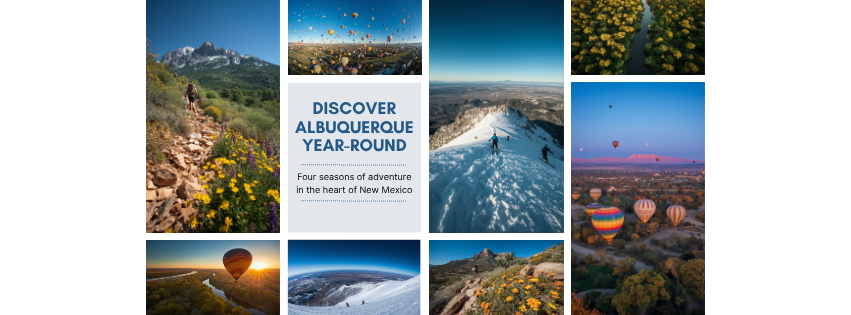
The year-round activity claim requires specific context, because 310 days of sunshine does not mean 310 days of identical outdoor conditions. Albuquerque's four seasons are genuinely distinct:
- Spring (March through May): Mild temperatures, desert wildflowers, and the specific quality of the Rio Grande at moderate levels. Perfect for hiking, biking, and balloon flights without the heat concern.
- Summer (June through August): Hot afternoons (routinely 90 to 100 degrees), cooler mornings (typically 65 to 75 degrees before 9am), and the July-August monsoon season that delivers afternoon thunderstorms and the specific dramatic sky that Albuquerque photographers pursue. Morning activities and elevation-based activities are ideal; afternoon heat is real.
- Fall (September through November): The most consistently celebrated season by Albuquerque residents. The monsoon has cleared, leaving the air dry and clear. Temperatures are ideal for hiking and cycling. The bosque cottonwoods turn gold in October. The Balloon Fiesta happens. The Sandia Mountains glow amber in the afternoon.
- Winter (December through February): Mild by national standards (average January high 45 to 55 degrees), with periodic snow that provides Sandia skiing while melting quickly from the valley floor. The outdoor running and cycling season does not fully stop even in winter — most days are sunny, dry, and suitable for outdoor activity at lower elevations.
The practical result: unlike most American cities where winter shuts down outdoor life for 3 to 4 months, Albuquerque's valley-floor climate supports outdoor activity year-round, with the alpine environments above the city providing winter sports during the cold months. There is no dead season — only the need to match the activity type to the current conditions.
Spring — The Outdoor Season Residents Wait For
Hiking the Sandia Foothills — When the Desert Blooms
Spring is the season that produces the specific hiking experience that brings people to the Sandia foothills who then never leave. The desert wildflowers — globe mallow, desert marigold, and the specific display of spring bloom that the foothills produce after winter rains — appear on the trails from late March through early May. The air is cool, the light is low and flattering in the morning, and the city below is not yet hidden behind the summer atmospheric haze.
The Elena Gallegos Open Space trailhead is the most popular spring hiking access point, with trails ranging from a casual 30-minute walk to a full-day Embudo Canyon ascent. Pino Trail and the Foothills Loop provide the most flexible range of difficulty options from the same general trailhead area. Spring hikers who start before 8am have the trails largely to themselves and the best possible light on the Sandia rock faces.
Balloon Flights — Spring Season Begins
Rainbow Ryders, Albuquerque's established balloon tour operator, confirms their season runs from May 1 through October 31 — making spring the opening of the primary balloon flight season outside the October Fiesta window. As the Rainbow Ryders outdoor adventures guide describes: 'Come fly with us in our majestic hot air balloons. Greet the sun as you float.' The specific spring flight experience — mild temperatures at altitude, the desert floor greening with spring color, the Rio Grande at medium flow — is the version that the serious balloon photograph enthusiasts most specifically seek.
Spring balloon flights typically launch from the Balloon Fiesta Park or adjacent open spaces in the North Valley. The Albuquerque Box meteorological phenomenon that makes the city the world balloon capital is active year-round, making spring flights as navigable as the October Fiesta flights. Cost: approximately $200 to $250 per person for a standard sunrise flight.
Rio Grande Cycling and the Bosque Awakening
The Paseo del Bosque Trail — the 16-mile paved trail that runs north-south through the Rio Grande bosque corridor — is at its most vibrant in spring, when the cottonwood trees are leafing out in the specific lime green that the bosque produces before the leaves reach full summer size and color. The trail is entirely flat, entirely paved, and accessible from multiple trailheads throughout the city.
The combination that most Albuquerque spring cyclists use: a morning ride on the bosque trail followed by breakfast at one of the Nob Hill cafes accessible from the Old Town trailhead. The complete circuit from Old Town north to Alameda and back is approximately 20 miles — a two-to-three-hour outing for a casual cyclist, less for an experienced one.
Paragliding at Sandia Crest — Spring and Summer Season
Sandia Crest, at 10,678 feet on the eastern face of the Sandia Mountains, is a prime paragliding and hang gliding launch site — one of the most spectacular in the American Southwest. The launch from the Crest produces a flight that begins above the tree line, descends through the mixed conifer forest, and lands in the foothills or the valley below depending on conditions and the pilot's route.
Enchanted Air Paragliding offers tandem paragliding flights from the Sandia Crest area for beginners who want to experience the flight without the training investment of solo paragliding certification. Tandem flights cost approximately $275. The specific experience of launching from the top of a 10,678-foot mountain and descending to the Albuquerque valley floor under a wing is available in a number of mountain locations — but the specific combination of Albuquerque's city-light descent and the Sandia's dramatic vertical relief makes this one of the most photogenic paragliding experiences in the Southwest.
Summer — Morning Adventures and Elevation Escapes
Early Morning Hiking Before the Heat
Summer hiking in Albuquerque requires understanding that the before-10am experience and the after-1pm experience are qualitatively different activities. The desert foothills trails at 7am in July — when the temperature is 70 degrees, the sun is low, and the city is still quiet below — are among the best hiking conditions available anywhere in the region. The same trails at 2pm, at 95 degrees, with full midday sun on exposed granite, are a physically demanding experience that requires specific preparation.
The summer hiking strategy that residents use: rise early, start the trail by 7am, complete the primary hike before 10am, and spend the afternoon in one of the temperature-controlled activity options. The specific trail destinations that reward the early start: La Luz Trail in its first two miles of desert terrain, the Foothills Loop at sunrise with the Sandia rock faces catching the morning light, and the Piedra Lisa Trail slab section where the smooth granite surface and the city view are at their most dramatic in early light.
Upper Elevation Escape — The Sandia Crest Scenic Byway
One of Albuquerque's most consistently underutilized summer escapes is accessible in 45 minutes from the city: the Sandia Crest Scenic Byway (New Mexico Highway 536) ascends from the east side of the mountains through five ecological life zones to the 10,678-foot crest — where the summer temperature is typically 15 to 25 degrees cooler than the valley floor.
A July afternoon that is 98 degrees in Albuquerque is approximately 73 to 80 degrees at the Crest. The trails above 9,000 feet are in mixed conifer and spruce-fir forest, completely shaded, and cool. The Kiwanis Cabin at the Crest summit provides a rest point with 360-degree views. The specific summer experience: drive up from the hot city, hike in the cool forest for 2 to 3 hours, and descend back to the valley in the late afternoon when the temperature has begun to drop.
Rio Grande Kayaking and Paddleboarding
Summer is the primary season for Rio Grande flat-water kayaking and stand-up paddleboarding through the Albuquerque corridor. The river runs most actively from late May through early July during peak snowmelt, providing the most consistent paddling conditions of the year.
The specific city-corridor paddling experience — through the bosque cottonwood forest with the Sandia Mountains visible on the eastern horizon — is one of the more distinctive urban outdoor activities available in any American city. The water is calm through the Albuquerque section, making it appropriate for beginners. New Mexico River Adventures and other local outfitters offer rentals and guided paddles.
The ABQ BioPark — Summer Programming
The ABQ BioPark complex — encompassing the Zoo, the Aquarium, the Botanic Garden, and Tingley Beach — provides summer programming that specifically serves Albuquerque's family-with-children visitor and resident population. The outdoor zoo and botanic garden are most pleasant in the morning; the Aquarium provides air-conditioned indoor engagement for the afternoon heat.
The Botanic Garden's summer programming includes the Japanese garden's seasonal displays, the Heritage Farm's growing season exhibitions, and the Rio Grande Heritage garden that demonstrates the specific plant communities of the Rio Grande corridor. The Zoo's summer feeding demonstrations and keeper talks are the programming most consistently rated by families as the highlight of their visit.
Fall — Albuquerque's Best Season
The International Balloon Fiesta — October 3-12, 2026
The Balloon Fiesta is the specific reason that fall is the most universally celebrated season in Albuquerque. 700 balloons, 9 days, 900,000 visitors, and the specific meteorological phenomenon of the Albuquerque Box that makes the mass ascension possible at this scale.
For residents who attend multiple years, the Balloon Fiesta experience evolves: the first year is the spectacle of scale — 700 balloons launching from a single field. The second year adds the detail — the specific balloon shapes, the dawn patrol launch in darkness, the balloon glow. Subsequent years add the social ritual — the specific meeting point, the predictable vendors, the annual reacquaintance with the event's specific energy.
The best Balloon Fiesta experience for first-timers: arrive by 5:45am for the dawn patrol launch. Stay through the mass ascension. Leave before 9:30am when the balloon-watching crowds peak and the temperature rises.
The Bosque Cottonwood Walk — October's Peak Color
The Rio Grande bosque corridor's cottonwood forest turns gold in October — a specific phenomenon that Albuquerque residents specifically plan their fall around. The cottonwood color peak typically arrives in the second and third weeks of October, coinciding with the Balloon Fiesta. The combination of the Fiesta mass ascensions in the sky and the golden cottonwoods on the river trail below produces the specific visual quality that makes October in Albuquerque the most frequently photographed month of the year.
The most photogenic bosque sections: the Paseo del Bosque Trail between Rio Bravo and Isleta in the south, and the section between Montaño and Alameda in the north, where the cottonwood canopy is most complete and the trail most shaded. Riding a bike through the bosque at peak color, on a weekday morning before the weekend crowds, is the Albuquerque fall experience that residents describe with the most emotional specificity.
Fall Hiking — The Best Temperatures of the Year
September and early October hiking conditions in the Sandia Mountains are universally considered the best of the year by Albuquerque's hiking community. The monsoon moisture has freshened the vegetation. The temperature at trail elevation is in the 60s and 70s. The light has the specific clarity that the cleared monsoon atmosphere produces. The aspen groves at upper elevations are turning gold.
The aspen groves in the Sandia Mountains are one of New Mexico's most accessible fall color destinations — reachable from the Sandia Crest Scenic Byway within 45 minutes of Albuquerque. The Crest Trail in October, with the aspen at peak color and the views stretching to the Manzano Mountains 100 miles south, is the specific hiking experience that produces the response of "this is why I live here."
Winter — Skiing 30 Minutes From Downtown
Sandia Peak Ski Area — The Mountain Visible From the Living Room
Sandia Peak Ski Area occupies the eastern face of the Sandia Mountains, accessible via the Sandia Crest Scenic Byway from the east or the Sandia Peak Aerial Tramway from the western base. The specific characteristic that distinguishes Sandia Peak from most American ski resorts: the city of Albuquerque is visible from the ski runs 5,000 feet below. You are skiing with a metropolitan view that no other ski resort in the United States provides at this relationship of elevation and urban proximity.
Sandia Peak is intermediate in scale — it is not a destination resort in the way that Taos or Angel Fire are — but it is the neighborhood ski hill that provides the convenience of a ski-on-a-Tuesday experience that residents of the mountain west specifically value. When conditions are right (December through early March), the drive from Northeast Heights homes to the ski area runs approximately 30 to 45 minutes.
Valles Caldera National Preserve — Cross-Country Skiing in an Ancient Volcano
The Valles Caldera National Preserve, 90 minutes northwest of Albuquerque, operates winter programming that produces one of the most specifically extraordinary outdoor experiences available within a half-day of any American city: groomed cross-country skiing on the floor of a collapsed volcanic crater that erupted 1.25 million years ago.
The 89,000-acre preserve also offers winter snowshoe hikes and ranger-led snow programs in addition to the cross-country skiing. The caldera floor in winter — the meadow covered in snow, the inner rim visible in all directions, the silence of a landscape 90 miles from any significant city — is the specific outdoor experience that the Jemez Mountains' geography makes available to Albuquerque's residents and that no comparable-distance destination can match.
Winter Hiking in the Valley — The Mild Climate Advantage
While the mountains provide skiing, the valley floor provides the mild-winter hiking experience that distinguishes Albuquerque's winter outdoor life from cold-weather markets. January average highs of 45 to 55 degrees — with most days sunny and dry — make the Sandia Foothills Trail, the Paseo del Bosque, and the Petroglyph National Monument trails accessible without the gear requirements that the same activity would require in a cold-weather market.
Petroglyph National Monument is specifically excellent in winter: the trail traffic is lowest, the low-angle winter sun illuminates the basalt escarpment at the ideal angle for reading the carved images, and the silence of the monument in the off-season produces a meditative trail experience unlike the summer visitor traffic.
Year-Round Indoor Activities — When Weather Is Not the Point
Albuquerque's indoor activity landscape is strong enough that even on the 55 days per year that are not perfect outdoor weather, there is no shortage of genuinely excellent options.
The Cultural Institutions
- Indian Pueblo Cultural Center: Owned and operated by all 19 Pueblos of New Mexico. Permanent collection covering 1,000 years of Pueblo cultural history, weekend dance performances in the outdoor courtyard (spring through fall), and the Indian Pueblo Kitchen restaurant. The most culturally significant institution in the city.
- National Museum of Nuclear Science and History: The world's only museum dedicated to the full history of the nuclear age — from 1930s physics through the Manhattan Project through contemporary applications. The outdoor Heritage Park displays actual aircraft, missiles, and historical hardware. Free parking, moderate admission.
- New Mexico Museum of Natural History and Science: The dinosaur exhibit alone justifies the visit — including Seismosaurus and Coelophysis skeletons specific to New Mexico fossil discoveries. The Lodestar Astronomy Center's planetarium provides evening sky programs. Located adjacent to Old Town.
- Explora Science Center: Over 250 hands-on science, technology, and art exhibits in Old Town — the specific children's science museum that consistently earns "best rainy day activity" from Albuquerque families. Adults without children will also find the interactive physics exhibits genuinely engaging.
- National Hispanic Cultural Center: The performing arts complex with the torreón housing the largest commissioned fresco in North America — a 4,000-square-foot ceiling painting depicting 3,000 years of Hispanic cultural history. The NHCC's theater programming, art gallery exhibitions, and library collections make it one of the most comprehensive cultural institutions in the Southwest.
The Arts and Performance Venues
- KiMo Theatre: The world's only Pueblo Deco building, hosting regular film screenings, theatrical performances, and concerts throughout the year. A performance inside the KiMo is the complete version of the architectural experience.
- Popejoy Hall at UNM: The primary performing arts venue for national touring productions — Broadway touring companies, symphony performances, international dance companies, and major concert programming. Albuquerque's primary classical and large-scale performing arts venue.
- Albuquerque Museum: The city's primary fine arts and history museum, with a permanent collection covering Southwestern art and New Mexico history alongside rotating exhibitions. Adjacent to the Tiguex Park and walkable from Old Town.
- 516 Arts: The contemporary art gallery in the Arts District that most consistently provides the cutting-edge side of Albuquerque's visual art scene — emerging artists, experimental work, and the specific community energy of a gallery that is genuinely embedded in the local arts culture rather than catering to tourist expectations.
Indoor Recreation and Wellness
- Meow Wolf (Santa Fe, 60 min north): The immersive art experience that has become one of the Southwest's most distinctive cultural destinations is technically in Santa Fe — but its proximity to Albuquerque makes it accessible as an afternoon excursion. The permanent installation at 1352 Rufina Circle is the original and most critically regarded of the Meow Wolf locations.
- Climbing gyms: Albuquerque's outdoor climbing culture has produced a strong indoor climbing gym community. Stone Age Climbing Gym is the primary Albuquerque facility, with bouldering and top-rope walls that serve both the serious climber maintaining fitness between outdoor sessions and the beginner who wants a first taste of vertical movement.
- ABQ Isotopes baseball (spring through early fall): The Albuquerque Isotopes, Triple-A affiliate of the Colorado Rockies, play at Isotopes Park in a setting that is specifically pleasant: the stadium is intimate, the sightlines are good, the prices are minor league, and the summer evening temperature — dropping from the 90s to the 70s by first pitch at 7pm — makes the outdoor stadium experience specifically comfortable in a way that summer baseball at lower-elevation cities cannot match.
Year-Round Signature Experiences — Available Any Day
Some Albuquerque experiences are not seasonal. They are available every day of the year and represent the most reliably consistent activity options regardless of when you are visiting or living here:
The Sandia Peak Aerial Tramway
The longest single-span aerial tram in the United States operates year-round, weather permitting. The summit experience is different in each season: spring wildflowers in the foothill zone, summer afternoon thunderstorms visible from the Crest, fall aspen color on the upper mountain, winter snow on the Crest with the city 5,000 feet below. The descent after dark is the signature year-round experience — available any night the tram is operating — where the city lights spread across the valley floor from the cables of the descending car.
Hot Air Balloon Rides
While the primary Rainbow Ryders season runs May through October, year-round balloon flights are available from multiple Albuquerque operators on appropriate weather days throughout winter. The Albuquerque Box meteorological phenomenon that makes the city the world balloon capital is active year-round. A winter sunrise balloon flight — launching in cold, clear air with the Sandia Mountains visible in their winter snow state — is a version of the experience that the October Fiesta crowds never access.
Old Town and Cultural Dining
Old Town Albuquerque, founded in 1706, is a year-round destination that does not have an off-season. The shops, galleries, and restaurants are operational year-round. The San Felipe de Neri Church is one of the oldest continuously operating churches in the United States. The surrounding galleries house some of the finest Pueblo pottery, Native American jewelry, and Southwestern art available in any single square mile in the region. A winter afternoon in Old Town — with the adobe buildings absorbing the low-angle winter sun and the plaza quiet of summer crowds — is a qualitatively different and often preferred experience to the summer visitor version.
The Paseo del Bosque Trail — 16 Miles, Paved, Free
The Paseo del Bosque Trail is the year-round outdoor infrastructure that ties Albuquerque's daily active life together. Cyclists, runners, walkers, and inline skaters use it in every month of the year. The specific seasonal version changes dramatically — spring's leafing cottonwoods, summer's full green canopy and shaded cool air, fall's gold corridor, and winter's bare trees and clear sightlines across the Rio Grande to the West Mesa volcanoes — but the activity is always accessible. It is 16 miles long, flat, paved, free, and adjacent to the Rio Grande.
For the deeper outdoor adventure side of Albuquerque's year-round activity landscape, our guide to the best outdoor adventures around Albuquerque New Mexico covers hiking, mountain biking, rock climbing, and the major day-trip destinations in detail. And our complete guide to things to do in Albuquerque provides the full activity picture including dining, culture, and the city's unexpected gems.
The Bottom Line — No Dead Season
The year-round activity question in Albuquerque has a direct answer: there is no dead season.
Spring produces the hiking weather that people move here for. Summer requires morning timing and elevation strategy, but both are readily available and produce experiences unavailable in most American cities at comparable altitude. Fall is the best season by consensus — the Balloon Fiesta, the bosque color, the hiking temperatures, and the specific quality of New Mexico's post-monsoon atmosphere produce a version of the city that its most enthusiastic advocates specifically love. Winter puts skiing within 30 to 45 minutes of most neighborhoods while the valley-floor climate remains mild enough for outdoor running, walking, and casual hiking throughout.
The indoor options — the cultural institutions, the arts venues, the performing arts, the climbing gyms — are excellent enough that the days when outdoor activity is genuinely not ideal produce no deficit of things to do. Albuquerque is an outdoor city that has also built the indoor infrastructure to match it.
For people who are evaluating cities to live in and who are placing a high value on year-round activity, Albuquerque's offering is genuinely uncommon: the combination of an outdoor season that never fully ends, four seasons that each produce something the others cannot, and a cultural and indoor activity landscape that the city's reputation does not fully communicate.
Considering Making Albuquerque Your Year-Round Home?
Jenn & Vinay from The Rodgers Neighborhood Real Estate Group help buyers find homes in Albuquerque neighborhoods that put the year-round activities they value most within the closest reach — the foothills trail that starts at the end of the street, the bosque access a bike ride away, the ski area 30 minutes from the garage. If Albuquerque's year-round lifestyle is part of what is drawing you here, the conversation about which neighborhood fits starts with a call.
Jenn & Vinay Rodgers are Albuquerque's trusted real estate professionals with The Rodgers Neighborhood Real Estate Group, brokered by Real Broker, LLC, serving buyers and sellers across Albuquerque, Rio Rancho, Corrales, Los Lunas, Tijeras, Cedar Crest, Sandia Park, the East Mountains, Bernalillo County, Sandoval County, and surrounding New Mexico communities.
The Rodgers Neighborhood Real Estate Group
Jenn & Vinay Rodgers
Real Broker, LLC
Albuquerque, NM
📞 505-417-2733
🏠 Browse Albuquerque homes near the best year-round activitiesCategories
- All Blogs (337)
- 2026 & Beyond for Real Estate (232)
- Doctors and Nurses looking for homes in NM (4)
- Guide to buying a home in NM (149)
- Health Care Heros (7)
- Home Upgrades (40)
- Jenn & Vinay your Local Real Estate Experts! (116)
- Moving to Albuquerque (131)
- Neighborhoods in Albuquerque NM (90)
- Rent or Own (2)
- Sellers Questions for Selling homes (2)
Recent Posts

GET MORE INFORMATION