
Best Types of Rental Properties in Albuquerque — The Complete 2026 Investor Guide
DISCLAIMER: Investment returns in real estate are not guaranteed. All figures in this guide are estimates based on current market data that changes over time. Consult qualified financial, tax, and legal professionals before making investment decisions. We are not financial advisors.
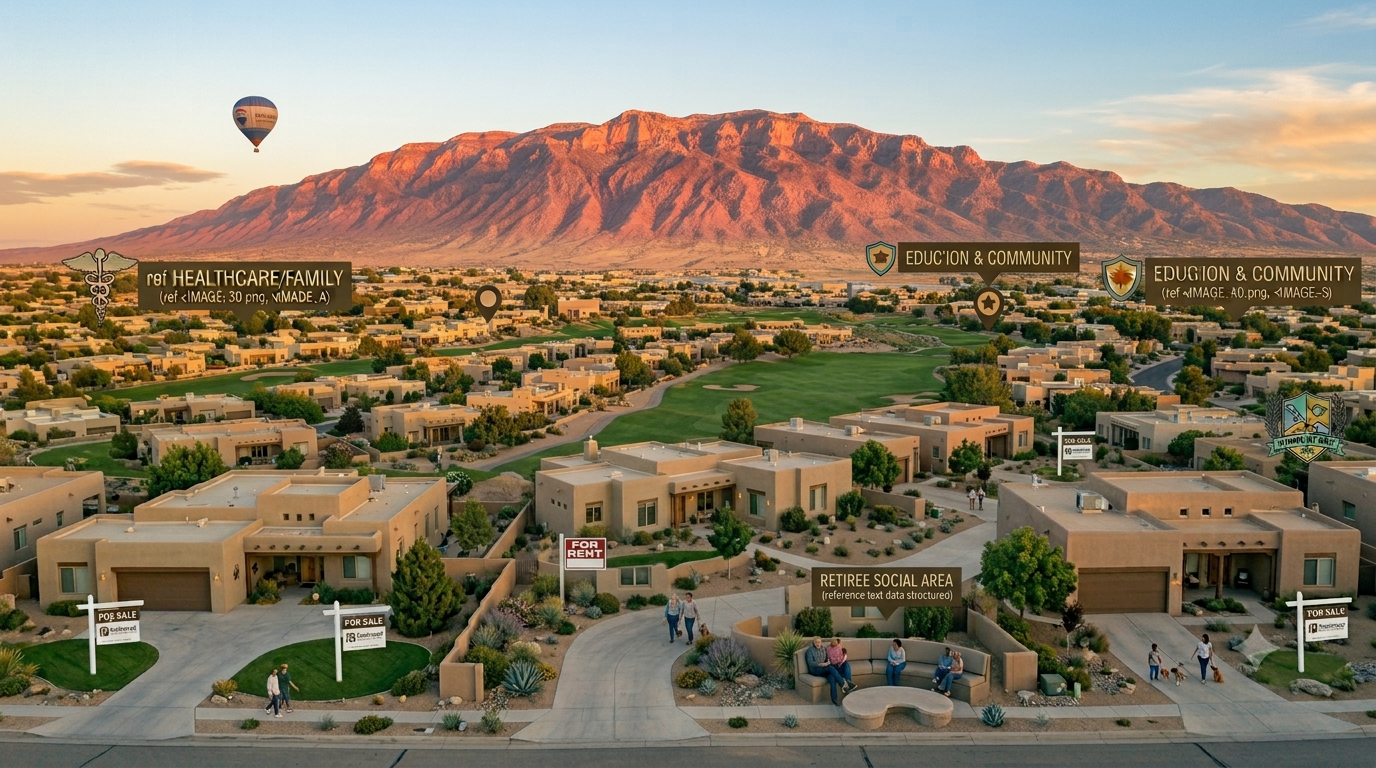
The Albuquerque rental market in 2026 is structurally favorable for investors: a 13,000-28,000 unit housing shortage (Root Policy Research), a 38% renter-occupied population, rental demand up 8% year-over-year, and a median home price still significantly below comparable Mountain West metros. The question is not whether Albuquerque is a viable rental market — it is. The question is which type of rental property best matches the investor's capital, experience level, and return objectives.
The Albuquerque Rental Market Baseline — 2026 Numbers
- Renter-occupied households: 93,057 — 38% of all occupied housing units in Albuquerque (RentCafe June 2026)
- Average rent (RentCafe June 2026): $1,387/month (+0.3% YoY)
- Average SFH rental income (Mashvisor): $2,114/month
- Average STR income (Mashvisor): $2,844/month
- Vacancy rate:0%
- Rental demand trend: Up 8% year-over-year
- Rent trend: Up approximately 5% year-over-year (SWMLS data)
- Housing shortage: 13,000-28,000 units below demand (Root Policy Research)
- Median sale price (June 2026): $387,500 (SWMLS detached), up 4.6% YoY
The structural picture: Albuquerque's rental market has more demand than supply, a growing employment base (Intel CHIPS Act, Netflix, Sandia Labs expansion), and home prices that still allow positive cash flow at reasonable leverage — which is not true of many larger western metros at current interest rates.
Type 1 — Single-Family Homes (SFH): The Stable Long-Term Play
"Single-family properties: suburbs near new job centers or good schools continue to top tenant wish lists in 2026. There's a sense among industry watchers that multifamily renters might become more cost-conscious, benefiting buildings that combine convenience with affordability," confirmed Heart Mortgage's 2026 rental property ROI and cap rate analysis (June 2026).
TYPICAL CAP RATE IN ALBUQUERQUE: 4.5-6.5% depending on neighborhood and purchase price.
TYPICAL MONTHLY RENT: $1,400-$2,200 for standard 3/2 homes; $2,000-$3,500 for premium zones.
Single-family homes are the entry point for most Albuquerque investors and the most liquid investment type — they have the largest buyer pool when it comes time to sell, including both investors and owner-occupant buyers. The specific Albuquerque SFH rental advantage: the school zone premium drives both rental demand and long-term appreciation in ways that are specifically strong in Albuquerque's APS zone structure.
- Best neighborhoods for SFH rentals: Northeast Heights (La Cueva and Eldorado school zones) — attracts long-term family tenants who are school-zone-motivated; typically lower turnover and higher rent than comparable homes outside the zone. Heritage East / Bear Canyon — Kirtland AFB and Sandia Labs workforce, reliable tenants with government employment. Rio Rancho — Intel employment proximity, growing family market, new construction available at accessible price points.
- The military tenant advantage: Military families stationed at Kirtland AFB are among the most reliable rental tenants available in any market. Basic Allowance for Housing (BAH) provides a government-backed income source. Military families are accustomed to taking care of properties, have the discipline of military culture, and typically fulfill lease commitments. The 1-3 year assignment cycles create predictable turnover but consistent demand.
- SFH rental challenges in Albuquerque: The desert climate is harder on properties than more temperate markets — HVAC systems work harder, roofing ages differently (flat roofs require more attention than pitched roofs), and swamp coolers require seasonal service. Budget 1.5-2% of property value annually for maintenance reserves, not the 1% national average.
- Cash flow math example: $355,000 SFH, 20% down ($71,000), 6.30% rate → PITI approximately $2,360/month. At $2,114 average Mashvisor rent → negative cash flow at 20% down. At 25% down or lower purchase price, cash flow turns positive. Or: same $355,000 at $2,500/month rent (school zone premium) → approximately $140/month positive cash flow before management fees and reserves. Albuquerque SFH investing in 2026 requires either higher down payment, below-median purchase price, or school-zone rent premium to achieve positive cash flow.
Type 2 — Duplexes and Small Multifamily (2-4 Units): The Best Entry Investor Opportunity
TYPICAL CAP RATE: 6.0-7.2% (Heart Mortgage 2026 data).
TYPICAL GROSS RENT: $1,100-$1,600/unit × 2-4 units = $2,200-$6,400/month gross.
HUD data confirms that 15% of occupied Albuquerque rental units are in 2-4 unit buildings — a meaningfully larger small multifamily market than most comparable cities. Duplexes, triplexes, and fourplexes are a real Albuquerque investment category, not a niche product.
- The FHA house-hacking strategy: The most powerful wealth-building entry point available in Albuquerque's 2026 market: purchase a 2-4 unit property with FHA financing (3.5% down payment — FHA permits this for owner-occupied multifamily up to 4 units), live in one unit, and rent the other unit(s). The other units' rent often covers 50-100% of the total PITI, dramatically reducing the effective cost of living while building equity.
- FHA multifamily financing rules: FHA permits purchases of 2-4 unit properties with 3.5% down when the buyer occupies one unit as their primary residence. The rental income from the other units can be used (at a percentage) toward income qualification. For many first-time buyers in Albuquerque, FHA multifamily is the single most powerful path to owning both a home and an investment property simultaneously. Verify current FHA rental income calculation rules with a participating lender.
- Best neighborhoods for duplexes and small multifamily: UNM/University Heights area — consistent student and young professional demand, walkable amenities, proximity to both UNM and Presbyterian hospital creates diverse tenant pool. Nob Hill adjacent — two-unit properties in the walkable corridor command premium rents. Southeast Heights and South Valley — more affordable purchase prices relative to rent, serving the lower-rent demand segment.
- Multifamily advantages over SFH: Vacancy risk is spread across multiple units — a vacant unit in a duplex still produces 50% of the rent, vs. a vacant SFH producing zero. Management scale improves as units increase. The cap rate is typically 1-2 percentage points higher than equivalent SFH. Roof, foundation, and structural costs are shared across more rental income.
- Financing note: Up to 4 units qualifies for residential financing (conventional and FHA). At 5+ units, the property transitions to commercial financing — higher down payment requirements (typically 20-25%), different underwriting criteria, and higher rates than residential. This makes the duplex-to-fourplex range specifically accessible for investors who want to start with residential financing.
Type 3 — Short-Term Rentals (STR/Airbnb/VRBO): The Premium Income Play
TYPICAL MONTHLY INCOME (Mashvisor): $2,844/month average — versus $2,114/month for long-term rentals. The STR premium is real and significant.
Albuquerque's STR market is driven by five specific demand drivers that produce higher-than-national-average STR income in the right locations:
- The Balloon Fiesta effect (October): The International Balloon Fiesta draws 800,000+ visitors in 9 days. STR rates during Fiesta week typically reach $200-$400/night — 3-5× the standard nightly rate. A well-located Albuquerque STR can generate $3,000-$8,000+ in October alone from Fiesta bookings.
- Route 66 centennial (2026 elevated): The 2026 centennial is specifically driving higher-than-usual travel interest and occupancy throughout the year.
- Sandia Labs and Intel visitor housing: Defense contractors, consulting firms, and technology vendors visiting Sandia Labs and Intel for extended project engagements prefer STR over hotels for stays of 2-4 weeks. Mid-term STR rentals (30-89 days) to this professional segment command significant premiums over hotel rates.
- UNM parent weekends, graduation, and sports events: UNM events (basketball season, graduation, homecoming) fill Albuquerque hotels quickly. STRs within reach of campus and the Pit (arena) are specifically well-positioned for these recurring event demand spikes.
- The best STR locations in Albuquerque: Old Town adjacent (cultural tourism, proximity to River of Lights, luminarias, museums), Nob Hill (Route 66 character, walkable dining), Near Balloon Fiesta Park (9201 Balloon Museum Dr NE — proximity commands premium during October), East Mountains (cabin-style STR for hiking/outdoor seekers).
- STR regulation in Albuquerque: The City of Albuquerque requires STR operators to register with the city and comply with the Integrated Development Ordinance (IDO) short-term rental provisions. Verify current registration requirements at cabq.gov/planning before operating an STR. Some HOA communities specifically prohibit STRs — confirm HOA rules if purchasing in an HOA community.
- STR management considerations: STR requires more active management than long-term rental — cleaning between stays, dynamic pricing, guest communication, and maintenance response. Professional STR management companies operate in Albuquerque and typically charge 20-35% of revenue. Calculate net income after management fees to compare STR vs. long-term rental for any specific property.
Type 4 — Small Apartment Buildings (5-20 Units): The Professional Investor Category
TYPICAL CAP RATE: 6.5-8.0% (Heart Mortgage 2026 data). Active listings in Albuquerque have confirmed 9.24%+ cap rates on some 4-unit buildings.
HUD data confirms that 41% of occupied Albuquerque rental units are in 5+ unit buildings — confirming that apartment buildings are the dominant form of rental housing in the city. The opportunity is real; the access requirements are higher.
- The financing step-change: At 5 units, financing transitions from residential (conventional/FHA) to commercial — requiring minimum 20-25% down payment, debt service coverage ratio (DSCR) underwriting instead of personal income qualification, and typically higher interest rates than residential mortgages. Commercial financing for 5-20 unit buildings is a different process and a different cost structure than the residential financing that works for 1-4 units.
- Best neighborhoods for small apartments: Southeast Heights and South Valley (highest density of existing small apartment stock, closest to affordable acquisition prices), Central Corridor from Downtown through UNM (walkable amenities attract young professional tenants), Old Town adjacent (cultural amenities and tourism proximity).
- Management requirements: 5+ unit buildings typically require professional property management unless the owner is operationally experienced and locally based. Property management fees in Albuquerque typically run 8-12% of collected rents for residential properties.
- The higher cap rate reward: The additional complexity of commercial financing and management is rewarded with higher cap rates (6.5-8.0%) vs. SFH (4.5-6.5%). The investor who can navigate commercial financing and management finds Albuquerque's small apartment market specifically attractive at these cap rates.
Type 5 — Casita / ADU Rentals: The New Mexico Tradition with 2026 Momentum
TYPICAL MONTHLY RENT: $800-$1,400 for a casita (detached ADU) depending on size, location, and condition.
The New Mexico casita (detached guesthouse, often called an ADU elsewhere) is both an architectural tradition and a rental income strategy unique to this market. The homeowner who lives in the primary residence and rents the casita is practicing a form of house-hacking that New Mexicans have been doing for generations — before "house hacking" was a term.
- Why casitas work in Albuquerque: The standalone casita provides the renter with a fully private residence — their own entry, their own outdoor space, their own utility connections — while being physically separate from the owner's home. This privacy is specifically what renters are paying for, and why casita rents are higher per square foot than apartments of equivalent size in multifamily buildings.
- IDO expansion of ADU rights: The City of Albuquerque's Integrated Development Ordinance has been expanding ADU permitting rights, making it easier to add a casita to an existing residential lot than at any previous point in the city's history. Verify current ADU rules at cabq.gov/planning or at codelibrary.amlegal.com/codes/albuquerque for your specific zoning designation.
- The return profile: A casita built for $75,000-$150,000 generating $1,100/month in rent produces an effective cap rate of approximately 8-17% on the cost of construction — the highest return rate of any rental type on this list, when executed on a property where a casita is permitted and needed. The constraint is the construction cost and the construction timeline.
Type 6 — Student Rentals (UNM Adjacent): High Yield, Active Management
TYPICAL RENT: $600-$900/bedroom — for a 4-bedroom student house near UNM, $2,400-$3,600/month gross.
UNM's enrollment of 27,000+ students creates a consistent rental demand within a specific geographic area: the streets around the UNM campus in the University Heights and Nob Hill adjacent neighborhoods.
- The student rental advantage: Student rentals can command per-bedroom rents that exceed what a family or professional couple would pay for the same property as a single household. A 4-bedroom house rented to four UNM students at $750/bedroom generates $3,000/month; the same house rented to a family might rent for $2,200/month.
- The student rental challenges: Higher turnover (annual lease cycles aligned with academic year), property wear-and-tear that exceeds what family tenants produce, summer vacancy risk if students return home, and the requirement for more active management. Many student landlords require parent co-signers on leases.
- Best student rental locations: Streets within walking distance of the UNM campus (Yale Blvd, University Ave, the grid streets between Central and Lomas in University Heights). The walkability premium means that 3-4 block proximity to campus commands significantly higher rents than 8-10 block proximity.
The Albuquerque-Specific Rental Property Considerations
"Albuquerque's average rental income is $2,114 per month for traditional rentals, with an average monthly rental income of $2,844 for short-term rentals. The vacancy rate in Albuquerque is 6.0%, rental demand has increased by 8%, and the rental rate has gone up by 5% compared to last year," confirmed Mashvisor's Albuquerque rental property data.
- The swamp cooler factor: Approximately 30-40% of pre-2000 Albuquerque rental properties have evaporative cooling rather than refrigerated air. Tenants increasingly prefer refrigerated air (especially out-of-state tenants from California and Texas where swamp coolers are uncommon). Properties with refrigerated air rent faster and command higher rents. This makes the swamp cooler-to-refrigerated air conversion ($5,000-$12,000) a specifically high-ROI landlord improvement in Albuquerque.
- Xeriscaping reduces management burden: A rental property with traditional turf landscaping requires the landlord or tenant to maintain irrigation during the summer heat. A property with properly installed xeriscape requires essentially no irrigation maintenance. The ABCWUA xeriscape rebate makes the conversion financially accessible, and the management simplification is a specific landlord benefit.
- The 1977 median build year maintenance budget: Albuquerque's median housing stock was built in 1977 — meaning the average rental property is approximately 48 years old. Budget 1.5-2% of property value annually for maintenance (above the 1% national average) to account for the age of HVAC systems, electrical panels, plumbing, roofing, and windows.
- Property management in Albuquerque: Multiple professional property management companies operate in Albuquerque. Typical fees: 8-12% of collected rent for residential management; additional fees for leasing (typically 50-100% of first month's rent), maintenance coordination, and inspection. Property management is specifically recommended for out-of-state investors and for investors with 3+ properties.
- New Mexico landlord-tenant law: New Mexico is a reasonably balanced landlord-tenant state with a 3-day notice for nonpayment of rent, a 30-day notice for month-to-month termination, and standard habitability requirements. Consult a New Mexico attorney familiar with landlord-tenant law before structuring your first lease.
The Rental Property Type Quick Decision Guide
- First-time investor with limited capital: FHA duplex house-hacking (3.5% down, live in one unit, rent the other). This is the highest-leverage entry point in the Albuquerque market and available to owner-occupant buyers with qualified income.
- First-time investor with 20% down: Single-family home in a school zone or near a major employer. The most liquid investment type with the largest exit market.
- Existing homeowner with a casita-eligible lot: ADU/casita construction and rental. The highest per-dollar return rate when building conditions are favorable.
- Active investor who wants premium income: Short-term rental in Old Town adjacent, Nob Hill, or near Balloon Fiesta Park. Requires more management but the Mashvisor $2,844/month average and Balloon Fiesta premium are compelling.
- Professional investor with commercial financing capacity: 5-20 unit apartment building in Southeast Heights or South Valley. Higher cap rates, commercial financing required, professional management necessary.
For the complete investment analysis of Albuquerque real estate — with the appreciation data, the neighborhood-by-neighborhood ROI comparison, and the 2026 market conditions that make Albuquerque specifically attractive to investors — our post on whether Albuquerque real estate is a good investment in 2026 covers the complete investment case. And for the neighborhood-by-neighborhood rental investment analysis — which specific Albuquerque areas produce the best rental cash flow — our post on the top Albuquerque areas for rental property investment covers the geographic investment guide.
The Bottom Line — Albuquerque's Rental Market Has a Property Type for Every Investor
The 93,057 renter-occupied households in Albuquerque, the 13,000-28,000 unit housing shortage, the 8% year-over-year rental demand increase, and the still-accessible home prices relative to Mountain West peers make Albuquerque a specifically strong rental investment market in 2026. The structural supply deficit that prevents meaningful price decline also prevents meaningful rent decline — the conditions that sustain rental returns are the same conditions that sustain the buy-side market.
The entry point that makes the most sense depends on the investor's capital position, experience level, and return objectives. The FHA duplex house-hacking strategy is the most powerful entry point for investors with limited capital who can owner-occupy one unit. The school-zone SFH is the most stable long-term hold with the most liquid exit. The STR near Old Town or the Balloon Fiesta Park is the highest gross income producer for active investors. The small apartment building is the professional investor's 6.5-8.0% cap rate opportunity for those with commercial financing capacity.
All of them work in Albuquerque in 2026. Choosing the right type requires honest assessment of capital, time commitment, management capacity, and investment horizon. The next step is a conversation about which property type and which specific neighborhood best match the investor's specific situation.
Ready to Find the Right Albuquerque Rental Property for Your Portfolio?
Jenn & Vinay from The Rodgers Neighborhood Real Estate Group work with both new and experienced investors to identify the right property type, the right neighborhood, and the right acquisition price for each investment objective. We provide comparable rental analysis, neighborhood cap rate data, and the market-specific knowledge of where tenant demand is strongest relative to purchase price in Albuquerque's 2026 investment landscape. The conversation about building your Albuquerque rental portfolio starts with a call.
Jenn & Vinay Rodgers are Albuquerque's trusted real estate professionals with The Rodgers Neighborhood Real Estate Group, brokered by Real Broker, LLC, serving buyers and sellers across Albuquerque, Rio Rancho, Corrales, Los Lunas, Tijeras, Cedar Crest, Sandia Park, the East Mountains, Bernalillo County, Sandoval County, and surrounding New Mexico communities.
The Rodgers Neighborhood Real Estate Group
Jenn & Vinay Rodgers
Real Broker, LLC
Albuquerque, NM
📞 505-417-2733
🏠 Browse Albuquerque investment properties and rental listingsCategories
- All Blogs (332)
- 2026 & Beyond for Real Estate (228)
- Doctors and Nurses looking for homes in NM (4)
- Guide to buying a home in NM (146)
- Health Care Heros (7)
- Home Upgrades (40)
- Jenn & Vinay your Local Real Estate Experts! (113)
- Moving to Albuquerque (131)
- Neighborhoods in Albuquerque NM (89)
- Rent or Own (2)
- Sellers Questions for Selling homes (2)
Recent Posts


GET MORE INFORMATION