

Relocating to Albuquerque NM as a retiree
Relocating to Albuquerque NM as a retiree: cost of living breakdown, tax benefits, and financial planning before your move
You can stretch retirement dollars in Albuquerque with a cost-of-living index near 92, modest property taxes, and no state tax on Social Security; map housing, healthcare, and HOA costs up front to lock in a stable long-term budget. Your window is favorable if you compare total ownership costs across neighborhoods and secure financing before you write an offer a guide to home buying in New Mexico - Albuquerque
Why This Matters Right Now
You are weighing a move at a time when timing and clarity matter. Local MLS data for Q1 2026 shows about 3.2 months of single-family supply, which tilts slightly toward sellers, yet 22 percent of listings had price reductions in the past six months. That mix gives you room to negotiate if you are prepared. Median prices rose roughly 4.8 percent year over year to about $330,000 Albuquerque housing costs data, and condos and townhomes saw even stronger gains. If you are seeking single-level living or low-maintenance options, those segments are competitive.
You also face interest rate realities. The April 2026 Freddie Mac survey places a typical 15-year fixed near 5.1 percent. Combine that with Albuquerque’s cost-of-living index around 92 on a 100 scale and you get a market where your monthly budget can work if you plan precisely. Your window is favorable if you compare total ownership costs across neighborhoods and secure financing before you write an offer.

What You Need to Know Before You Relocate
You should model your full monthly carry cost, not just the mortgage. Your active retirement depends on predictable housing, healthcare, and utility expenses.
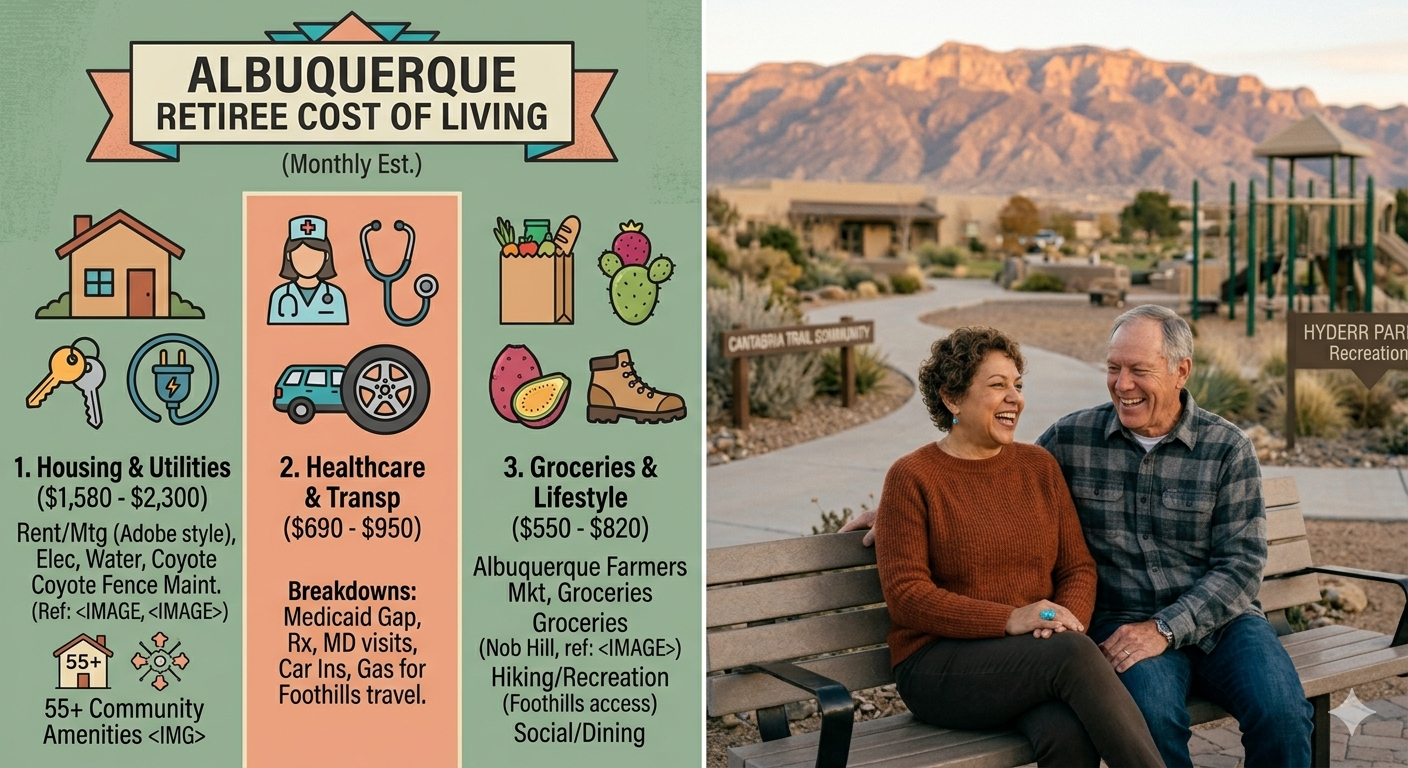
- Housing: The March 2026 median single-family price sits near $330,000 per local MLS. Condos and townhomes run lower on average and often include exterior maintenance.
- HOA fees: Many 55+ communities fall between $200 and $350 per month. You should confirm what is covered versus add-on services like meals or shuttles.
- Utilities and essentials: Typical monthly estimates often pencil out near $190 for utilities and about $450 for groceries, with transportation around $250 depending on car use and transit.
- Taxes: New Mexico does not tax Social Security benefits. If your income is modest and you are 65 or older, you may qualify for a property tax rebate up to $2,000, and you should also review valuation freeze options. Confirm eligibility with the New Mexico Department of Revenue.
- Healthcare: Budget about $420 per month on average, then price your specific plan and any supplemental coverage.
- Resale liquidity: Homes in 55+ communities have sold in roughly 45 days versus about 65 days in traditional neighborhoods, which matters if you plan to right-size again later.
- Financing: Consider paying cash, a 15-year fixed, a bridge loan to avoid rushed decisions, or a Home Equity Conversion Mortgage for Purchase if liquidity is a priority.
By pressure-testing these line items, you reduce surprises and move with confidence.
How amenities translate to savings
You save most when community amenities replace expenses you would otherwise shoulder. A fitness room can offset a gym membership, front-yard care can cut landscaping bills, and included exterior maintenance can hold down long-term capital costs.
How to Compare 55+ Communities vs. Traditional Neighborhoods
You will compare lifestyle, cost, and resale prospects side by side. In Albuquerque, established 55+ neighborhoods like Azure West, Balducci Village, and Calle Corto at Andaluz generally offer single-level plans, accessible bathrooms, social programming, and exterior maintenance bundled into an HOA that typically ranges from $200 to $350 per month. Resale prices often cluster around the low to mid $300s, and average days on market are shorter than citywide figures. That convenience can reduce your monthly outlay and simplify life.
Traditional areas offer broader home styles and lot sizes, often at similar or slightly lower prices for comparable square footage. The East Mountains, for example, provide quieter settings in the $280,000 to $350,000 range, yet you take on more yard work, potential septic or well maintenance, and longer drives to services. If you prioritize autonomy, a larger detached garage, or space for hobbies, a traditional neighborhood can fit well, but you should account for higher variable costs.
Your choice ultimately balances HOA fees and on-site services against do-it-yourself maintenance and commuting. If you value walkability, social events, and predictable monthly budgets, a 55+ setting may be the better fit.
Key factors to evaluate:
- Access to healthcare and shopping: Measure minutes, not miles, during typical traffic.
- HOA scope and reserves: Verify what the fee includes and review reserve disclosures to gauge future special assessments.
- Resale velocity and buyer pool: Shorter days on market can protect your equity later.
Your Step-by-Step Financial Guide
1) Define your after-move budget. List fixed income sources, required distributions, and pensions. Build a conservative monthly target that includes mortgage or rent, HOA, utilities, groceries, transportation, healthcare, and a 10 percent buffer.
2) Clarify tax impacts. Confirm that Social Security is untaxed in New Mexico. Review eligibility for senior property tax relief and valuation freeze programs with the New Mexico Department of Revenue. Estimate New Mexico’s gross receipts tax impact on common services you use.
3) Choose a purchase strategy. If you are equity-rich, paying cash simplifies your offer and quickens closing. If you want to keep cash invested, compare a 15-year fixed near recent Freddie Mac averages to a HECM for Purchase that can free liquidity while controlling payments Best mortgage lenders in Albuquerque NM for first-time home buyers
4) Coordinate the sale of your current home. Aim to list in late spring or early summer when buyer activity is high. Pre-inspections, decluttering, and professional staging have historically improved outcomes by 3 to 5 percent, according to many brokered sales records.
5) Consider a bridge solution. If you do not want to move twice, a short bridge loan or a negotiated rent-back of up to 90 days can let you buy first, then sell without pressure.
6) Secure insurance quotes. Price homeowners, wind and hail, and umbrella coverage before your offer. Adjust your deductible to match your emergency reserve.
7) Underwrite lifestyle costs. If a 55+ HOA covers front-yard care, fitness, and exterior paint, factor those savings against the monthly fee. If a traditional home requires yard crews and higher utilities, price those services now.
8) Verify accessibility features. Prioritize no-step entries, wider doors, and grab-bar-ready showers to reduce near-term renovation costs and future-proof your layout.
9) Stress test your plan. Model a 10 percent rise in HOA or insurance and a 5 percent rise in utilities. If the plan holds, you are ready to shop confidently.
What This Looks Like in Northeast Albuquerque and Surrounding Areas
You will likely start your search near Northeast Heights and the Sandia foothills if you want proximity to hiking, shopping, and medical providers. Local MLS trends place Northeast Heights medians near the mid $300s, with mature landscaping, established streets, and good access to the I-25 corridor and the Albuquerque International Sunport via surface roads. The Foothills area trends higher near the mid to upper $400s with hillside views and quick trail access. Downtown and West Downtown often price in the low $300s and bring walkable arts and dining. The North Valley, with a rural feel and larger lots near the bosque trails, hovers around the upper $300s.
Transit and services help you age in place. ABQ RIDE fixed routes, the Sun Van paratransit service, and the Rail Runner to Santa Fe and Belen provide reliable options. City recreation centers, including the North Domingo Baca Multigenerational Center, offer senior programs and fitness. According to the City of Albuquerque, investments in bike lanes and bus rapid transit corridors continue to expand access.
Neighborhoods to consider:
- Northeast Heights: Mid $300s on average, single-level ranch homes, near shopping and healthcare, easy airport access without freeway noise. Top neighborhoods in Albuquerque
- Foothills: Around the mid to upper $400s, low-maintenance xeriscape lots, exceptional trail access, strong long-term desirability.
- North Valley: Upper $300s, larger lots with a rural feel, bosque trails, room for hobbies or gardening while staying close to city services.
What Most People Get Wrong
You might focus on list price and forget the lifetime cost of stairs, yard work, and deferred maintenance. A two-story with a low HOA can cost more over ten years than a single-level with a moderate HOA if you factor orthopedic risks, future stair lifts, and exterior upkeep. You also might overestimate tax burdens. New Mexico’s decision not to tax Social Security reduces your effective rate, and senior property tax relief may apply if your income meets thresholds.
Another miss is ignoring liquidity. If you plan to move again in five to seven years, you should favor locations and home types with faster resale, like accessible floor plans near medical services. Finally, you should not assume all 55+ HOAs cover the same items. Always verify reserves, upcoming capital projects, pet rules, and shuttle schedules so you are not surprised later.
Frequently Asked Questions
What is a realistic monthly carry cost after downsizing?
You should budget housing, HOA, utilities, groceries, transportation, and healthcare. For many retirees in Albuquerque, a common range is mortgage or rent plus $200 to $350 HOA, $190 utilities, $450 groceries, $250 transportation, and about $420 healthcare. Adjust for your plan.
How do property taxes change when you move to Albuquerque?
You benefit from generally modest property taxes by regional standards, and New Mexico does not tax Social Security benefits. If you are 65 or older with qualifying income, you may access a property tax rebate and valuation freeze. Confirm your eligibility with the state.
Are 55+ communities more affordable than traditional neighborhoods?
You often trade a monthly HOA for lower variable costs. If the HOA covers exterior maintenance, front-yard care, and amenities, your total cost can be competitive or lower than a traditional home that requires separate services. Compare all line items, not just fees.
What financing options make sense for retirees?
You can pay cash to simplify and reduce closing time. If you want liquidity, a 15-year fixed near recent survey rates can keep interest costs manageable. A HECM for Purchase can reduce or eliminate monthly principal and interest, but you should review obligations carefully.
When is the best time to list your current home if you need the proceeds?
You should target late spring through early summer to capture peak buyer activity. Pre-inspections, thoughtful staging, and minor repairs can add 3 to 5 percent to your net. If timing is tight, consider a bridge loan or negotiate a rent-back up to 90 days.
The Bottom Line
You can retire in Albuquerque with a budget that works if you plan the whole picture. The city’s cost-of-living index below the national average, no state tax on Social Security, and available senior property tax relief create a favorable baseline. Your next step is to align lifestyle with numbers. Weigh 55+ communities with predictable HOA coverage against traditional neighborhoods where you control the pace but take on more maintenance. When you map total costs, secure financing, and choose accessible layouts near healthcare and transit, you protect your cash flow and enjoy more of what drew you to New Mexico.
If you are ready to explore your options for relocating to Albuquerque as a retiree, Vinay Rodgers at The Rodgers Neighborhood Real Estate Group can walk you through the specifics for your situation Meet Jenn and Vinay - your trusted New Mexico realtors
 5054172733
Categories
- All Blogs (362)
- 2026 & Beyond for Real Estate (256)
- Doctors and Nurses looking for homes in NM (4)
- Guide to buying a home in NM (160)
- Health Care Heros (7)
- Home Upgrades (42)
- Jenn & Vinay your Local Real Estate Experts! (124)
- Moving to Albuquerque (139)
- Neighborhoods in Albuquerque NM (94)
- Rent or Own (2)
- Sellers Questions for Selling homes (2)
Recent Posts









GET MORE INFORMATION