
Will Albuquerque Home Prices Drop in 2026?
Will Albuquerque Home Prices Drop in 2026? The Data-Driven Answer
Let's answer the question directly, the way it deserves to be answered.
No. Albuquerque home prices are not expected to drop in 2026 — not in any meaningful, widespread way. Not according to Redfin's current data. Not according to the Albuquerque Journal's March 2026 reporting. Not according to the local builders, lenders, and market analysts who work in this market every day. And not according to the fundamental supply-and-demand dynamics that drive home values in the long run.
What is happening in the Albuquerque market right now is something more nuanced than either "prices are crashing" or "prices are soaring." It is stabilization. Measured appreciation. A market finding its footing after several years of extraordinary disruption — and doing so in a way that is genuinely healthy for buyers and sellers alike.
This post gives you the complete picture: the current data, the scenarios that could change the forecast, the neighborhoods where values are strongest, and the honest answer to whether buyers who have been waiting should keep waiting or should stop.
What the Current Data Actually Shows
The Price Trajectory — Up, Not Down
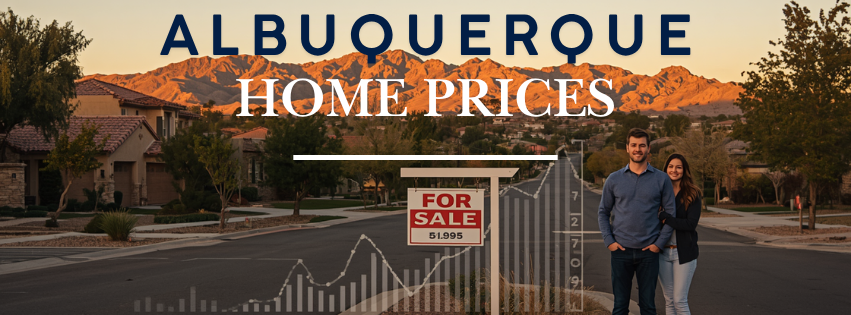
According to Redfin's current Albuquerque housing market data, the median sale price of a home in Albuquerque was $365,000 last month — up 7.4% year over year. The median sale price per square foot is $214, up 1.4% year over year. Albuquerque's median sale price remains 16% below the national average.
That 7.4% year-over-year appreciation is not a blip. It is consistent with the trajectory that local and national analysts have been tracking throughout the first half of 2026. Albuquerque home values rose approximately 3% in 2025 — which directly contradicted a widely-circulated prediction from a national firm that prices would fall by 4%. They did not fall. They grew. The people who waited for that predicted drop are now buying into a market that has appreciated further since that prediction was made.
Expert analysis from multiple sources points to continued moderate price appreciation of approximately 2.5% during 2026 — a figure that acknowledges the forward momentum in Albuquerque's real estate market while reflecting a measured pace compared to the peak appreciation years of 2021 and 2022.
The Supply Gap — The Structural Reason Prices Cannot Drop Significantly
The most important number in understanding why Albuquerque home prices will not drop in 2026 is not the current sale price. It is this: the Albuquerque metro is 13,000 to 28,000 housing units short of meeting current demand, according to estimates by Root Policy Research.
That is not a short-term inventory fluctuation. It is a structural deficit built up over years of underbuilding relative to population growth. Housing prices drop when supply exceeds demand. When demand exceeds supply by tens of thousands of units, prices do not drop — they are structurally supported even when sales volumes slow and days on market increase.
In 2025, the inventory of single-family homes for sale in the Albuquerque area actually decreased by 7% year over year, according to the Greater Albuquerque Association of Realtors' 2025 Annual Market Report. That is in a year when the national narrative was about inventory returning to balance. Albuquerque did not follow that narrative — because its local supply-demand dynamics are more constrained than most comparable metros.
What Local Experts Are Actually Saying in 2026
"I think there's still a little bit of dissonance coming off of COVID. It's always a cycle, but we're coming out of such a crazy period of time to something that's a little bit more stable." That is Teri Hatcher, 2026 Southwest MLS president, speaking to the Albuquerque Journal in March 2026.
Mackenzie Bishop, co-founder of Albuquerque homebuilder Abrazo Homes, described 2026 as "the first normal year for the local housing market since before COVID" — a characterization that aligns with what the data shows: not a crashed market, not a frenzied one, but a functioning, sustainable market returning to pre-pandemic norms.
Local real estate analysts Tego and Tracy Venturi, whose market forecasts have tracked closely with actual Albuquerque outcomes, describe the 2026 outlook as "steady, stable, not dramatic" — with moderate sales activity, modest appreciation, and a market that feels slower than the peak years but healthier and more sustainable for it.
The Scenarios — What Would Have to Happen for Prices to Drop
Being honest about this topic means addressing not just what is expected to happen, but what conditions would have to change for a meaningful price decline to occur. There are scenarios — none of which are currently forecasted as likely — under which Albuquerque home prices could weaken.
Scenario 1: Mortgage Rates Spike Significantly Higher
Mortgage rates are the single variable with the most direct short-term impact on buyer affordability and demand. Current rates are in the mid-to-upper 6% range for conventional 30-year loans, with FHA rates in the mid-5% range. If rates were to spike to 8.5% or higher — which would require a significant and unexpected Federal Reserve policy reversal — buyer demand would be materially suppressed and price pressure could build.
The current trajectory is the opposite. Rates have been quietly and gradually easing through the first half of 2026. "If you've been waiting, saying, 'I'm waiting for rates to drop, to go buy a house' — well, they've dropped," noted local real estate analyst Tego Venturi in a February 2026 market update. That rate direction, if it continues, points toward more buyer activity rather than less — which is a price-positive force, not a price-negative one.
Scenario 2: A Major Local Economic Shock
Albuquerque's economic base is built on federal government, healthcare, higher education, and military — sectors that are structurally stable and recession-resistant in ways that single-industry economies are not. Kirtland Air Force Base, Sandia National Laboratories, the University of New Mexico, Presbyterian Healthcare, and Lovelace Health System are the employment anchors of this market. None of them are vulnerable to the kind of rapid contraction that would flood housing inventory onto the market and suppress prices.
The city's emerging film production sector — anchored by Netflix Studios and other major production facilities — adds diversification. The Intel presence in Rio Rancho provides a high-wage manufacturing employment base that is unlikely to evaporate quickly. For prices to drop significantly in Albuquerque, something would have to go very wrong with the city's economic fundamentals in a way that is not currently on the horizon.
Scenario 3: A Sudden and Dramatic Increase in Housing Supply
If builders dramatically increased production — far beyond current projections — and flooded the market with inventory that exceeded buyer demand, prices could come under pressure. This is not happening. Abrazo Homes, one of Albuquerque's most active local builders, built 210 homes in 2025 and is increasing production modestly in 2026. The national home building environment is constrained by construction costs, labor, and land availability in ways that prevent the kind of supply surge that would materially change Albuquerque's demand-supply balance.
New construction is competing with resale homes at every price point — which creates competitive pressure on resale sellers — but it is not overbuilding in a way that destabilizes the market. Albuquerque builders are not making the same mistakes that defined the 2005 to 2007 overbuilding period that preceded the Great Recession's price declines.
The Scenario Most Likely to Actually Play Out
The consensus forecast from local and national analysts for the Albuquerque market in 2026 is continued modest price appreciation in the 2% to 4% range, with the higher end of that range becoming more likely if mortgage rates continue their gradual decline. A true buyer's market — defined as six or more months of housing supply — is not projected to materialize in Albuquerque in 2026. The market is moving toward balance, but it is not there yet, and the structural supply deficit makes it unlikely to tip fully into buyer's market territory this year.
The Prediction That Got It Wrong — And Why It Matters
In 2025, at least one nationally prominent real estate analytics firm predicted that Albuquerque home prices would decline by approximately 4% in the year ahead. That prediction was widely circulated and influenced some buyers to sit on the sidelines waiting for the drop.
The drop did not happen. Albuquerque home values rose approximately 3% in 2025 — a 7 percentage point gap between the prediction and the reality. Buyers who paused their search in anticipation of falling prices are now purchasing in a market that has appreciated from where they would have bought.
This is not a gotcha moment. Forecasting is genuinely difficult, and national models that use metro-level aggregates miss the local dynamics that make Albuquerque behave differently from markets with weaker fundamentals. The lesson is not that all forecasting is wrong. The lesson is that Albuquerque's structural supply deficit, stable economic base, and sustained in-migration from higher-cost markets create downside price protection that national models consistently underestimate.
Buyers who are waiting for a price drop that local fundamentals do not support are not being prudent. They are speculating on an outcome that the evidence consistently argues against.
What This Means by Price Segment and Neighborhood
The citywide appreciation figure conceals meaningful variation across price segments and neighborhoods. Here is the honest picture by category:
Entry-Level Homes Under $300,000
This is the most resilient segment in the Albuquerque market. Albuquerque's affordability advantage relative to Phoenix, Denver, and Austin continues to attract buyers at this price point from higher-cost markets. Any decline in mortgage rates disproportionately benefits entry-level buyers by expanding the affordability window — which means pent-up demand floods this segment first when rate relief arrives. Price drops in entry-level Albuquerque are the least likely outcome of any scenario.
Mid-Range Homes from $300,000 to $500,000
The sweet spot of the Albuquerque market. This is where the strongest buyer demand is concentrated in 2026 — families with school-zone priorities, out-of-state relocators, healthcare professionals, and dual-income professional couples. Neighborhoods like the Northeast Heights, Ventana Ranch, and Taylor Ranch in this price range are seeing consistent demand. Well-positioned listings in this segment are still moving in 15 to 20 days. Prices here are stable to modestly appreciating.
Luxury Homes Over $750,000
The luxury segment requires more time and more strategic positioning in 2026. Days on market for luxury properties run significantly longer than the metro average. Overpriced luxury listings are experiencing the price reduction dynamic more sharply than mid-range properties — with some high-end listings cycling through expired, withdrawn, and relisted status before finding buyers at adjusted prices. This segment is not crashing, but it is the one where the gap between correct pricing and wishful pricing is most visible and most costly.
The Neighborhoods Where Values Are Strongest
Northeast Heights, High Desert, Tanoan, and the foothills corridor continue to demonstrate the strongest price stability and the fastest absorption rates. These neighborhoods have the school zoning, safety profiles, and lifestyle amenities that create durable demand regardless of broader market conditions. Buyers who purchase in these areas are buying into markets with structural protection against downside price pressure.
Mesa del Sol and portions of the Westside are showing longer days on market — Mesa del Sol averaging around 111 days — as new construction supply creates competition within those specific micro-markets. This is not a price drop story — it is a days-on-market story that resolves as the infrastructure investment in those areas matures.
The Interest Rate Factor — The Variable Everyone Is Watching
Mortgage rates are the most significant external variable affecting the Albuquerque market in 2026 — and the direction of travel matters as much as the current level.
If rates stay in the 6.5% to 7.5% range, local analysts project continued stabilization with slow price growth of 1% to 2% annually. High rates suppress affordability and keep some buyers on the sidelines, but the structural supply deficit prevents that demand suppression from tipping into price declines.
If rates drop to the 5% to 6% range — which is within the range of current forecasts if Federal Reserve policy continues its current trajectory — the Albuquerque market will heat back up. The buyers who have been waiting on the sidelines due to affordability concerns will re-enter the market simultaneously. Inventory, already thin at around 1,500 active listings for the entire metro, will face a surge of demand that will push prices upward more aggressively — potentially 4% to 5% annual appreciation in desirable neighborhoods.
The buyers who are waiting for rates to drop before purchasing are making a specific bet: that rates will drop meaningfully before prices absorb the resulting demand surge. The historical pattern in markets with structural supply deficits like Albuquerque suggests that prices respond to rate drops faster than most buyers expect, because the sidelined buyer demand is large and will activate quickly.
What Buyers Who Have Been Waiting Should Actually Do
If you have been waiting for Albuquerque home prices to drop before buying — this section is specifically for you.
The waiting strategy made logical sense when it was formed. Prices were high. Rates were high. The national news was full of stories about housing corrections in overheated Sun Belt markets. It was reasonable to wonder whether Albuquerque would follow.
Here is what the data says that strategy has cost the average waiting buyer since mid-2024: approximately 7% in price appreciation on the home they would have purchased. On a $350,000 home, that is $24,500 in additional purchase price. Add in the mortgage payments the seller has been making on their current home while waiting, and the actual cost of waiting is higher still.
The correct question is not "will prices drop?" The data consistently answers that question: no, not meaningfully, not in 2026 in the Albuquerque market. The correct question is: "given current prices and current rates, does buying now make financial and lifestyle sense for my specific situation?"
That question has a different answer for every buyer — and it requires a real conversation about your financial position, your target neighborhood, your timeline, and your long-term goals. What it does not require is a price drop that the market's structural fundamentals argue strongly against.
For a broader look at what the current market means for buyers and sellers right now, our Albuquerque housing market update for 2026 covers every current data point in depth. And if you are a seller wondering whether to list now or wait, our guide to whether to sell your home now or wait gives you the complete framework for that decision.
What Sellers Should Take Away From This
For sellers, the 2026 Albuquerque market picture is best summarized this way: prices are not falling, but the market is not as forgiving as it was in 2021. The sellers who achieve strong outcomes in this environment are the ones who price from current comparable sales data rather than peak-year expectations, who prepare their homes to compete with new construction's modern presentation, and who launch with a strategy built around generating activity in the first two weeks.
The 7.4% year-over-year appreciation means that sellers who bought in 2023 or earlier have genuine equity to work with. The 38% of active listings that have taken price reductions means that sellers who launch too high are paying a real cost in time, carrying costs, and ultimately in final sale price.
The market rewards preparation and precision in 2026. It does not reward optimism divorced from data.
The Bottom Line — Prices Are Not Dropping. Now What?
Albuquerque home prices will not drop meaningfully in 2026. The structural supply deficit, stable economic base, sustained out-of-state buyer demand, and moderating rate environment all point in the same direction: continued modest appreciation in a stabilizing, healthier market.
The prediction of a 4% price drop that circulated in 2025 was wrong. The buyers who acted on that prediction and waited are now purchasing at prices 7% higher than they would have paid. The buyers who understood the local fundamentals and purchased accordingly have been right.
None of this means every home at every price point in every neighborhood will appreciate uniformly. It means that Albuquerque's market fundamentals are sound, that meaningful price declines are not supported by the evidence, and that the decision to buy or sell should be based on your personal situation and current market data — not on a headline forecast that may not understand what makes this specific market behave the way it does.
That is the honest answer. And it is the one that will hold up when you look back on the decision you make in 2026.
Ready to Make a Decision Based on Real Data?
Jenn & Vinay from The Rodgers Neighborhood Real Estate Group track the Albuquerque market at the neighborhood level every week. Whether you are a buyer who has been waiting for a price drop that is not coming, or a seller trying to understand what your home is worth in the current environment, the conversation starts with a call.
We will give you the current data for your specific neighborhood, your specific price range, and your specific situation — not a national forecast that may not apply to the street you are buying on.
Categories
- All Blogs (263)
- 2026 & Beyond for Real Estate (161)
- Doctors and Nurses looking for homes in NM (4)
- Guide to buying a home in NM (123)
- Health Care Heros (6)
- Home Upgrades (25)
- Jenn & Vinay your Local Real Estate Experts! (86)
- Moving to Albuquerque (100)
- Neighborhoods in Albuquerque NM (73)
- Rent or Own (2)
- Sellers Questions for Selling homes (2)
Recent Posts






GET MORE INFORMATION