
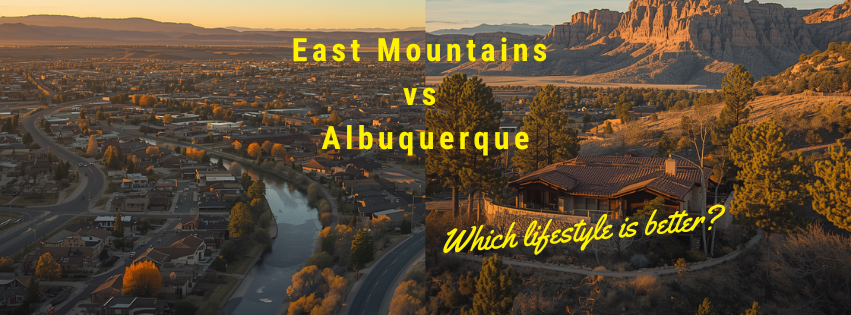
East Mountains vs Albuquerque: Which lifestyle is better?
It is one of the most common conversations I have with buyers exploring the greater Albuquerque market.
They have done their homework. They know they want New Mexico. They love what they have seen of the city. But then they drive east through Tijeras Canyon on I-40, the desert scrub gives way to piñon and ponderosa, the elevation climbs, and something shifts. The air smells different. The pace feels different. Suddenly the question is not which neighborhood in Albuquerque — it is whether to skip Albuquerque entirely and live in the mountains.
East Mountains vs Albuquerque is not a comparison most national real estate sites cover well. So this guide is for the buyers actually wrestling with it — the ones who need a clear-eyed look at what each choice actually means day to day, financially, and long term.
What "The East Mountains" Actually Means
Before making a fair comparison, it helps to understand what you are actually considering when you say "East Mountains."
The East Mountains is not a single city or suburb — it is a loose collection of distinct communities strung along I-40 and Highway 14 east of the Sandia Mountains. The area is comprised of Tijeras, Cedar Crest, Sandia Park, Edgewood, Moriarty, Estancia, Mountainair and other surrounding areas east of Albuquerque. Each has its own character, price range, elevation, and distance from the city:
- Tijeras — closest to Albuquerque, sitting at over 6,000 feet elevation, small-town feel with direct I-40 access, fewer than 500 residents
- Cedar Crest — the most amenity-rich of the East Mountain communities, with grocery stores, restaurants, banks, and its own farmer's market
- Sandia Park — quieter and more scenic, situated along the eastern Sandia slope, beloved for its proximity to Tinkertown Museum and Sandia Crest trails
- Edgewood — the regional hub, more open and expansive, with a Walmart, Smith's, chain restaurants, and a growing community feel about 20–30 minutes from ABQ
Mountain living is just a short 15-minute drive east of Albuquerque from the closest communities — though that number stretches meaningfully once you get to Edgewood, Moriarty, or beyond.
The Lifestyle Comparison — What Each Side Actually Offers
The Case for the East Mountains
The East Mountains sell themselves on a feeling that is genuinely difficult to describe until you have experienced it — and nearly impossible to replicate once you have.
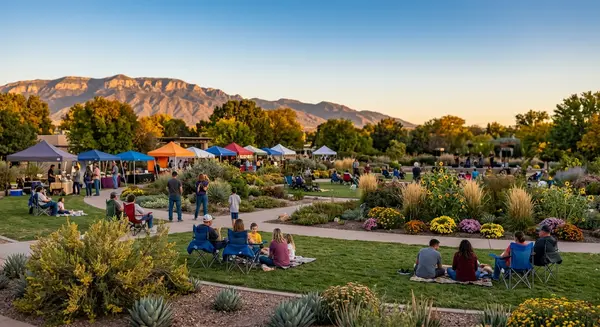
The clear night skies are amazing for star gazing. You can smell the wonderful scents of nature — especially the pine trees — while breathing in the crisp and fresh mountain air. You are close to hiking trails you can explore or even scenic drives. If you love snow, you will get more in the East Mountains.
That is not marketing copy. It is exactly what East Mountain residents consistently say when asked why they live there and why they stay. The lifestyle is outdoor-first, quiet, and deeply connected to the natural landscape in a way that no Albuquerque neighborhood — however nice — can fully match.
The specific advantages stack up quickly:
Space. East Mountain properties routinely sit on one, two, five, or more acres. For buyers coming from states where a quarter-acre lot feels generous, the land available in the East Mountains at comparable or lower price points is genuinely striking.
Privacy. No shared walls. No neighbors thirty feet away. No HOA telling you what color your mailbox can be. For buyers who have lived in dense suburban or urban environments for years, the East Mountains can feel like genuinely breathing for the first time.
Nature as your backyard. The landscape blends wooded hillsides with open land, making it ideal for those seeking more space and privacy while remaining within easy reach of the city. Tijeras, Cedar Crest, and Sandia Park are known for their tall pines, piñon-juniper woodlands, and other trees, creating serene settings perfect for enjoying nature right from your backyard.
The Turquoise Trail. Highway 14 — the Turquoise Trail Scenic Byway — runs north through the East Mountains toward Madrid and Santa Fe, giving residents one of the most scenic daily commute alternatives and weekend drives in the state.
Outdoor recreation at your doorstep. Sandia Peak Ski Area, Cibola National Forest trails, the Sandia Crest, and miles of mountain biking and hiking terrain are not day trip destinations for East Mountain residents — they are their backyard.
Tight-knit community. A slower pace prevails here, and a more hospitable attitude. People still wave when they pass each other on the road. For people exhausted by urban anonymity, that social texture is not a small thing.
The Case for Albuquerque
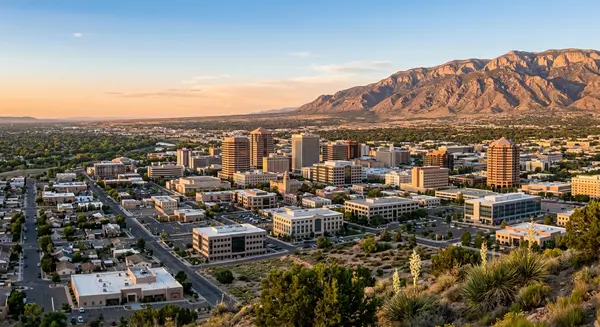
Albuquerque offers something the East Mountains structurally cannot: the full infrastructure of a metropolitan area of 565,000 people, immediately accessible from wherever you are in the city.
The practical advantages are wide-ranging:
No commute friction. For buyers who work in the city — at a hospital, Kirtland AFB, Sandia Labs, UNM, or any of Albuquerque's major employers — living inside the city eliminates the daily I-40 commute entirely. That matters more than most buyers calculate in advance.
Urban amenities, immediately. Restaurants, hospitals, specialty retail, cultural institutions, entertainment, and services are five to fifteen minutes away from virtually any Albuquerque neighborhood — not twenty to forty-five minutes.
Stronger school infrastructure. Major Albuquerque neighborhoods like the Northeast Heights and Tanoan have access to A-rated public schools including La Cueva High School, Georgia O'Keeffe Elementary, and Eisenhower Middle School. East Mountain schools are solid but smaller and more limited in program breadth.
Higher property liquidity. Albuquerque homes in desirable neighborhoods sell in 24–44 days on average. East Mountain properties can sit considerably longer depending on location, conditions, and market moment — a real consideration for buyers who need flexibility or anticipate reselling within five to seven years.
City utilities. Municipal water and sewer. Natural gas lines. Fiber internet in most neighborhoods. These are not considerations buyers in established Albuquerque neighborhoods think about — because they are simply there.
More neighborhood options. From the walkable energy of Nob Hill to the prestige of Tanoan to the suburban comfort of the Northeast Heights to the modern master plan of Mesa del Sol, Albuquerque has legitimate variety at every price point and lifestyle preference.
The Commute Reality — What Buyers Underestimate
This is the dimension most buyers underweight — and it is the one that most directly determines long-term satisfaction with an East Mountains choice.
The drive from Tijeras to Downtown Albuquerque on a clear morning runs approximately 15–20 minutes. From Cedar Crest, plan 20–30 minutes. From Sandia Park, 25–35 minutes. From Edgewood, 30–45 minutes. These are best-case numbers.
In winter, when snow hits the pass and the canyon road becomes icy, those numbers can double or triple. It is a longer commute to many things in the city, so prepare to spend money and time on travel and gas. You may have to plan "city days" to go into Albuquerque and make the most of it. You will have to plan more travel time to get places, especially in the winter snow.
This is not unique to New Mexico — it is the universal math of rural-adjacent living. What makes the East Mountains version of this tradeoff workable for many buyers is that I-40 is a fast, uncongested highway corridor for most of the route, and the commute time is genuinely reasonable by national standards. What makes it not workable for others is frequency: if you are driving that canyon twice a day, five days a week, 50 weeks a year, the romance wears off faster than the views do.
Remote workers, retirees, and buyers with flexible or local schedules tend to thrive in the East Mountains. Daily city commuters need to take an honest inventory of how they will feel about that drive in February, in the dark, on icy roads, after a long day.
The Real Cost Comparison — It Is Not What Most Buyers Expect
Home Prices and Land
This is where the comparison gets interesting. The East Mountains are not always cheaper than Albuquerque — they are different.
Land and home costs in Tijeras run approximately $350,000–$1.18 million. The average sale price in Cedar Crest recently came in around $564,000, up 13% year-over-year. Custom acreage homes in Sandia Park and gated communities like Nature Pointe and Eagle Crest Estates push higher. Edgewood offers the most affordable entry points in the region — more land for less money, with a semi-rural character that suits a specific buyer profile well.
The bottom line: for raw square footage and acreage, the East Mountains generally deliver more property per dollar than comparable Albuquerque neighborhoods. For turnkey suburban convenience, Albuquerque's mid-range neighborhoods remain competitive.
The Hidden Costs of East Mountain Living
Homes in Tijeras are fundamentally different from valley and suburban markets and require a more informed approach to buying. Homes are custom-built, often set on acreage, and influenced by factors such as water source, road access, elevation, and winter conditions. Community water systems, private wells, and hauled water are all common, and every property relies on a private septic system.
This is the most important practical reality of East Mountain homeownership that buyers from city backgrounds consistently underestimate. When you buy in the East Mountains, you are taking on the full responsibility of your home's water supply and waste management. Septic inspections are not optional extras — they are critical due diligence items that can and do affect purchase negotiations, lender approval, and long-term maintenance costs.
Beyond water and septic, East Mountain buyers should budget for:
- Propane — many homes are not on natural gas lines and use propane for heating and cooking
- A capable vehicle — four-wheel drive is a practical necessity for many East Mountain properties, not a lifestyle accessory
- Internet reliability — service quality varies significantly by exact location and is not consistently comparable to city options
- Wildfire insurance — fire risk is a real consideration in the East Mountains, and insurance costs reflect it
- Road maintenance — some properties are accessed by unpaved or steep roads that require ongoing attention
A Word on Water in the East Mountains
Water is not a footnote in the East Mountains — it is a central homeownership consideration. Properties may be served by a community water system, a private well, or in some cases hauled water. Each carries different cost structures, reliability profiles, and due diligence requirements. Before falling in love with a specific East Mountain property, understanding exactly how it is served for water is one of the first questions to ask and answer with your agent.
Schools, Services, and Daily Life
Schools: Albuquerque has the advantage here for breadth and ratings. East Mountain students in Tijeras, Cedar Crest, and Sandia Park attend A. Montoya Elementary, Roosevelt Middle School, and Manzano High School. Edgewood students attend South Mountain or Route 66 Elementary, Edgewood Middle, and Moriarty High School. These schools are well-regarded within their communities, but the program options and resources of larger Albuquerque schools — particularly La Cueva, Albuquerque Academy, and the district's magnet programs — are meaningfully broader.
Healthcare: Albuquerque wins without contest. Presbyterian, Lovelace, UNM Health, and a full medical infrastructure are city-based. East Mountain residents manage routine care locally but travel to Albuquerque for anything specialized.
Dining and retail: Cedar Crest has become a legitimate local food scene — Burger Boy has been winning accolades as the best burgers in New Mexico for four decades, and Rumor Brewing Co. offers brick-oven pizza, house-crafted beer, and a stunning Sandia Mountains view. That said, for consistent variety, Albuquerque is in a different category entirely.
Internet and remote work infrastructure: Improving across the East Mountains but still variable. Buyers who are remote workers should specifically verify their prospective address's service options before committing.
Who Belongs in the East Mountains — and Who Belongs in Albuquerque
After working with buyers across this entire region, the honest framework comes down to one core question: Is your life primarily city-based, or primarily home-based?
You likely belong in the East Mountains if:
- You work remotely, are retired, or have a flexible schedule that makes daily commuting irrelevant
- Acreage, privacy, and the outdoor lifestyle are your non-negotiables
- You are a hiker, mountain biker, equestrian, skier, or general outdoors-first person who wants recreation to be daily, not occasional
- You want a genuine small-town, tight-knit community atmosphere over the anonymity of a larger city
- You have experience with or are comfortable learning rural utilities — wells, septic, propane
You likely belong in Albuquerque if:
- You commute to work in the city five days a week
- School quality, breadth of programs, and extracurricular access are primary considerations for your children
- You value restaurants, hospitals, entertainment, and services within a short drive
- You anticipate needing to resell within five to seven years and want strong market liquidity
- The thought of managing a well and septic system is a source of stress rather than self-sufficient satisfaction
Neither answer is the right answer in the abstract. They are both right answers for specific people, specific priorities, and specific life stages.
The Bottom Line on East Mountains vs Albuquerque
The East Mountains offer a lifestyle that Albuquerque genuinely cannot replicate — pine-scented air, dark sky nights, mountain solitude, land, and the particular quiet that only comes from living above 6,000 feet in a place where cell coverage is spotty and your neighbors are hundreds of feet away.
Albuquerque offers a lifestyle the East Mountains cannot replicate — full urban infrastructure, a 15-minute drive to everything, strong schools, city-grade medical care, and a housing market with the liquidity and inventory to match.
The buyers who are happiest are almost always the ones who chose honestly — not aspirationally. The East Mountains resident who thrives is the one who genuinely wanted the mountain life, not the one who romanticized it from a suburban starting point. The Albuquerque resident who thrives is the one who wanted convenience and community depth, not the one who settled for it.
If you are working through this decision seriously, browse Albuquerque listings and East Mountain properties side by side — the price and property differences become immediately tangible when you look at real inventory.
Not Sure Which Is Right for You? Let's Figure It Out Together.
This is exactly the kind of decision that benefits from a conversation with someone who knows both sides of the canyon. Vinay Rodgers and The Rodgers Neighborhood Real Estate Group work with buyers across Albuquerque and the East Mountains — and we have helped plenty of people realize they belonged somewhere different from where they started.
We can help you find the right community, ask the right questions, and make a decision you will feel good about for years.
📞 (505) 417-2733 | rodgersvj@gmail.com 🏠 Browse all New Mexico listings →
Categories
- All Blogs (362)
- 2026 & Beyond for Real Estate (256)
- Doctors and Nurses looking for homes in NM (4)
- Guide to buying a home in NM (160)
- Health Care Heros (7)
- Home Upgrades (42)
- Jenn & Vinay your Local Real Estate Experts! (124)
- Moving to Albuquerque (139)
- Neighborhoods in Albuquerque NM (94)
- Rent or Own (2)
- Sellers Questions for Selling homes (2)
Recent Posts






GET MORE INFORMATION