

Why Overpricing Your Albuquerque Home Can Backfire Fast
Overpricing a home feels like a conservative strategy. You are starting high, leaving yourself room to negotiate, and protecting yourself from leaving money on the table. The logic seems reasonable on the surface.
The data says something different.
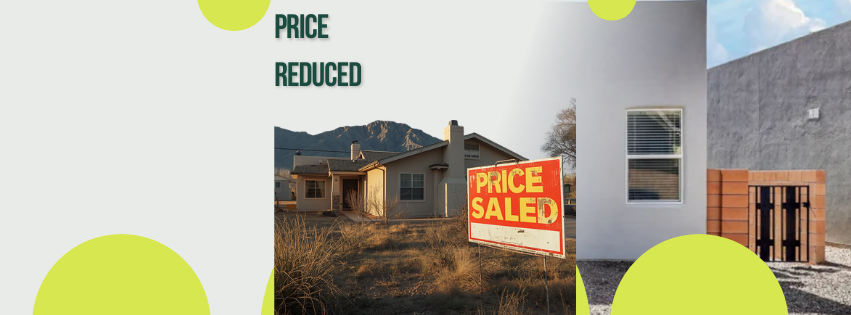
In Albuquerque's current market, 39% of active listings have taken a price reduction. That is more than one in three homes on the market right now — homes that started at a price the market would not pay, accumulated days on market while the silence built, and eventually took the reduction that a correct original price would have made unnecessary.
The sellers in that 39% did not plan to take a price reduction. They planned to sell. Overpricing was the mechanism that converted their plan into a problem — and it is a mechanism that works faster and more permanently in the 2026 Albuquerque market than most sellers anticipate when they are making the decision.
"Price your home right from day one. Overpriced listings sat long enough to go stale — and in a market where price cuts are trending down, needing one is a setback you can avoid. Albuquerque's market favors sellers — but doesn't forgive sloppy pricing," confirmed the Yahoo Finance April 2026 Albuquerque market analysis. That phrase — doesn't forgive sloppy pricing — is the precise characterization of the current market's tolerance for the overpricing mistake.
The Current Data — What Is Actually Happening Right Now
Before the mechanism explanation, the current market numbers that establish the context:
- 39% of active listings: Have taken a price reduction in the current period. This is the population of sellers who started above market and are paying the consequences.
- 57 days median days on market: The March 2026 median, up 14% year over year. This is the average outcome for the full market. Hot homes — correctly priced, well-prepared — are still going under contract in approximately 14 days. The 57-day average reflects the weight of the overpriced listings that are pulling the number higher.
- 5% of list price: What sold homes are receiving. This is the reward for correct pricing — a near-list-price sale without the renegotiation that overpricing produces. The sellers in the 39% are not receiving 98.5% of their list price. They are receiving less than 98.5% of a reduced list price.
- Median listing price: $389,545 (Realtor.com, April 2026): Basically flat year over year. Prices have stabilized. The market is not appreciating fast enough to bail out an overpriced listing — unlike 2021, when market appreciation itself sometimes rescued listings that started above market.
The specific market description that most accurately characterizes 2026 Albuquerque: selective. Well-priced homes in desirable locations still move quickly. Overpriced homes sit, accumulate market time, and eventually settle for less than a correct original price would have produced. The market is not a safety net. It is a mirror.
The Week-by-Week Damage Cascade
The specific sequence that transforms an overpriced listing into a price-reduced, extended-market-time problem is not a single event. It is a cascade of smaller events, each one making the next outcome worse. Understanding the cascade explains why overpricing backfires so fast — and why the damage compounds rather than simply pausing until the price is corrected.
Days 1-7: The Silence That Speaks
The first week of a new listing is when the market's response is most concentrated and most informative. The buyers who have been searching in this price range and neighborhood — who have been waiting for a new listing — receive the new-listing notification. They evaluate the home online. If the price and presentation are aligned with their expectations, they schedule showings. If they are not, they do not.
An overpriced listing in the first week produces a specific and telling kind of silence. The showing requests do not come. The buyer agents who routinely monitor new listings for their clients look at the price, look at the comparables they are already tracking for their buyers, and make the immediate professional assessment: this is priced above where it will transact. They do not bring their clients.
What the seller experiences in week one: few or no showing requests, despite being a new listing in an active market. This is the market's first message. It is also the most actionable moment — the moment when the overpricing damage is still reversible without stigma, because the days-on-market counter has not yet accumulated to the level that registers as a warning signal to buyers.
Days 8-21: The Showing Feedback Accumulates
The second and third weeks of an overpriced listing produce showings — not from the motivated, market-watching buyers who would have engaged in the first week, but from curiosity visitors whose agents bring them to satisfy due diligence, buyers who have not yet fully calibrated to the market and think the price might be justified, and the occasional serious buyer whose search parameters are broader than the price range's comparable set.
The showing feedback from these visits is consistent: priced too high. Not the condition. Not the location. Not the floor plan. The price. When three consecutive showing feedback reports say the same thing, the market is not expressing an opinion — it is providing accurate information about where the transaction will and will not occur.
Many sellers in this position wait for one more showing before making a pricing decision. That impulse — one more showing, maybe the next one will be the buyer — is the mechanism that converts a two-week problem into a six-week problem.
Days 22-45: The Stigma Begins
By the time a listing has been on the market for three to four weeks without a contract, the buyer psychology has shifted in a specific and consequential way. As the Wedgewood Homes March 2026 market analysis directly states: "Buyers — and their agents — are watching listing history. A home that's been on the market for 60 days with one price reduction doesn't look like a deal. It looks like a home other buyers passed on. That perception is hard to shake."
The stigma begins not at 60 days but at approximately 21 to 30 days in the current Albuquerque market, where the median days on market for hot homes is 14 days. A home that has been available for 30 days without a contract is already twice as old as the market's fastest-moving properties. Buyers who are evaluating it know this. Their agents know this. The question they are all implicitly asking — what's wrong with it? — does not need to be spoken to influence their approach.
What changes: buyers who would have made aggressive, near-list-price offers in the momentum window (first 14 days) are now making offers with more caution, more contingencies, and more price negotiation. The seller who was trying to protect against leaving money on the table by starting high has created the exact negotiating dynamic — a skeptical buyer with leverage — that they were trying to avoid.
Days 45-90: The Price Reduction and Its Aftermath
The price reduction that eventually arrives on a stagnating listing is not the clean reset that most sellers expect it to be. It does produce a burst of renewed attention — the "price reduced" badge on Zillow and Redfin generates re-engagement from buyers who previously saw the listing and passed. That burst is real.
What the burst cannot provide: the momentum-window conditions that existed when the listing first went active. The buyers who are now re-engaging with the price-reduced listing are doing so with the full context of the listing's history. They know:
- The listing has been on the market for 6 to 10 weeks. That duration communicates that motivated buyers at market price have already passed. The buyer who is now engaging has leverage.
- The seller has already reduced once. That reduction communicates a motivated seller who has responded to market feedback. The buyer who is now negotiating knows the seller will negotiate further.
- The price reduction itself is visible as a listing event. Every serious buyer checks the listing history. The date of the price change, the original price, and the current price are all visible. The buyer is negotiating against a seller whose ceiling has already been demonstrated to be moveable.
The result: the price-reduced listing frequently sells below where a correctly priced listing would have transacted — despite the fact that the price after the reduction may actually be at or near correct market value. The stigma of accumulated market time and the demonstrated seller motivation from the price reduction combine to produce a final sale price that is below what the correctly priced original listing would have achieved.
The Appraisal Trap — How Overpricing Can Kill a Deal Even When You Find a Buyer
There is a version of the overpricing backfire that sellers rarely anticipate: the scenario where an overpriced home eventually attracts an above-market offer, and the deal still collapses — because of the appraisal.
When a buyer uses financing to purchase a home — which describes the overwhelming majority of Albuquerque transactions — the buyer's lender requires a licensed appraisal to confirm that the property is worth the amount being borrowed. The appraiser is working from the same data as the agent's CMA: the recent closed comparable sales in the same neighborhood and price range. If the contract price is above what the comparable sales support, the appraisal will come in below the contract price.
The specific outcome: the buyer's lender will only finance the appraised value, not the contract price. The buyer then faces a choice: pay the difference between the appraised value and the contract price in cash (above their original down payment), renegotiate the price to the appraised value, or walk away from the transaction. Many buyers choose the third option.
The seller who was overpriced is now back on the market with a failed contract — which is the most damaging possible market event. A failed contract communicates to every subsequent buyer that another buyer evaluated the home and chose not to complete the purchase. Even when the failure was caused by an appraisal gap rather than a home deficiency, the market does not always distinguish between the two.
Correct first-time pricing eliminates this risk entirely. A home priced at or slightly below market value will appraise at or above the contract price because the comparable sales that support the listing price also support the appraisal. The appraisal becomes a confirmation rather than a threat.
The Carrying Cost Clock — What Every Unsold Day Costs
The financial cost of overpricing extends beyond the eventual sale price. Every day a home remains unsold costs the seller in carrying costs — the mortgage payment, property taxes, insurance, utilities, and maintenance that continue during the period of market time that overpricing creates.
For a median-priced Albuquerque home with a $380,000 purchase price and a standard mortgage:
- Monthly mortgage payment (principal + interest, 6.30% rate): Approximately $1,800 to $2,100 depending on down payment
- Property taxes (Bernalillo County, approximately 0.79% annually): Approximately $250 per month
- Homeowner's insurance: Approximately $100 to $150 per month
- Utilities (maintaining showing-ready condition): Approximately $150 to $200 per month
- Total monthly carrying cost: Approximately $2,300 to $2,700 per month
A home that sits for 60 days because of overpricing — 30 days longer than the 30-day sale that a correct price would have produced — carries an additional $2,300 to $2,700 in costs. If the eventual sale price is also $10,000 lower due to accumulated market stigma and the buyer's strengthened negotiating position, the total overpricing cost is $12,300 to $13,700. The overpricing that was designed to protect value has destroyed it — by a specific, calculable, avoidable amount.
The Comparison Shopping Effect — How Albuquerque Buyers Research in 2026
The 2026 Albuquerque buyer is not evaluating your listing in isolation. They are comparing it in real time against every other active listing in the same price range and neighborhood — and they are doing this comparison with more data and more sophistication than buyers in any previous real estate cycle.
Zillow, Redfin, and Realtor.com allow buyers to filter by price, bedrooms, square footage, and neighborhood, and to compare active listings side by side in seconds. A buyer who is searching for homes in the $380,000 to $420,000 range in the Northeast Heights has an immediate visual comparison of every listing in that category. If your home at $415,000 has the same square footage as a comparable home at $389,000 and lacks the comparable's mountain views or updated kitchen, the buyer understands the comparison without being told.
"Overpriced homes will sit, driving that 60-day average even higher. You must work with a knowledgeable agent to ensure your listing is priced exactly right," confirmed the Norada Real Estate Albuquerque market forecast. The 'exactly right' framing is not a figure of speech. In a market where buyers have immediate comparison tools, a listing that is $15,000 to $25,000 above its comparable peers is not competing — it is simply advertising the competition.
The specific mechanism: a buyer touring homes in the $390,000 to $420,000 range who sees your home at $415,000 and a comparable at $389,000 in the same visit leaves with a ranking. If your home does not specifically justify the $26,000 premium through quantifiable features — better views, larger lot, recent renovation, school zone premium — it loses the comparison. The buyer makes an offer on the $389,000 home, or waits. Your home accumulates days on market.
The Albuquerque-Specific Factors That Make Overpricing More Consequential Here
New Mexico Non-Disclosure State — Buyers Are More Data-Dependent on Agents
New Mexico's non-disclosure status — meaning sold prices are not part of the public record — means that buyers in Albuquerque rely more heavily on their buyer agents' CMA work to understand market values than buyers in disclosure states who can independently verify pricing from public records. A buyer working with an active, knowledgeable buyer agent is receiving a current CMA for every property they consider. That CMA tells the agent — and through them, the buyer — exactly where the overpriced listing stands relative to recent closed sales.
The implication: in Albuquerque, the buyer's agent is almost certainly more aware of the overpricing than the seller realizes. The agent is not bringing their client to an overpriced listing with the intent of paying above market — they are either not bringing them at all, or they are bringing them with the specific intent of making a below-market offer that leverages the accumulated days on market.
The Active New Construction Competition
Albuquerque's active new construction market — with national builders offering rate buydowns, appliance packages, and builder warranties across the Westside, Mesa del Sol, and Rio Rancho corridors — provides the specific competition that resale sellers who overprice ignore at their cost. A buyer comparing a $415,000 resale home to a $399,000 new construction home with a builder warranty, modern systems, and a 2-1 rate buydown is not comparing apples to apples. They are comparing their total cost of ownership, their risk profile, and their monthly payment — and the overpriced resale loses that comparison more decisively than the list prices suggest.
The Out-of-State Buyer's Research Standard
Albuquerque's growing relocation buyer base from California, Seattle, and Denver arrives with a specific research standard: they have been comparing Albuquerque to other markets and to Albuquerque's own neighborhood-level comparable sales for weeks or months before their visit. A buyer from Los Angeles who has been researching Albuquerque real estate for 90 days knows the market better than many casual in-market buyers. They will identify an overpriced listing immediately and will not make an offer unless the price reduction justifies re-engagement.
What Correct Pricing Actually Prevents
The case for correct first-time pricing is not merely avoiding the negative consequences of overpricing. It is the specific positive outcome that correct pricing produces — the momentum-window sale at near-list price that overpricing makes impossible.
A correctly priced home in the current Albuquerque market:
- Generates showing concentration in the first weekend: Multiple motivated buyers evaluate the home simultaneously, creating the competitive dynamic that produces the strongest offers.
- Appraises at or above the contract price: Because the list price is supported by recent comparable sales, the appraiser's work confirms rather than threatens the transaction.
- Produces offers from buyers who have not yet engaged their skepticism: The first-weekend buyer is excited, not strategic. The day-60 buyer is strategic, armed with leverage, and specifically motivated by the perceived weakness that accumulated market time communicates.
- Closes the carrying cost clock faster: Every week of reduced carrying costs is direct financial return on the decision to price correctly.
- Eliminates the failed-contract risk: No appraisal gap, no failed transaction, no back-to-market signal.
For the full framework on how to build the correct price from current comparable sales — including the New Mexico non-disclosure state advantage that makes MLS-based CMA the only reliable pricing source in this market — our guide to how to price your Albuquerque home correctly the first time covers the complete process. And our companion post on the biggest pricing mistakes Albuquerque sellers are making right now catalogs every specific pricing error — overpricing is one of eight, and understanding all eight produces the most complete seller strategy.
The Bottom Line — The Market Responds to Price Immediately
Albuquerque's 2026 market is often described as still favoring sellers — the Market Action Index is above the seller's market threshold, supply is below the 10-year average, and correctly priced homes are still going under contract in 14 days. All of that is true.
It is also true that 39% of active listings have taken a price reduction. Both facts coexist because the market is not uniformly generous. It is generous to correctly priced homes and selectively brutal to overpriced ones. The generous version of the market — the 14-day sale at 98.5% of list price — is available. It requires one specific decision to access it: a first-day price that is supported by the current comparable sales data and positioned to generate the buyer competition that produces the best possible outcome.
The cost of overpricing is not speculative. It is documented in the 39% of listings with price reductions, the 57-day median market time for all listings, and the specific financial calculation of carrying costs, appraisal risk, and negotiating leverage lost for every day a listing sits above where the market will transact.
Overpricing does not protect value. It destroys it — and it begins destroying it within the first week of an above-market listing going live.
Ready to Price Your Home Right From Day One?
Jenn & Vinay from The Rodgers Neighborhood Real Estate Group provide Albuquerque sellers with the specific, MLS-based comparative market analysis that produces correct first-day pricing — and the honest conversation about why the number the data supports is the number that produces the best outcome, even when it is not the number a seller hoped to hear. The conversation, and the free CMA, starts with a call.
Jenn & Vinay Rodgers are Albuquerque's trusted real estate professionals with The Rodgers Neighborhood Real Estate Group, brokered by Real Broker, LLC, serving buyers and sellers across Albuquerque, Rio Rancho, Corrales, Los Lunas, Tijeras, Cedar Crest, Sandia Park, the East Mountains, Bernalillo County, Sandoval County, and surrounding New Mexico communities.
The Rodgers Neighborhood Real Estate Group
Jenn & Vinay Rodgers
Real Broker, LLC
Albuquerque, NM
📞 505-417-2733
🏠 Get your free Albuquerque home valuationCategories
- All Blogs (332)
- 2026 & Beyond for Real Estate (228)
- Doctors and Nurses looking for homes in NM (4)
- Guide to buying a home in NM (146)
- Health Care Heros (7)
- Home Upgrades (40)
- Jenn & Vinay your Local Real Estate Experts! (113)
- Moving to Albuquerque (131)
- Neighborhoods in Albuquerque NM (89)
- Rent or Own (2)
- Sellers Questions for Selling homes (2)
Recent Posts


GET MORE INFORMATION