
Why Investors Are Watching Albuquerque's West Side Closely — The 2026 Analysis
The West Side of Albuquerque — the residential communities and developing master-planned areas west of the Rio Grande — has historically attracted families seeking newer construction at accessible prices without the Northeast Heights premium. In 2026, a specific combination of infrastructure investment, residential density increase, long-term employment development, and one irreplaceable geographic characteristic is drawing investor attention at a level the West Side has not previously experienced.
This guide covers the specific reasons the West Side is receiving increased investment scrutiny in 2026, with the honest assessment of what the investment case actually is and what it is not.
The Foundation — What Albuquerque's West Side Is
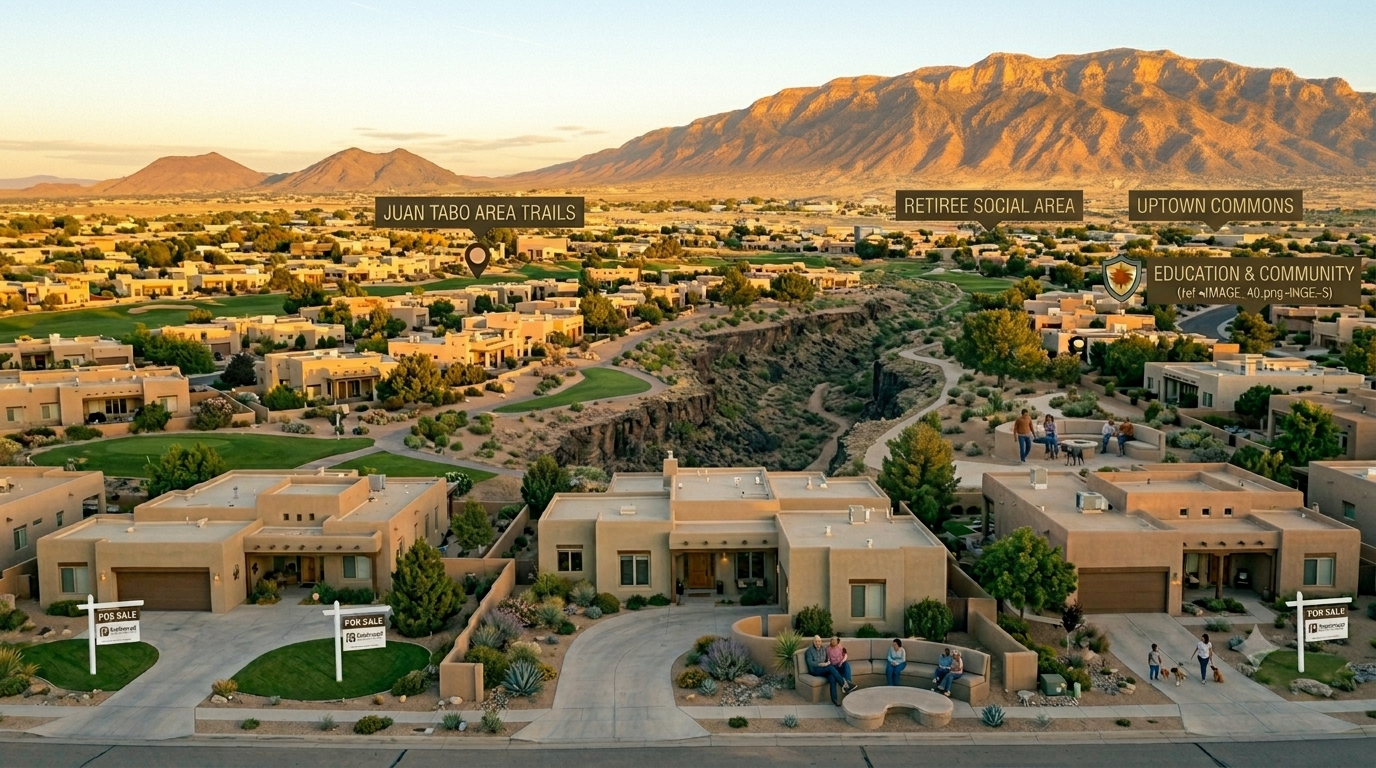
The West Side's geographic and demographic profile provides the baseline: "The Westside includes all the area west of Coors Boulevard, north of I-40, and south of Rio Rancho. It is bounded by the Petroglyph National Monument on the far Westside. This massive part of the city is home to over 69,000 people of all ages and walks of life. With a median home price of $370,000 as of May 2026 and an average of $208 per square foot, many people can find a great home on this side of town. Most homes were built after 2000, giving many neighborhoods a more modern vibe," confirmed ABQ Mom's Albuquerque West Side Moving Guide (May 2026).
The key data points from this most-current West Side overview:
- $370,000 median home price (May 2026): Above the overall Albuquerque median of $355K (Redfin May 2026) — indicating that the West Side's predominantly newer construction commands a slight premium over the city's older housing stock overall.
- $208 per square foot: Above the $200-$212/sqft citywide range confirmed by Steadily and Redfin — consistent with the newer construction premium.
- 69,000+ residents: A substantial and growing residential population that is the tenant base for West Side rental investments and the consumer base for the retail and services infrastructure that is developing to serve them.
- Mostly post-2000 construction: The specific investment advantage of newer stock: lower deferred maintenance, energy-efficient construction, modern systems, and the design preferences (open floor plans, attached garages, master suites) that the current rental and buyer market specifically requests.
- Active new construction ongoing: Unlike established neighborhoods where all development has been absorbed, the West Side has active builder presence across multiple communities — providing both new-construction acquisition opportunities and the ongoing development activity that drives neighborhood improvement.
Reason 1 — The Petroglyph National Monument Boundary: The Most Durable Investment Protection in West Albuquerque
The single most consequential factor in the West Side investment case is also the one most often treated as merely a lifestyle feature: the western boundary of the developed West Side communities is formed by Petroglyph National Monument's 7,244 acres of federally protected land. This is not a city park that could be rezoned. It is not a green belt with development potential. It is a federally designated national monument under the management of the National Park Service and the City of Albuquerque — land that can never be developed for residential, commercial, or industrial use.
Why this matters as an investment: the most powerful appreciation driver in any real estate market is geographic constraint — the impossibility of supply expansion in response to demand. When a neighborhood's boundaries are physically fixed, growing demand can only be satisfied by price increases rather than additional supply. The West Side's federally protected western boundary creates a specific permanent constraint on western expansion.
Properties in Volcano Cliffs, Petroglyph Estates, Piedras Marcadas, and the other Petroglyph-adjacent communities specifically benefit from this constraint: their western views across the monument's volcanic landscape and the ancient basalt escarpment are permanently unobstructed. No future development will block those views. The proximity premium embedded in those properties will not be eroded by development because development cannot occur there.
Reason 2 — The 283-Unit Apartment Complex Approval: Density Increasing Near the Monument
A specific 2026 development news story confirms that residential density on the West Side is actively increasing despite community opposition: "On the 10-acre parcel of land next to the Petroglyph National Monument, developers are proposing a 283-unit apartment complex. Despite community concerns, the Environmental Planning Commission commissioners were overwhelmingly in support of moving the plans forward," confirmed KRQE's December 2025 West Side development coverage. The original plans were set in motion in 2017 and approved in 2024.
The approval of the 283-unit apartment complex near the monument is a significant data point for West Side investors for several reasons:
- The EPC approval confirms city support for West Side residential density: Despite community and tribal opposition regarding viewshed concerns, the city's planning commission overwhelmingly supported the development — indicating institutional support for continued West Side residential growth.
- 283 new units adds to the rental tenant pool: New apartment inventory means more potential tenants are living on the West Side — which supports the retail and service development that the West Side is still building out, and reduces the daily cross-river commuting that historically characterized the West Side's bedroom-community status.
- The viewshed controversy is an honest disclosure: The community opposition to the monument-adjacent development represents a real tension between property rights and cultural sensitivity. The Pueblo of Laguna's concerns about the spiritual significance of the monument's viewshed are legitimate and documented. Investors considering monument-adjacent properties should be aware that this type of development approval process and the associated community concerns are part of the West Side's development story.
Reason 3 — The Volcano Heights Long-Term Vision: From Bedroom Community to Self-Sufficient District
The most important long-term investment story on Albuquerque's West Side is not the current residential market — it is the Volcano Heights area's planned transition from a residential subdivision zone to a mixed-use urban district with employment, retail, and higher-density residential components integrated into a walkable environment.
The Volcano Heights sector plan — developed through the City of Albuquerque's planning process — envisions the Volcano Heights area (the northern West Side communities near the monument's volcanic cones) as a higher-density employment and mixed-use node. The plan's specific elements:
- Employment center development: The plan specifically incorporates employment centers into the Volcano Heights area — the specific transition from bedroom community to self-sufficient district that would reduce the West Side's dependence on cross-river commuting and create the economic activity that sustains retail and service development.
- Mixed-use urban character: Higher-density residential development alongside commercial and retail creates the walkable district character that currently does not exist on the West Side at any meaningful scale.
- Panoramic view preservation: The Volcano Heights communities already have some of the most spectacular panoramic views in Albuquerque — the Sandia Mountains to the east, downtown Albuquerque below, and the vast western mesa extending to the horizon. The planned development specifically focuses on preserving and incorporating these views into the mixed-use environment.
The investor timing observation: Volcano Heights-adjacent properties are currently in the early-to-middle stages of this development trajectory. The employment centers and mixed-use development that will eventually produce the most significant appreciation premium are planned but not yet built. Buyers who enter this specific geography at current pricing are purchasing the trajectory before it is fully reflected in prices.
Reason 4 — The West Side's Established Master-Planned Communities: Proven Value Retention
Ventana Ranch — The Maturity Model
Ventana Ranch, one of the earliest significant West Side master-planned communities, has been developing since the 1990s and now provides the most complete picture of what a maturing West Side community looks like: mature landscaping, an extensive trail system, established school reputations, and the specific community character that only decades of residential occupation produces. For investors, Ventana Ranch represents the endpoint of the West Side's development trajectory — and its consistent value retention through multiple market cycles confirms that the West Side's investment fundamentals are durable rather than speculative.
The Ventana Ranch investment lesson: the community avoided the dramatic speculative spikes that characterized some newer communities while maintaining consistent value retention through market fluctuations. The pattern of slow but stable appreciation with minimal downside risk is the specific investment profile that the West Side's newer communities are likely to follow as they mature through the same development stages.
Taylor Ranch — The Affordable Family Rental Sweet Spot
Taylor Ranch represents the core of the West Side's proven rental market — the established suburban family community with good schools (for its zone within APS), proximity to Cottonwood Mall's commercial infrastructure, and the family-friendly residential environment that attracts the dual-income household tenant demographic. Properties in Taylor Ranch in the $260,000-$340,000 range consistently produce the best rent-to-price ratios available on the West Side, serving the tenant base that Kirtland AFB employees, Healthcare workers from the Lovelace system, and the broader West Side population represent.
Cabezon and the Master-Planned North West Communities
Cabezon, in the northwestern section of Albuquerque west of Rio Rancho Road, represents the HOA-supported master-planned community model at its most complete — community pool, parks, trails, and the maintained common environment that specifically appeals to the family tenant who values community amenity infrastructure. Cabezon properties serve both the Rio Rancho employment corridor (Intel's Fab 11X facility is accessible within 20-25 minutes) and the West Side residential demographic, providing the crossover investor opportunity between Albuquerque West Side pricing and Rio Rancho employment demand.
Reason 5 — The Intel Connection: Rio Rancho Employment's Spillover to the West Side
Intel's $3.5 billion Fab 11X expansion in Rio Rancho — adding an estimated 1,000+ technical jobs to an already large employment base — creates specific residential demand that does not stop at the Rio Rancho city limit. The northern West Side communities of Albuquerque, immediately south of the Rio Rancho border, are within 20-25 minutes of Intel's campus and provide Intel employees with the family-friendly suburban character of Rio Rancho's planned communities at Albuquerque's property tax rate (0.79% vs. Sandoval County's slightly higher rate) and with Albuquerque's school zone access.
The Intel-to-West Side commute: the Paseo del Norte corridor runs directly from the northern West Side of Albuquerque (through Ventana Ranch and the Cabezon area) to the Rio Rancho/Intel employment zone. An Intel professional living in the Cabezon or northern Ventana Ranch area has a 15-20 minute commute that is specifically accessible and specifically relevant to the investment case.
Reason 6 — New Construction Quality at Scale: Active Builder Market
The West Side has the most active builder presence of any Albuquerque residential sector in 2026, with multiple builders (Abrazo Homes, Hakes Brothers, and national builders) actively constructing new homes across a range of price points. Active new construction serves investors in several ways:
- Renovation-free rental inventory: New construction rentals in the $1,500-$1,900/month range on the West Side attract the professional tenant demographic that specifically values modern construction. The investor who acquires a new-construction or near-new property avoids the deferred maintenance costs that older construction carries.
- Comp-setting activity: Active builder sales in a neighborhood set comparables that support resale values. The investor whose acquisition price is supported by nearby new construction sales at similar or higher prices has a specific protection against appraisal gaps and resale compression.
- Energy efficiency performance: Post-2000 construction with current energy codes in Albuquerque's high-altitude desert climate produces significantly lower utility costs than older construction — a specific operating cost advantage for the investor whose lease is structured as a gross rent rather than a net rent with tenant-paid utilities.
Reason 7 — Unser Boulevard and Improving Infrastructure Connectivity
The expansion of Unser Boulevard as a north-south arterial connecting the West Side communities from the southern end to the Rio Rancho border has improved the West Side's internal connectivity dramatically. Previously, movement north and south across the West Side required navigating residential collector streets. Unser's expanded capacity provides the arterial connectivity that converts the West Side from a series of disconnected subdivisions into a coherent community corridor.
Infrastructure investment of this type — arterial expansion that improves circulation and reduces travel time — is a specific preceding condition for commercial development. As Unser Boulevard's traffic volumes increase and the connectivity is established, the commercial nodes along the corridor attract the retail, dining, and service businesses that reduce the West Side's dependence on the Cottonwood Mall corridor and the cross-river commercial infrastructure of Central Albuquerque.
The Honest Investment Assessment — Strengths, Limitations, and the Right Buyer
The Westside Investment Strengths
- Permanent western boundary (Petroglyph NM): The most durable single supply constraint on the West Side — federally protected land that can never be developed.
- New construction quality stock: Post-2000 homes with modern systems and energy efficiency.
- Active development trajectory: The Volcano Heights employment vision is planned but not yet complete — current pricing does not fully reflect the trajectory.
- Intel/Rio Rancho commute accessibility: The fastest-growing employment corridor in the metro is accessible from the northern West Side communities.
- New rental inventory demand: The 283-unit apartment approval and ongoing residential growth are building the residential density that supports retail and services development.
The Westside Investment Limitations
- Car dependence is total: The West Side has essentially no transit access, minimal walkability, and requires a car for every errand. This limits the tenant demographic to car-owning households and reduces the long-term flexibility as demographics shift toward car-optional preferences.
- Not the La Cueva school zone: The West Side is served by APS schools in its geographic zone, not the La Cueva and Eldorado zones that drive the Northeast Heights premium market. Families specifically requiring the La Cueva zone will not find it on the West Side.
- Still largely a bedroom community: The cross-river commute to Central Albuquerque's employment centers remains the West Side's primary mobility pattern. The Volcano Heights employment vision is planned; it is not yet realized.
- Cultural sensitivity around monument adjacency: Development near Petroglyph National Monument involves legitimate cultural concerns from Pueblo communities regarding viewshed preservation. Investors in monument-adjacent properties should be aware of this ongoing tension.
Who Should Be Watching the West Side in 2026
- The long-horizon investor (10+ years): The Volcano Heights employment vision, if realized, produces above-market appreciation for properties purchased at current pre-employment-center pricing.
- The new-construction rental investor: Post-2000 West Side homes in the $270,000-$380,000 range produce the best low-maintenance rental income from family tenant demographics.
- The Intel-employment-adjacent buyer: Northern West Side communities with Paseo del Norte access to Rio Rancho are specifically positioned for Intel workforce demand.
- The Petroglyph-adjacent monument-view buyer: Properties backing the monument with permanently protected open space views have a specific, permanent premium that other West Side properties do not.
For the complete framework of which Albuquerque neighborhoods have the strongest structural appreciation case — and how the West Side's Petroglyph boundary fits within that framework — our post on the best Albuquerque neighborhoods for long-term real estate appreciation covers the full six-driver model. And for the rental income specifics on the West Side's Taylor Ranch and Ventana Ranch communities, our post on the top Albuquerque areas for rental property investment covers the GRM and cap rate data by neighborhood.
The Bottom Line — The West Side Is Worth the Attention It Is Getting
The West Side is not Albuquerque's highest-appreciation market — the Northeast Heights foothills and the supply-constrained North Valley and Corrales communities have stronger structural appreciation cases for buyers who can access those price tiers. But the West Side in 2026 has a specific combination of attributes that is producing legitimate investor attention: the federally permanent western boundary, the Intel-adjacent northern communities, the active new construction quality stock, the Volcano Heights long-term employment vision, and the recent infrastructure investment that is incrementally reducing the bedroom-community status.
The investor who enters Albuquerque's West Side in 2026 and holds for 10-15 years, in a Petroglyph-adjacent or Intel-commute-positioned property, is buying into a trajectory whose endpoint is a more complete, more economically self-sufficient, and more valuable community. That endpoint is not guaranteed on a specific timeline — West Side development has always moved more slowly than optimistic projections. But the federally protected western boundary is permanent, the Rio Rancho employment growth is current and documented, and the city's planning investment in the Volcano Heights employment vision is ongoing.
The West Side is worth watching in 2026. The investors who are watching it know why.
Interested in West Side Albuquerque Investment?
Jenn & Vinay from The Rodgers Neighborhood Real Estate Group cover the full Albuquerque market including the West Side communities — from the established Ventana Ranch rental sweet spot to the monument-adjacent Volcano Cliffs new construction to the Intel-commute-positioned Cabezon neighborhoods. We know which West Side properties are backing the Petroglyph National Monument boundary, which are positioned for the Volcano Heights employment vision, and which produce the best current rental returns in the Taylor Ranch and Cabezon corridors. The conversation about West Side investment starts with a call.
Jenn & Vinay Rodgers are Albuquerque's trusted real estate professionals with The Rodgers Neighborhood Real Estate Group, brokered by Real Broker, LLC, serving buyers and sellers across Albuquerque, Rio Rancho, Corrales, Los Lunas, Tijeras, Cedar Crest, Sandia Park, the East Mountains, Bernalillo County, Sandoval County, and surrounding New Mexico communities.
The Rodgers Neighborhood Real Estate Group
Jenn & Vinay Rodgers
Real Broker, LLC
Albuquerque, NM
📞 505-417-2733
🏠 Browse Albuquerque West Side homes and investment propertiesCategories
- All Blogs (362)
- 2026 & Beyond for Real Estate (256)
- Doctors and Nurses looking for homes in NM (4)
- Guide to buying a home in NM (160)
- Health Care Heros (7)
- Home Upgrades (42)
- Jenn & Vinay your Local Real Estate Experts! (124)
- Moving to Albuquerque (139)
- Neighborhoods in Albuquerque NM (94)
- Rent or Own (2)
- Sellers Questions for Selling homes (2)
Recent Posts


GET MORE INFORMATION