

Is Mesa del Sol a Smart Long-Term Investment? — The Honest 2026 Analysis
The Mesa del Sol investment question does not have a simple yes or no answer — and the analysis that produces only one of those answers without the context of the other is not serving the buyer or investor well. This guide covers both sides fully: the genuine and substantial long-term investment case that Mesa del Sol's employer anchors and public investment are building, and the specific cautionary history that any honest analysis of a 21-year-in-progress master-planned development must include.
What Mesa del Sol Is — The Scale and the Vision
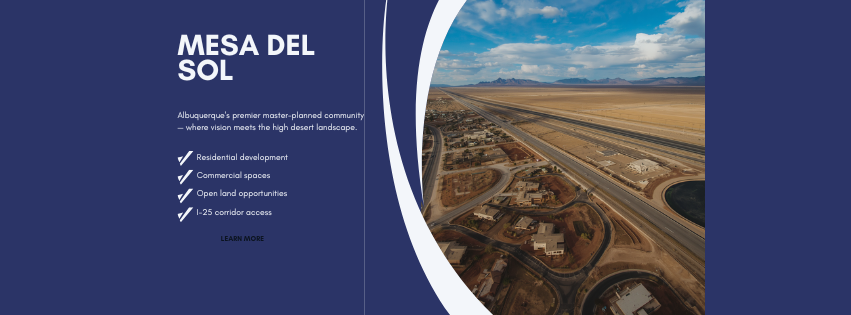
Mesa del Sol is one of the largest master-planned communities in the United States. "Mesa del Sol is a 12,900-acre mixed-use community located on Albuquerque's South Mesa. By combining job creation with sustainable urban community planning, Mesa del Sol will represent a blend of natural resources, economic objectives, and social amenities in a community with a forward-looking and distinct sense of place," confirmed the Mesa del Sol Wikipedia entry (updated March 2026). The full development plan calls for 37,000 homes on 4,400 acres of residential property and 18 million square feet of office, industrial, and retail space.
The geographic position: Mesa del Sol sits in southeastern Albuquerque, bounded by the Albuquerque International Sunport to the northwest, Kirtland Air Force Base to the north and east, the Isleta Reservation to the south, and Interstate 25 to the west. This position places it approximately 6 miles southeast of downtown, within minutes of the airport, and adjacent to the military and federal employment corridor that extends from Kirtland through the southeastern quadrant.
The development history: Mesa del Sol was conceived in the early 2000s as a public-private partnership between the City of Albuquerque, the State of New Mexico, and Forest City Enterprises. It broke ground in 2005. The 2008 financial crisis significantly slowed development and eventually led to Forest City's withdrawal from the project. The community has continued to grow under different developer management, but at a slower pace than the original projections anticipated. In 2026, the development is active and growing — but the full 37,000-home, 18-million-square-foot vision is a multi-decade project, not a near-term achievement.
The Employer Anchors — The Strongest Part of the Investment Case
The most compelling single element of the Mesa del Sol investment case is its employment base — a cluster of major employers that is growing, not contracting, and that represents some of the most economically durable industries in the American economy:
Netflix / Albuquerque Studios — The Flagship Anchor Expanding
Netflix acquired Albuquerque Studios — located within Mesa del Sol — in 2018, making Mesa del Sol home to one of the largest film production facilities in the United States. Netflix has employed nearly 4,000 local film and production workers, merchants, and talent at the Mesa del Sol facility, making it one of the most significant private sector employment anchors in Albuquerque.
The 2026 expansion announcement substantially improves the investment case: "Netflix has recently announced plans to expand its existing campus by an additional 300 acres, making its North American headquarters in Albuquerque one of the largest high-tech and sustainable film production facilities in the world. The expansion will create an estimated 1,000 new jobs and more than double production capacity with the addition of 10 new sound stages to supplement the 8 existing stages," confirmed Colliers' Mesa del Sol commercial property analysis.
The Netflix expansion is the single most significant positive 2026 development for the Mesa del Sol investment case. Adding 300 acres, 1,000 jobs, and 10 sound stages to an already large facility increases Mesa del Sol's employment base dramatically — and employment is the foundational driver of residential demand and rental income. The professionals and skilled workers hired for the Netflix expansion will need housing, and Mesa del Sol's proximity is a direct advantage.
The Breaking Bad connection: the original ABQ Studios — now Netflix's facility — served as the headquarters for Breaking Bad and Better Call Saul filming, as well as The Avengers, The Lone Ranger, and The Book of Eli. The desert exteriors of Breaking Bad visible to worldwide audiences were filmed on Mesa del Sol's terrain. The global cultural visibility this produced for Mesa del Sol is an indirect but real brand asset.
Fidelity Investments — Expanding Financial Services Anchor
Fidelity Investments operates a major regional client services and human resources support center at 5401 Watson SE in Mesa del Sol — a 216,000 square-foot facility that is currently undergoing a $2.5 million expansion adding approximately 10,000 square feet. Fidelity's ongoing and expanding presence represents the financial services sector's confidence in Mesa del Sol as a viable long-term business location.
Fidelity's employee profile — financial services professionals, customer service specialists, HR professionals — represents a different and complementary tenant and buyer demographic from the film industry workers Netflix employs. The combination of film industry employment and financial services employment creates a more diverse economic base than either sector alone would provide.
Kairos Power and the Technology Sector
Kairos Power, a company developing advanced molten-salt nuclear micro-reactor technology, has established a presence at Mesa del Sol — bringing a high-technology, high-skilled employment sector to the community. The nuclear technology sector, backed by federal research funding and the proximity to Kirtland Air Force Base's extensive energy research infrastructure, represents the kind of long-term, high-wage employment anchor that sustains residential demand through economic cycles.
The technology cluster dynamic: Netflix, Fidelity, Kairos Power, and the UNM Film & Digital Arts department at the Mesa del Sol Aperture Center create a multi-sector employment cluster that is more resilient than a single-industry employment base. The diversity of sectors — film, financial services, nuclear technology, higher education — reduces the specific vulnerability that single-employer community dependence creates.
Maxeon Solar Technologies and the Renewable Energy Sector
Maxeon Solar Technologies represents the renewable energy manufacturing sector at Mesa del Sol — aligned with New Mexico's growing position as a hub for solar and renewable energy infrastructure. The state's solar resources and competitive incentive environment have attracted energy sector investment, and Mesa del Sol's industrial land is positioned to accommodate this growth.
The New Mexico United Sports Complex — Community Infrastructure
New Mexico United has developed a multi-sport complex within Mesa del Sol — currently six fields established in a 180-acre complex with a long-term plan for 32 fields and New Mexico United's own practice facility. The sports complex creates a community infrastructure anchor that specifically serves family demographics and increases the daily activity and foot traffic that supports the retail and service development the master plan envisions.
The Current Residential Development — Momentum Confirmed in 2025-2026
"Mesa del Sol, a 12,900-acre master-planned community in southern Albuquerque, has emerged as a hub for commercial and residential growth in recent years. The community's growth coincides with numerous employers planting roots in the area, including Netflix, Maxeon Solar Technologies and Kairos Power," confirmed the Albuquerque Journal's Mesa del Sol development coverage (May 2025). The 167-lot Montage 5 infrastructure completion in May 2025 marked a significant milestone.
The residential development status:
- Montage subdivision: The primary residential development at Mesa del Sol. 872 total lots planned across 7 phases. As of mid-2025, 617 lots had been handed to builders with approximately 600 homes built. The May 2025 completion of Montage 5 infrastructure (grading, utilities, roads) released 167 additional lots to builders — the most recent phase of active residential construction.
- Encanto: 318-unit apartment project recently completed, adding substantial rental inventory and increasing the residential density that supports the retail and service development the master plan requires.
- Via Verde I: 248-unit apartment project, completed in late 2025, further increasing the residential population base.
- Price range: New construction in Mesa del Sol's Montage subdivision typically runs $300,000-$410,000 — below the Albuquerque Northeast Heights premium tier but comparable to the westside established communities. The new construction premium (warranties, energy efficiency, modern systems) is valued by the Mesa del Sol buyer who is specifically choosing new construction over resale.
The Infrastructure Investment — Public Commitment Signals
Public infrastructure investment is one of the most reliable signals of long-term development commitment — when a city or county invests its capital outlay budget in a neighborhood's infrastructure, it signals a multi-decade commitment to the community's viability:
- $8 million University Boulevard expansion: The City of Albuquerque is investing approximately $8 million to expand University Boulevard over the Tijeras Arroyo, improving access to Mesa del Sol from the north. Infrastructure investment of this scale signals the city's view that Mesa del Sol is a permanent and growing part of Albuquerque's residential and commercial geography.
- $4.3 million Bernalillo County sports complex: Bernalillo County is seeking $4.3 million in capital outlay funding to develop a sports complex at Mesa del Sol — complementing New Mexico United's existing multi-sport facility. County-level capital investment confirms the multi-governmental commitment to Mesa del Sol's long-term success.
- New fire station: The City of Albuquerque has allocated funds for a new fire station at Mesa del Sol. Of all the infrastructure signals that indicate a neighborhood's permanence and long-term support, the allocation of emergency services funding is among the most concrete and most irreversible. A city does not build fire stations in neighborhoods it is not committed to serving for decades.
The Honest Counterpoint — Why the Investment Requires Patience and Calibrated Expectations
The Mesa del Sol bull case is real and the current momentum is genuine. The honest analysis must also include the specific realities that qualify the enthusiasm:
21 Years of Slower-Than-Projected Development
Mesa del Sol broke ground in 2005 with original plans that projected significantly faster development than has occurred. The 2008 financial crisis was the most severe single disruption — it froze residential development nationally and specifically devastated master-planned community economics. Forest City Enterprises eventually withdrew from the project, transferring development management to different partners.
In 2026, the community is still described in its own Wikipedia article as "uncompleted." This is not a criticism — it is an accurate description of a 12,900-acre master planned community that is genuinely large and genuinely complex. But the buyer or investor who enters Mesa del Sol with the expectation that the full 37,000-home, 18-million-square-foot vision will be complete within a decade is misreading the development timeline. The full realization of Mesa del Sol's vision is a 20-40 year project from today.
The Retail and Services Gap
The master plan's vision for retail, dining, and services integrated within walking distance of the residential communities is not yet fully realized. Mesa del Sol residents in 2026 are driving to other parts of Albuquerque for most of their everyday commercial needs. This car-dependence is a quality-of-life and investment limitation — the neighborhood character that a walkable mixed-use community produces is specifically what Mesa del Sol's vision promises and what its current reality does not yet fully deliver.
This gap will narrow as the residential population increases (the Encanto and Via Verde apartment completions, the Montage subdivision's continued build-out, the Netflix workforce expansion) and as the retail threshold — the residential density required to support neighborhood-serving businesses — is reached. But it has not yet been reached, and the timeline for reaching it depends on development velocity that has historically been slower than projected.
The School Zone Reality
Mesa del Sol is served by Albuquerque Public Schools — not the La Cueva or Eldorado zone that drives the premium demand in the Northeast Heights. For families whose home purchase decision is primarily driven by school zone access, this is a material difference. The school serving Mesa del Sol does not carry the same documented premium that La Cueva and Eldorado carry in the resale market.
This is not a criticism of the schools serving Mesa del Sol — it is a statement about the specific market dynamic that school zone premium creates in Albuquerque real estate. The family buyer who specifically needs the La Cueva zone will not find it in Mesa del Sol; the family buyer for whom school zone is less determinative will find Mesa del Sol's new construction value proposition more attractive.
The Developer Continuity Uncertainty
The original development vision required sustained, multi-decade developer commitment that Forest City Enterprises's withdrawal disrupted. The current development partnership — Titan Development and MDS Investments — is actively building and producing results (the Montage 5 infrastructure completion is genuine progress). But the 21-year history of Mesa del Sol includes a major developer transition, and the investor evaluating Mesa del Sol's long-term trajectory should be aware that the full vision's realization depends on sustained private-sector commitment that has historically proven vulnerable to economic cycle disruption.
The Specific Buyer and Investor Who Should Consider Mesa del Sol
The Long-Horizon Buyer
The buyer who purchases in Mesa del Sol and intends to hold for 15-20 years is buying into a development trajectory whose eventual outcome — a complete mixed-use community with walkable retail, major employers, and established residential character — is compelling. The buyer who purchases today and expects 5-year appreciation equivalent to the Northeast Heights is misaligning their expectations with the development timeline.
The 15-20 year holder who purchases a $340,000 Mesa del Sol home and holds through the Netflix expansion's employment buildout, the retail development's eventual arrival, and the community's continued population growth is positioned for above-market appreciation relative to comparable price-point purchases elsewhere in the city. The appreciation that emerges as the vision materializes will specifically reward buyers who entered before the vision was widely priced in.
The New Construction Value Buyer
Mesa del Sol's active new construction in the Montage subdivision provides new homes with warranties, energy efficiency, and modern systems at prices ($300K-$410K) that are competitive with comparable-quality new construction elsewhere in Albuquerque. The buyer who values new construction quality and is comfortable with the current lifestyle limitations of a developing community finds Mesa del Sol specifically suitable.
The Employment-Adjacent Buyer or Renter
Professionals hired by Netflix's 300-acre expansion, by Fidelity Investments, by Kairos Power, or by the sports complex operations will be looking for housing in or near Mesa del Sol. The investor who owns a rental property in the community at the time this workforce expansion arrives is positioned to capture the above-market rental demand that new employment typically produces in the adjacent residential market.
The Investment Verdict — Smart Long-Term, Patient Required
Mesa del Sol is a smart long-term investment for the buyer whose definition of long-term is 10-20 years rather than 3-5 years. The employer anchor strengthening (Netflix's 300-acre expansion is the most consequential single 2026 development in Mesa del Sol's history), the public infrastructure investment (fire station, University Boulevard), and the continued residential build-out (600+ homes built, 167 new lots in progress) collectively indicate a development trajectory that is genuinely positive in 2026.
What Mesa del Sol requires — and what it has always required — is patience. The 37,000-home vision will not be complete in five years. The retail and services infrastructure will not arrive on a predictable schedule. The school zone premium that drives the Northeast Heights market does not apply here. These are real limitations that an honest analysis cannot overlook.
The buyer who understands the 10-20 year investment timeline, who is comfortable with the current lifestyle limitations of a developing community, and who recognizes the genuine employer anchors as the strongest single indicator of long-term success will find Mesa del Sol's current pricing to be a reasonable entry point for a patient investment in one of Albuquerque's most ambitious long-term development projects.
The buyer who needs the full community infrastructure now, who values the La Cueva school zone, or whose holding horizon is 5 years or less will find Mesa del Sol's current stage of development misaligned with their needs.
Honest answer: for the right buyer with the right time horizon, yes. For the wrong buyer with the wrong time horizon, no. Mesa del Sol's investment case is specifically about alignment — between the buyer's horizon and the development's trajectory, between the buyer's lifestyle tolerance for a developing community and the community's current stage.
For the complete framework of what makes Albuquerque neighborhoods appreciate over time — and how Mesa del Sol's employer anchors and infrastructure investment fit within that framework — our post on the best Albuquerque neighborhoods for long-term real estate appreciation covers the structural drivers in detail. And for the broader picture of where Albuquerque home values are rising fastest today, our post on which Albuquerque neighborhoods are appreciating the fastest in 2026 covers the current market signals.
Thinking About Mesa del Sol?
Jenn & Vinay from The Rodgers Neighborhood Real Estate Group have followed Mesa del Sol's development trajectory over the years and can provide the specific, current picture of what is actively being built, what the school zone assignment means for resale value, and how the Netflix expansion and public infrastructure investment compare to other Albuquerque neighborhoods at the same price point. Whether you are evaluating Mesa del Sol as a primary residence or an investment, the conversation about whether it fits your specific situation starts with a call.
Jenn & Vinay Rodgers are Albuquerque's trusted real estate professionals with The Rodgers Neighborhood Real Estate Group, brokered by Real Broker, LLC, serving buyers and sellers across Albuquerque, Rio Rancho, Corrales, Los Lunas, Tijeras, Cedar Crest, Sandia Park, the East Mountains, Bernalillo County, Sandoval County, and surrounding New Mexico communities.
The Rodgers Neighborhood Real Estate Group
Jenn & Vinay Rodgers
Real Broker, LLC
Albuquerque, NM
📞 505-417-2733
🏠 Browse Mesa del Sol and all Albuquerque listingsCategories
- All Blogs (362)
- 2026 & Beyond for Real Estate (256)
- Doctors and Nurses looking for homes in NM (4)
- Guide to buying a home in NM (160)
- Health Care Heros (7)
- Home Upgrades (42)
- Jenn & Vinay your Local Real Estate Experts! (124)
- Moving to Albuquerque (139)
- Neighborhoods in Albuquerque NM (94)
- Rent or Own (2)
- Sellers Questions for Selling homes (2)
Recent Posts






GET MORE INFORMATION