
Is Albuquerque a Good Place to Retire?
For a specific type of retiree — one who values outdoor activity, cultural richness, sunshine, affordability, and an authentic community character over resort amenities and beach proximity — Albuquerque is genuinely excellent as a retirement destination. For a retiree who prioritizes specialized healthcare access, walkability without a car, or the social infrastructure of a large retiree community in a purpose-built active adult environment, other markets serve better.
This guide provides the honest, category-by-category assessment of Albuquerque as a retirement destination in 2026 — including the two items that most generic retirement rankings either oversimplify or get wrong: the crime picture and the tax environment.
The 2026 Tax Environment — More Retirement-Friendly Than It Appears
New Mexico's retirement tax environment has improved significantly since 2022 and is now genuinely favorable for most retirees. The improvements are specific and important enough to cover first, because they often change the calculation for retirees who dismissed New Mexico based on older tax information.
Social Security — Exempt for Most New Mexico Retirees
Beginning with tax year 2022, New Mexico exempts Social Security benefits from state income tax for most seniors. The exemption applies to:
- Single filers and heads of household: Fully exempt if adjusted gross income is under $100,000
- Married couples filing jointly and surviving spouses: Fully exempt if adjusted gross income is under $150,000
- Married filing separately: Fully exempt if AGI is under $75,000
Approximately 86% of New Mexico seniors qualify for this exemption. The average qualifying senior saves approximately $710 per year in state income tax through this provision. For most middle-income retirees, Social Security income is completely free of New Mexico state income tax.
The 2026 Federal Senior Deduction — Breaking News for New Mexico Retirees
The "One Big Beautiful Bill Act" signed in 2025 introduces a new federal senior deduction that significantly benefits New Mexico's 400,000 qualifying retirees. The law creates an additional deduction of $6,000 for individual filers and $12,000 for married couples, layered on top of the standard deduction, effectively eliminating federal income tax on Social Security benefits for 88% of American seniors.
The combined result for a typical Albuquerque retiree: Social Security income is now effectively exempt at both the state level (for income under $100,000/$150,000) and largely exempt at the federal level through the new senior deduction. This is a materially better tax situation for Social Security recipients than existed even two years ago.
The 2026 Social Security COLA (cost of living adjustment) adds 2.8% to benefits — meaning recipients are seeing both increased benefit amounts and significantly improved tax treatment simultaneously.
Note: tax law is complex and individual circumstances vary significantly. Verify your specific tax situation with a licensed tax professional before making retirement location decisions based on tax projections.
Military Retirement — Fully Exempt in New Mexico
New Mexico fully exempts military retirement income from state income tax — a specific and significant benefit for the large veteran and military retiree community in the Albuquerque area. With Kirtland Air Force Base as a major local employer and a substantial veteran population throughout Bernalillo County, this exemption is specifically relevant for a large portion of Albuquerque's potential retiree population.
Property Taxes — Among the Lowest in the West
Bernalillo County's effective property tax rate of approximately 0.63% to 0.79% is well below the national average of 1.07%. On a $351,000 Albuquerque home, annual property taxes run approximately $2,213 to $2,773 — $184 to $231 per month. New Mexico's property tax limitation law also restricts rapid assessment increases on primary residences, providing predictability as values appreciate.
The specific comparison: in Colorado (a common comparison market for Albuquerque retirees), effective property tax rates in Denver-area counties run 0.5% to 0.8% — comparable to Albuquerque. In California, effective rates average approximately 0.74%, similar. In Texas, rates average 1.4% to 1.8%, significantly higher. New Mexico's property tax environment is competitive with or better than most comparable western markets.
Pension and IRA Income
Pension income and distributions from traditional IRAs and 401(k)s are taxable in New Mexico at the state income tax rates (1.7% to 5.9%). Seniors age 65 and older are eligible for a deduction of $8,000 on retirement income if their household AGI is under $28,500 — providing relief for lower-income retirees but less helpful for middle and upper-income retirees who have significant retirement account distributions.
The net tax picture: for most Albuquerque retirees on Social Security plus modest retirement account distributions, the combination of the Social Security exemption, the federal senior deduction, New Mexico's relatively moderate income tax rates, and the low property taxes produces a tax burden that is meaningfully below what comparable income would face in many other states. For high-income retirees with large retirement account distributions, the 5.9% top rate makes New Mexico less competitive with no-income-tax states like Nevada, Texas, and Florida.
The Climate Advantage — 310 Days of Sunshine
"Albuquerque is a good place to retire because of its affordable cost of living, access to great healthcare, a growing number of senior housing communities, warm and sunny climate, and its many cultural events and local community programs," confirmed the Extra Space Storage Albuquerque pros and cons guide (March 2026). The climate is the starting point for any honest Albuquerque retirement assessment, because it is the primary reason that active retirees specifically seek out the city.
The climate specifics that matter for retirement quality of life:
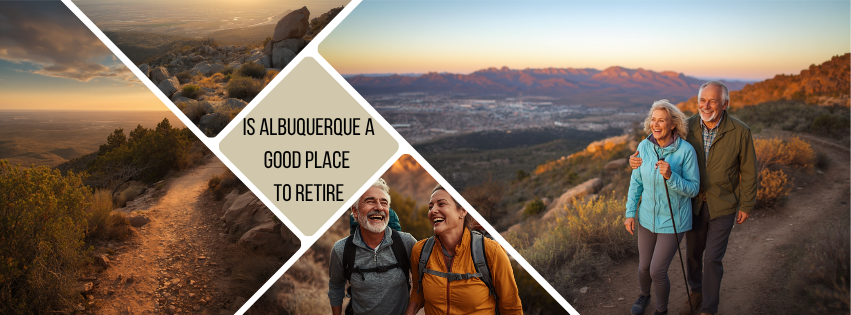
- 310 days of sunshine annually: More than virtually any other major American city. The outdoor lifestyle that sunshine enables — hiking, cycling, gardening, golf, outdoor dining — is available in Albuquerque across most of the calendar year in ways that cold-weather markets cannot match.
- Mild winters: Average January high temperature of 45 to 55 degrees. Snowfall is occasional and typically melts quickly from the valley floor. The mild winter that does not confine retirees indoors for 4 to 5 months is a specific quality-of-life advantage that retirees from the Midwest and Northeast most immediately appreciate.
- Dry heat: Summer heat in Albuquerque (90 to 100 degrees in July and August) is dry rather than humid, which most people find more tolerable than equivalent temperatures in humid climates. Morning temperatures are comfortable even in peak summer, allowing early-rising retirees to complete outdoor activities before the afternoon heat builds.
- Four distinct seasons: Spring wildflowers, fall cottonwood color, summer monsoon drama, and mild winter sunshine — Albuquerque experiences genuine seasonal variation without the extreme cold that makes winter retirement in northern climates physically and socially constraining.
- Altitude consideration: The city sits at 5,280 feet above sea level. This is generally manageable for healthy retirees — it is not the high-altitude stress of Denver's mountain suburban communities or Santa Fe's 7,000 feet. However, retirees with significant respiratory or cardiovascular conditions should consult a physician about altitude effects before committing to Albuquerque as a retirement destination.
Healthcare Access — Strong Academic Medicine, Limited in Some Specialties
Albuquerque's healthcare picture is more nuanced than the simple "limited healthcare" characterization that appears in some retirement rankings. The city has strong healthcare infrastructure for a metropolitan area of its size, with specific limitations that differ from what most retirees encounter in major coastal markets.
The UNM Health Sciences Center — Academic Medicine in Albuquerque
The University of New Mexico Health Sciences Center is New Mexico's only academic medical center — a comprehensive system that includes UNM Hospital (the state's only Level 1 Trauma Center), UNM Comprehensive Cancer Center, UNM Children's Hospital, and extensive outpatient specialty clinics. As an academic medical center, UNM attracts and trains specialists, making it the regional referral center for conditions requiring subspecialty care.
For retirees, the practical implication: conditions requiring subspecialty care — complex cancer treatment, advanced cardiac procedures, neurological subspecialties — are available within Albuquerque at the academic medical center. This is a significant advantage over smaller retirement markets where the nearest academic medical center requires a multi-hour drive.
Presbyterian Healthcare — The Largest NM Healthcare System
Presbyterian Healthcare Services is the largest healthcare system in New Mexico, with multiple Albuquerque hospitals and an extensive outpatient clinic network. Presbyterian Kaseman Hospital in the Northeast Heights is specifically well-positioned for the neighborhoods most retirement-oriented buyers target. Presbyterian's outpatient care network provides good primary care access throughout the city.
The Honest Healthcare Limitation
Retirement rankings that penalize Albuquerque for healthcare typically identify two legitimate limitations: specialty access wait times (longer for some specialties than in larger urban markets) and the fact that truly cutting-edge subspecialty procedures sometimes require travel to larger centers in Phoenix, Denver, or Houston for conditions not routinely handled at UNM.
For retirees with complex, active health conditions requiring frequent specialist visits or specialized procedures: this limitation is material and should be part of the location decision. For healthy, active retirees who need good primary care, general specialist access, and emergency capabilities: Albuquerque's healthcare infrastructure is adequate to excellent.
The VA healthcare option: For qualifying veterans, the Raymond G. Murphy VA Medical Center in Albuquerque provides comprehensive VA healthcare services — adding a third major healthcare system to the retiree's options and, for qualifying veterans, reducing out-of-pocket healthcare costs dramatically.
The Crime Reality — The Neighborhood Context That Rankings Miss
Albuquerque's crime statistics — which place it among the higher-crime American cities in national rankings — are the single factor most frequently cited as a retirement concern. The retirement-relevant context that those statistics require:
Albuquerque's citywide crime data includes neighborhoods that range from genuinely high-crime (certain Downtown, South Valley, and Central Avenue corridor areas) to well below the national average (the Northeast Heights foothills neighborhoods, parts of the North Valley, and the Far Westside). The neighborhoods where the overwhelming majority of Albuquerque's retirement-oriented buyers and existing retirees live are in the lower-crime segment of this range.
The specific neighborhood context for retirement searches:
- Northeast Heights (zip codes 87111, 87112, 87122): The primary destination for active adult and retirement-age buyers in Albuquerque. Proximity to the Sandia Mountain trail system, the La Cueva school zone (relevant for grandparents), and the Northeast Heights commercial corridors. Crime rates in these specific ZIP codes are well below the Albuquerque citywide average.
- East Mountain communities (Tijeras, Cedar Crest, Sandia Park): Rural character, significantly lower crime rates than the city, 15 to 30 minutes from Albuquerque proper. Popular with retirees who want the outdoors and lower density without full rural isolation.
- Rio Rancho: A separate municipality to the northwest with planned community character, lower crime rates than Albuquerque proper, and proximity to Albuquerque's cultural and healthcare infrastructure. Well-regarded as a retirement destination in its own right.
- Corrales: Agricultural village on the North Valley's west bank, extremely low crime rates, village character, bosque access, and the specific rural-near-urban combination that many retirees specifically seek.
The honest summary: the crime statistics that produce low retirement rankings for Albuquerque describe a genuine concern in specific parts of the city that most retirees do not choose as their neighborhoods. Selecting a retirement home in Albuquerque requires neighborhood-specific research using the CrimeGrade tool or similar resources rather than citywide statistics.
The Active Lifestyle Infrastructure — What Albuquerque Does Best for Retirees
Active retirees — those who plan their retirement around outdoor activity, cultural engagement, and social connection rather than passive leisure — find Albuquerque's specific infrastructure genuinely excellent.
Outdoor Recreation — Year-Round and Accessible
- Sandia Mountain hiking network: The foothills trail system is accessible from Northeast Heights neighborhoods without a drive, provides hiking at every difficulty level, and is one of the most generous urban hiking infrastructure offerings in the American West.
- Paseo del Bosque Trail: The 16-mile paved bosque trail provides cycling, walking, and wildlife watching along the Rio Grande — accessible, flat, and free.
- Golf: Multiple public and private golf courses take advantage of Albuquerque's 310 days of sunshine. The Arroyo del Oso and other public courses provide year-round play at reasonable rates.
- Sandia Peak Ski Area: 30 to 45 minutes from the city for the retiree who wants to ski without a major travel investment.
Senior Centers and Programming
The City of Albuquerque operates more than 20 senior centers offering programming, meals, fitness classes, social activities, and community connections throughout the city. The Albuquerque Senior Center at 328 Tijeras NW is the city's primary senior center facility, with a fitness center, pool, studio spaces, and extensive daily programming. The Senior Olympics program through the City of Albuquerque hosts annual athletic competitions for seniors across multiple disciplines.
The City's AARP Tax Assistance program — which provides free tax preparation through certified volunteers at senior centers throughout February through April — is specifically valuable for retirees navigating New Mexico's tax environment.
Cultural Life — One of Albuquerque's Strongest Retirement Assets
Albuquerque's cultural infrastructure is one of the most underrated retirement assets in any ranking that focuses primarily on financial metrics. The specific cultural institutions that retirees consistently cite:
- Indian Pueblo Cultural Center: The living cultural center of New Mexico's 19 Pueblos, with rotating exhibitions, weekend dance performances, and year-round cultural programming.
- National Hispanic Cultural Center: The performing arts complex with the largest commissioned fresco in North America, theater programming, and gallery exhibitions.
- Albuquerque Museum: Free Sunday mornings year-round.
- International Balloon Fiesta: The city's signature annual event, held in October — attended by retirees who specifically plan the month around it.
- First Friday ARTScrawl: Monthly free evening gallery walk — the social event that the arts-oriented retirement community attends consistently.
- Popejoy Hall: The UNM performing arts venue that brings Broadway touring productions, symphony, and major concerts to the city without requiring travel to a larger market.
Comparing Albuquerque to Other Western Retirement Destinations
Albuquerque vs. Tucson
The most frequently made comparison — both are sun belt desert cities with significant cultural heritage, below-average housing costs, and outdoor recreation access. Tucson has slightly lower crime rates in its best neighborhoods, a comparable climate (slightly hotter), strong University of Arizona medical access, and proximity to Mexico. Albuquerque has more dramatic mountain access (the Sandias vs. the Rincons), a stronger cultural arts infrastructure, lower property taxes, and the more extensive New Mexico DPA programs for age-55+ buyers who still need financing. Both are legitimate western retirement destinations. Tucson is slightly ahead on safety; Albuquerque is slightly ahead on outdoor dramatic geography.
Albuquerque vs. Santa Fe
Santa Fe is 60 miles north of Albuquerque and at 7,000 feet altitude — higher by 1,720 feet, which affects some retirees' respiratory comfort. Santa Fe has higher housing costs (median ~$650,000), more concentrated gallery and arts culture, and a smaller more intimate city character. Albuquerque has lower housing costs, more healthcare infrastructure, more senior center programming, and easier airport access. Many New Mexico retirees choose the Santa Fe/Albuquerque corridor — living in one and using the other's amenities — as a practical hybrid.
Albuquerque vs. Phoenix
"Albuquerque features walkable historic neighborhoods and offers classic desert scenery as well as a rich culture that incorporates a vibrant blend of Native American and Hispanic influences. Pros include: housing, utilities, and overall cost of living are more affordable than in most metro regions; Sandia Peak Tramway Area, Rio Grande Nature Center, and Balloon Fiesta Park offer recreational activities outdoors," confirmed the Motley Fool best places to retire in the West guide (January 2026).
The primary Albuquerque advantage over Phoenix: lower housing costs (Albuquerque median $351K vs. Phoenix ~$420K), lower overall cost of living, higher altitude meaning more temperate summers, dramatically more dramatic mountain scenery, and a richer authentic cultural heritage. Phoenix's advantages: more healthcare infrastructure (more specialty providers), warmer winters (important for retirees sensitive to cold), and the larger metro area's entertainment and airport options.
The Decision Framework — Is Albuquerque Right for Your Retirement?
Albuquerque retirement is likely a good fit if:
- You are an active retiree who plans to hike, cycle, garden, and use the outdoors regularly: Albuquerque's outdoor infrastructure is exceptional for this lifestyle.
- You value authentic cultural heritage over resort amenities: The Native American, Hispanic, and frontier history that permeates the city and its institutions is genuinely distinctive.
- Affordability matters — you want your retirement dollar to go further: At 4% below the national average cost of living and 10% below on housing, Albuquerque stretches a retirement budget meaningfully.
- You are a veteran or military retiree: The VA medical center, Kirtland Air Force Base community, full military retirement income exemption, and large veteran community make Albuquerque specifically supportive of military retirement.
- You are in good health and do not require frequent specialist visits: Albuquerque's healthcare is good — but for retirees managing complex ongoing conditions, the limited specialist depth relative to larger markets is a real consideration.
- You are comfortable with a car-dependent lifestyle: Albuquerque is not a walkable city in most neighborhoods. A retiree who plans to stop driving in the near term needs to factor in the transit limitations.
Albuquerque may be less suitable if:
- You have significant respiratory or cardiovascular conditions affected by altitude: Consult your physician. 5,280 feet is noticeable.
- You prioritize walkable neighborhoods over driving everywhere: Nob Hill is the most walkable Albuquerque neighborhood, but the city overall is car-dependent.
- You need frequent access to the most specialized medical subspecialties: UNM Health Sciences is strong but not a Mayo Clinic. Some conditions require travel.
- You have high retirement income and are sensitive to state income taxes: New Mexico's 5.9% top rate and pension income taxation are disadvantages vs. no-income-tax states for high-income retirees.
For the complete picture of what it costs to live in Albuquerque — including the monthly housing, utilities, and lifestyle costs that retirement planning requires — our post on the Albuquerque cost of living explained for 2026 covers the full category breakdown. And for the full lifestyle picture of what Albuquerque offers year-round, our complete guide to things to do in Albuquerque is the companion read.
The Bottom Line — Yes, For the Right Retiree
Albuquerque's retirement case in 2026 is stronger than it was five years ago — specifically because of the Social Security tax exemption improvements, the 2026 federal senior deduction, the growing senior community infrastructure, and the city's continued ability to deliver the outdoor lifestyle and cultural richness that active retirees specifically seek at a cost of living that is meaningfully below the western markets most of them are considering as alternatives.
The concerns are real: the citywide crime statistics require neighborhood-specific research, the healthcare depth is good but not exceptional for specialized conditions, and the car-dependent character of the city is a long-term consideration for retirees planning for a time when driving becomes difficult.
The opportunity is equally real: a city with 310 days of sunshine, some of the most dramatic accessible mountain scenery in the American West, a cultural heritage that is genuinely unique rather than manufactured for tourism, and an affordability position that most western retirees from higher-cost markets experience as a revelation.
The retiree who does the neighborhood-specific research, chooses the Northeast Heights or East Mountain communities where the crime statistics are well below average, and arrives with realistic expectations about healthcare access and car dependence will find Albuquerque to be one of the American West's most genuinely livable retirement destinations.
Considering Albuquerque for Your Retirement?
Jenn & Vinay from The Rodgers Neighborhood Real Estate Group work with retirees and pre-retirees evaluating Albuquerque from across the country — helping them understand which neighborhoods deliver the safety, access, and lifestyle they are looking for, which property types serve the mobility and maintenance preferences that retirement requires, and how the current market's affordability translates into a retirement home that serves the next chapter well. The conversation about whether Albuquerque is right for your retirement starts with a call.
Jenn & Vinay Rodgers are Albuquerque's trusted real estate professionals with The Rodgers Neighborhood Real Estate Group, brokered by Real Broker, LLC, serving buyers and sellers across Albuquerque, Rio Rancho, Corrales, Los Lunas, Tijeras, Cedar Crest, Sandia Park, the East Mountains, Bernalillo County, Sandoval County, and surrounding New Mexico communities.
The Rodgers Neighborhood Real Estate Group
Jenn & Vinay Rodgers
Real Broker, LLC
Albuquerque, NM
📞 505-417-2733
🏠 Browse Albuquerque retirement-friendly homesCategories
- All Blogs (352)
- 2026 & Beyond for Real Estate (246)
- Doctors and Nurses looking for homes in NM (4)
- Guide to buying a home in NM (158)
- Health Care Heros (7)
- Home Upgrades (40)
- Jenn & Vinay your Local Real Estate Experts! (120)
- Moving to Albuquerque (135)
- Neighborhoods in Albuquerque NM (93)
- Rent or Own (2)
- Sellers Questions for Selling homes (2)
Recent Posts





GET MORE INFORMATION