
How to Explore Albuquerque for Free Like a Local
Every city has two versions of itself. There is the version that appears in the itinerary — the list of attractions, the top-rated restaurants, the must-see sites. And there is the version that reveals itself to the person who slows down, wanders without a specific destination, and pays attention to what is actually in front of them.
The second version of Albuquerque is better than the first. Not because the attractions are overrated — the Tramway is genuinely extraordinary, Old Town is genuinely 320 years old, the petroglyphs are genuinely 700 years of human image-making on volcanic basalt. But because the space between the famous things is where the city lives. The mural on a Central Avenue building that does not appear on any tourism map. The three-generation conversation happening at the Frontier counter at 7:45am. The specific quality of the bosque light on a November morning when the cottonwoods are bare and the river is audible but invisible through the skeleton branches.
This guide covers the approach, the routes, and the habits that produce the second version of Albuquerque — free, specific, and available to anyone who shows up with the right posture toward the city.
The Approach — What 'Like a Local' Actually Means
Exploring a city like a local is not primarily about knowing the right places. It is about cultivating a specific relationship with time, pace, and curiosity that allows places to reveal themselves rather than requiring you to seek them out.
Local exploration is slow. A local who is walking through Nob Hill is not moving toward a destination at a pace calibrated to see the maximum number of things in the available time. They are walking at the pace that allows the wall mural to register, the bakery smell to produce a decision, and the gallery owner's eye contact to invite a conversation. The tourist's pace produces a checklist. The local's pace produces encounters.
Local exploration is opportunistic. When the farmers market vendor mentions the best green chile roaster in the lot, the local follows the suggestion. When the trail is quiet and leads somewhere unexpected, the local follows the trail. The itinerary is a starting point, not a commitment.
Local exploration is repeated. The best version of most Albuquerque experiences is not the first visit but the fifth or the tenth, when the specific quality of the light on a particular day, or the specific conversation with a particular person, adds to an accumulating relationship with a place rather than being a standalone event. The bosque at 6am in late October is better the fifth time than the first because the fifth time you know exactly where to stand when the sun clears the Sandia Mountains.
The Free Official Walking Tour Guides — Start Here
The most underused free resource for exploring Albuquerque like a local is the set of printable neighborhood walking tour guides that Visit Albuquerque provides on their official website. "Explore six of Albuquerque's most interesting and historic neighborhoods" with "handy printable guides that provide insight into Albuquerque's history," confirmed Visit Albuquerque's official walking tours page. The guides are free, printable, and self-guided — which means you can do them on your own schedule, at your own pace, with as many stops and diversions as you want.
Plaza to Plaza Walking Tour — Downtown to Old Town
The Plaza to Plaza walking tour connects Albuquerque's Downtown civic plaza to Old Town's historic plaza on foot — approximately 1.5 miles that pass through the transition from the railroad-era commercial corridor to the Spanish colonial residential district that predates the railroad by 150 years. The guide covers the architectural history of the buildings along the route: the Art Deco commercial buildings of the 1930s, the Mission Revival civic buildings, the KiMo Theatre's singular Pueblo Deco facade, and the specific buildings whose histories contain the specific human drama that general architectural descriptions omit.
The specific version of this walk that produces the most local experience: begin at the Downtown plaza in the early morning before the business district activates. Walk slowly. Read the building facades rather than the interpretive signs. The signs tell you the official history. The facades tell you what the people who built them valued — which is a different and usually more interesting story.
The Pueblo Deco Architectural Tour
The Art Deco Society of New Mexico has produced a specific tour of Albuquerque's Pueblo Deco architectural heritage — the specific style that blends 1920s Art Deco commercial architecture with Pueblo pottery motifs, Navajo textile patterns, and Spanish Mission forms in ways that produced a genuinely distinct regional architectural identity.
The KiMo Theatre is the most famous Pueblo Deco building — the world's only example of the style. But the tour's value is in the discovery of the other Pueblo Deco buildings across the Downtown and Route 66 corridor that are less photographed and equally specific to this city's architectural moment in the 1920s and 1930s. Walking this tour is walking through the specific decade when Albuquerque decided what it wanted to look like — and made choices that are visually legible eighty years later.
The Nob Hill Neighborhood Walk — Albuquerque's Best Walkable Hour
Nob Hill's Central Avenue corridor, from approximately Louisiana Boulevard to Washington Street, is the most concentrated hour of walkable Albuquerque that exists. Every block contains a gallery, an independent restaurant, a coffee shop, a bookstore, or a mural that rewards stopping. The Walk Score of 85 is not a data point — it is an accurate description of a neighborhood where you can spend three hours without a car and without running out of things to look at or into.
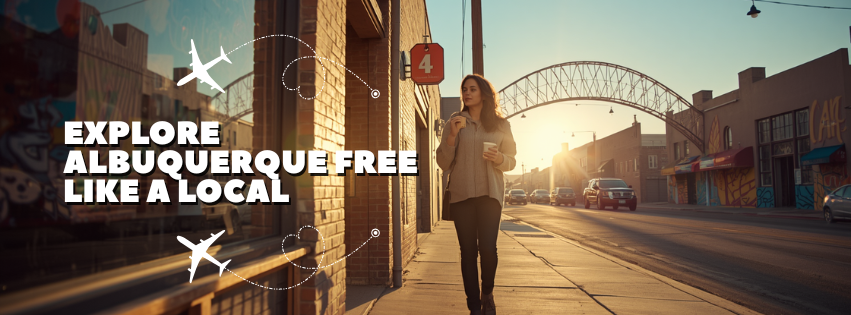
The local's Nob Hill walk: start at any coffee shop (Nob Hill has several) before 9am on a weekday. Walk east toward the neon arch. Read every mural. Look at every gallery window. Turn into any block that looks interesting. Do not plan to finish at a specific time. The best Nob Hill experience ends not when you run out of things to see but when you run out of time — and the inability to cover the whole thing in a single visit is specifically what makes it worth coming back.
How to Read Albuquerque's Neighborhoods on Foot
Albuquerque's neighborhoods each have a distinct character that is readable on foot but invisible from a car — the specific architectural language of each era of development, the specific community energy of the street-level activity, and the specific transitions that mark the boundaries between one neighborhood's identity and the next.
The Northeast Heights — Reading the Desert Mountain Suburb
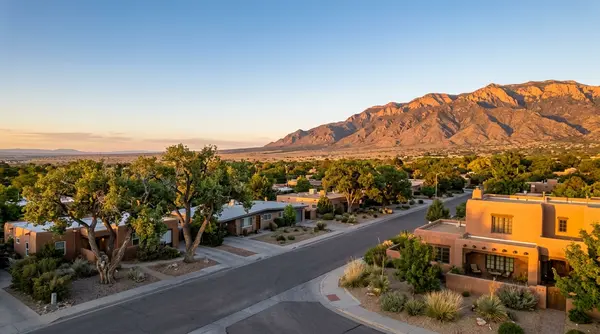
The Northeast Heights is primarily a post-World War II residential neighborhood — the suburban expansion that followed the war and the car and the availability of the foothills land that makes this the most geographically dramatic suburban neighborhood in the country. Walking the residential streets of the Northeast Heights reveals the specific evolution from the modest adobe ranch houses of the 1950s to the larger custom homes of the 1980s to the contemporary construction near the foothills.
The local walk in the Northeast Heights: start at any foothills trailhead in the early morning. Walk the trail for 30 minutes into the foothills, turn around, and walk back through the residential streets rather than returning directly to the parking area. The transition from the wild landscape of the foothills to the residential streets — the specific moment when the granite rocks give way to adobe walls and the coyote trail gives way to a sidewalk — is the specific geographic experience of living in a city that ends at a mountain.
Nob Hill — Reading the Urban Village
Nob Hill was originally developed as a streetcar suburb in the early 20th century — the upscale residential extension of the downtown core along the Central Avenue streetcar line. When the streetcar was replaced by the car, the neighborhood's commercial corridor survived by serving the University of New Mexico community on its western edge, attracting independent businesses that could not compete with the chain retail of the emerging suburban malls.
The result of that economic history is visible today: a neighborhood where the independent business culture is specifically strong because the corporate chain culture passed it over. The galleries, the bookstores, the restaurants, the coffee shops — they are here not because this is a fashionable neighborhood but because the neighborhood has always had the specific demographic (university-adjacent, walkable, economically mixed) that sustains independent business culture.
Old Town — Reading the Colonial Palimpsest
Old Town is the most legible neighborhood in Albuquerque for reading the city's layered history, because the layers are literally visible. The San Felipe de Neri Church (1706) stands next to adobe buildings from the 19th century, which stand next to 20th century tourist retail, which is surrounded by the parking infrastructure of the 21st century. Every era is present and visible in a single square mile.
The local's Old Town approach: arrive early and leave before 11am, when the tourist traffic begins. Walk the residential streets behind the plaza — the ones that are not tourist-facing — where the specific domestic character of a neighborhood that has been continuously occupied for 300 years is most visible. The specific quiet of Old Town at 8am on a weekday is the quiet of a very old place that is also a living place — the adobe walls absorbing the morning sun, the church bells marking the canonical hours, the specific smell of the bosque carried by the morning wind.
The Bosque at Different Hours — The Same Place, Four Experiences
The 16-mile Paseo del Bosque Trail along the Rio Grande is free, always open, and specifically different depending on when you walk it. Understanding the bosque's hourly and seasonal character is one of the most specifically local things you can know about Albuquerque.
- 6 to 8am on a weekday: The trail belongs to the regulars — the daily walkers and cyclists who have claimed this hour as theirs. Great blue herons stand in the shallows. The cottonwood forest is still, and the sound of the Rio Grande is audible from the trail in a way it is not when the trail is busy. This is the most private version of the bosque, and it is available every morning to anyone willing to arrive early.
- Saturday morning, 9 to 11am: Families, dogs, cyclists, and the social energy of a city using its public outdoor infrastructure collectively. The Saturday morning bosque is the most community-character version of the trail — the place where Albuquerque's diversity is most visibly present in a single outdoor space.
- Late October afternoon: The bosque in peak cottonwood color on a Tuesday afternoon is the specific experience that most long-term residents identify as their single most emotionally powerful Albuquerque memory. The gold of the cottonwoods in the low-angle October light, the absolute silence of the mid-week afternoon, and the specific smell of cottonwood leaves in the desert air produce a combination that is available in this form in almost no other place.
- After the monsoon, late July: The bosque after a monsoon rain smells of wet desert soil and cottonwood bark and the specific mineral quality of Rio Grande water after the upstream storm. The trail is briefly muddy. The birds are active. The light has the specific gray-gold quality of the post-monsoon sky. This version of the bosque is the one that most residents cannot fully describe to people who have not experienced it.
The Saturday Rail Yards Market — Free to Enter, Impossible to Leave Empty-Handed
The Rail Yards Market at the Sawmill District (April through October, typically 9am to 1pm on Sundays) is the community gathering event that most completely represents Albuquerque's specific democratic character — the farmers, the bakers, the chile roasters, the artisans, and the musicians who make the specific local food and craft culture of the city available in a single outdoor space for free entry.
The local's market approach: arrive at 9am. Walk the entire circuit once before buying anything. The first pass reveals what is available. The second pass produces the decisions. Arrive hungry — the prepared food vendors are the most practical demonstration of what New Mexico's food culture actually tastes like when it is made by people who have been making it for decades rather than restaurants performing authenticity for visitors.
The specific Rail Yards Market ritual that produces the most local experience: buy a green chile breakfast burrito from a vendor who did not arrive with a professionally designed booth and a social media presence. The specific vendor whose setup is a folding table and a tamale pot. The conversation that happens while waiting for the burrito is the conversation that constitutes community — the exchange between a buyer and a maker about the specific provenance of the specific food, in a city where the food's cultural roots are always present.
Reading the Public Art — Free Gallery Across 18 Miles
Albuquerque's Route 66 centennial in 2026 has produced the most significant new installation of public art on Central Avenue in a generation. The ABQ Public Art Map — available free from the City of Albuquerque's website and from the Visitors Center in Old Town — documents the complete public art collection across the city, including the new centennial murals that have been installed along Central Avenue from Downtown through Nob Hill.
The local approach to the public art walk: download the ABQ Public Art Map app or print the walking map. Begin at the KiMo Theatre, which is itself a public artwork of the first order. Walk east on Central through Downtown and into Nob Hill, following the map's mural and sculpture markers. Do not plan to cover the full distance in a single walk — it is not a route to complete but a collection to revisit.
The specific thing the public art walk reveals that no art museum can provide: the context. A mural on the wall of a building on Central Avenue is in conversation with the street it faces, the businesses around it, the pedestrians who pass it, and the 100-year history of the road it occupies. Art in a gallery is art in isolation. Art on Central Avenue in 2026 is art in the specific moment of a centennial, on the specific road whose 100 years of American highway culture are visibly layered in the architecture around it.
The UNM Campus Walk — Free Architecture and Culture in 30 Minutes
The University of New Mexico's main campus is one of the most architecturally cohesive university campuses in the American Southwest — a planned landscape of Pueblo Revival buildings designed primarily by John Gaw Meem, who defined the architectural identity of New Mexico's public buildings across the mid-20th century. The campus is publicly accessible and free to walk.
The specific UNM walk that produces the most complete experience: enter from the Central Avenue gate and walk the central mall north. The buildings on either side of the mall — the library, the student union, the classroom buildings — are all Pueblo Revival in their exterior character: the massive stucco walls, the portal arcades, the wooden vigas visible at the roof lines, the specific relationship between the architecture and the scale of the human body that the Pueblo Revival tradition produces.
At the north end of the campus, the fine arts complex houses the UNM Art Museum — free every day of the year, consistently the most undervisited cultural institution in Albuquerque, and the specific kind of museum that a university art collection produces: genuinely strong in areas of faculty research interest (photography, works on paper, Southwestern and Native American art), eccentric in the way that non-commercial collections are, and unmolested by the curatorial conservatism that major metropolitan museums must practice.
The Free Morning Routine — How Locals Actually Start Their Days
Understanding how Albuquerque residents begin their days is the most direct access to the specific quality of life that the city provides — and most of it costs nothing.
- The 6am foothills run or walk: A significant portion of the Northeast Heights and foothills neighborhood population begins the day on the Sandia Mountain trails before work. The trailhead parking at Elena Gallegos and Pino Trail is free on weekdays. The specific experience of the foothills at 6am — the cool air, the low light, the city below just beginning to activate — is the daily luxury that residents consistently name as the primary lifestyle reason for living near the mountains.
- The bosque cycling commute: Many residents who live within cycling distance of the Paseo del Bosque trail use it for their morning commute — combining the daily exercise routine with the practical need to move through the city. Watching the bosque cycling commute in action, the specific integration of fitness and transportation and the riparian landscape, communicates what it means to have a 16-mile river trail as part of the city's infrastructure.
- The Frontier before 9am: The Frontier Restaurant at 7:30am on a Tuesday morning is not the Frontier of the tourist guide. It is the place where night-shift workers, pre-class students, and early-rising professionals eat the same food in the same room with the same democracy that the Frontier has always provided. The specific combination of green chile stew, a flour tortilla, and black coffee in that room at that hour produces a specific quality of Albuquerque morning that cannot be replicated at any other time or in any other place.
Finding the Conversation — The Most Local Thing You Can Do
The most valuable free resource for exploring Albuquerque like a local is not a map or a guide or an app. It is a conversation with a person who lives and works here.
Gallery owners in Old Town and Nob Hill are among the most knowledgeable sources of local knowledge in the city — they know the provenance of every piece in their gallery, the artists' stories, and the specific context of the works in the broader Albuquerque cultural landscape. A 15-minute conversation with an Old Town gallery owner produces more specific knowledge about the Pueblo pottery tradition than an hour with an interpretive sign.
Farmers market vendors are the most direct connection to the specific agricultural and culinary culture of the Rio Grande valley. The person selling Hatch green chile at the Rail Yards Market knows more about the specific geography, climate, and cultivation practices that make Hatch chile distinct than any food guide, because they have been doing the work rather than writing about it.
The people at the Frontier who have been eating there for 20 years. The docent at the Indian Pueblo Cultural Center who is a Pueblo member. The trail regular at Elena Gallegos who has been running the foothills for 15 years and knows every drainage and every rock. These are the local experts whose knowledge is free, specific, and available to anyone who simply asks.
The Free Seasonal Calendar — What Months Unlock What
- March-April: Desert wildflowers on the foothills trails. The specific bloom of globe mallow and desert marigold on the Sandia foothills that transforms the standard brown-and-gray desert palette into color. Free. Walk the Pino Trail or the Embudo Canyon before 9am.
- May: Los Poblanos lavender season begins (late May). The lavender farm's walk-in market is free to enter; the lavender fields are visible from the property's grounds. Casa Rondena's courtyard begins its most beautiful season.
- August-September: Green chile roasting season. The propane-drum roasters appear at grocery store parking lots, road stands, and the Rail Yards Market. The smell is the smell of New Mexico arriving again after summer. Free to experience; the first-of-the-season green chile cheeseburger costs approximately $12.
- October: Bosque cottonwood peak color. Balloon Fiesta (requires a ticket for the Fiesta Park, but the balloons are visible from many free locations around the North Valley). The Sandia Mountains at alpenglow. The best hiking temperatures of the year.
- November: Bosque Sandhill Crane migration in the South Valley. Tens of thousands of cranes staging in the bosque at dawn and dusk. Free to observe from the South Diversion Channel trail and the Rio Bravo bosque access area.
- December: Christmas Eve luminaria walks in Old Town. The traditional New Mexico luminaria (paper bags weighted with sand and lit by candles, placed along walkways) transforms Old Town's streets into a specific visual experience that is ancient, simple, and moving. Completely free, weather permitting.
Resources for Finding What's Happening
The specific local intelligence resources that help residents stay aware of free events, new murals, neighborhood activities, and the seasonal moments that define the Albuquerque calendar:
- The City of Albuquerque Events Calendar (cabq.gov): The primary source for free city-organized events — summer concerts, First Friday ARTScrawl information, park events, and seasonal programming.
- Albuquerque Journal's Thursday Preview section: The weekly entertainment preview in the city's primary newspaper covers free and low-cost events alongside ticketed shows.
- Visit Albuquerque's events calendar (visitalbuquerque.org): The official tourism website maintains a calendar that covers major events and seasonal programming.
- The Sawmill Market / Rail Yards Market social channels: The most current vendor lineup, special events, and seasonal market programming.
- Neighborhood association social media groups: For each neighborhood — Nob Hill, Northeast Heights, Old Town, North Valley — there are typically active neighborhood social groups where residents share local events, new openings, and community activities.
For the complete list of free Albuquerque experiences with specific access details, our post on free things to do in Albuquerque covers the full landscape of no-cost activities with hours and access details. And for the specific restaurants and food experiences that define the local dining culture you will encounter as you explore, our guide to the best restaurants in Albuquerque that locals recommend is the companion food guide.
The Bottom Line — The Best Version of Albuquerque Costs Nothing
The version of Albuquerque that costs nothing is the version that the city's residents have always known as its best version: the morning trail, the bosque walk, the Frontier at 7:30am, the Old Town plaza before the shops open, the Nob Hill gallery conversation, the Rail Yards Market in August with the green chile smell in the air.
These are not budget alternatives to the paid experiences. They are the experiences that residents specifically choose over the paid alternatives, because they are more authentic, more specific to the city's actual character, and more connected to the daily life that makes Albuquerque a place people stay in rather than visit.
Exploring Albuquerque like a local is not a technique. It is a posture: slow, curious, unhurried, open to conversation, and willing to let the city reveal itself on its own terms rather than demanding that it reveal itself on a schedule. That posture costs nothing. It produces everything.
Want to Make This Your Everyday City?
Jenn & Vinay from The Rodgers Neighborhood Real Estate Group help people who fell in love with the local version of Albuquerque — the free, authentic, lived-in version — find homes where that version is accessible every morning. The foothills trail that starts at the end of the street. The bosque that is a bike ride away. The Nob Hill coffee shop that is walkable. If you want to live where you have been exploring, the conversation starts with a call.
Jenn & Vinay Rodgers are Albuquerque's trusted real estate professionals with The Rodgers Neighborhood Real Estate Group, brokered by Real Broker, LLC, serving buyers and sellers across Albuquerque, Rio Rancho, Corrales, Los Lunas, Tijeras, Cedar Crest, Sandia Park, the East Mountains, Bernalillo County, Sandoval County, and surrounding New Mexico communities.
The Rodgers Neighborhood Real Estate Group
Jenn & Vinay Rodgers
Real Broker, LLC
Albuquerque, NM
📞 505-417-2733
🏠 Browse Albuquerque homes — live where you exploreCategories
- All Blogs (334)
- 2026 & Beyond for Real Estate (229)
- Doctors and Nurses looking for homes in NM (4)
- Guide to buying a home in NM (147)
- Health Care Heros (7)
- Home Upgrades (40)
- Jenn & Vinay your Local Real Estate Experts! (114)
- Moving to Albuquerque (131)
- Neighborhoods in Albuquerque NM (89)
- Rent or Own (2)
- Sellers Questions for Selling homes (2)
Recent Posts
GET MORE INFORMATION