
What to Expect When Moving to Albuquerque, New Mexico From Another State — The Complete 2026 Guide
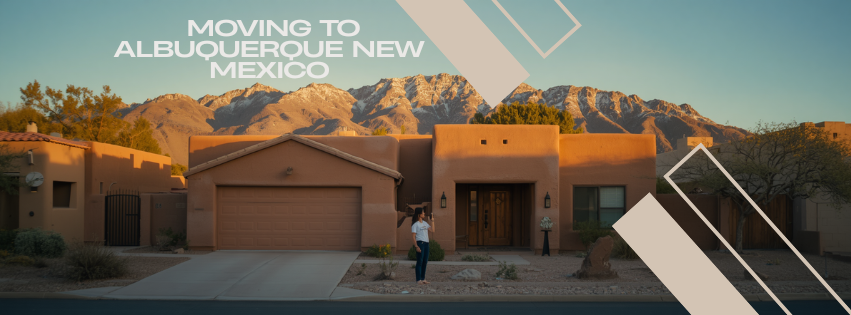
Albuquerque is one of the American cities that most consistently produces the reaction: 'I had no idea it was like this.' The people who move here from Texas, California, Seattle, and Colorado expecting a generic Sun Belt city — hot, flat, car-dependent, forgettable — encounter instead a city with 700 years of continuous human habitation, the most distinctive American food culture west of New Orleans, an architectural vocabulary that belongs to this specific desert, and the specific quality of high-altitude light on a mountain range that turns pink every evening. This guide covers what to actually expect.
Part 1 — The Physical Reality of Living at 5,312 Feet
"Albuquerque sits in the high desert and offers four distinct seasons, with hot summers and cold winters. At an elevation of over 5,000 feet, the city enjoys year-round sunshine and low humidity. Knowing what to expect weather-wise can help in planning your wardrobe, vehicle needs, and even home insulation requirements," confirmed a complete guide to moving to Albuquerque (October 2025). The elevation and climate are where most newcomers encounter their first genuine surprises.
The Elevation Adjustment
Albuquerque is at 5,312 feet above sea level — not the highest altitude in New Mexico (Santa Fe is at 7,000 feet; the Sandia Crest is at 10,378 feet) but significantly higher than most of the country's major cities. The practical effects:
- The first two weeks: Mild shortness of breath on stairs and during physical activity that would not have caused it at lower elevation. Faster fatigue on hikes. Headaches on the first day or two, especially if you arrived from sea level. Increased need for hydration — the dry air at elevation produces dehydration faster than most newcomers anticipate.
- The permanent adjustment: Most people adapt within 1-4 weeks. After adaptation, people who return to sea level often find aerobic activity feels surprisingly easy — the elevation builds an aerobic base that lower-altitude living does not.
- Hydration is not optional: The high-desert low humidity (15-30%) produces invisible dehydration — you lose moisture through breathing and skin at a rate the absence of sweating conceals. Drink water before you are thirsty.
- The sunscreen reality: Each 1,000 feet of elevation increases UV exposure by approximately 4%. Albuquerque's 310 days of sunshine combined with the elevation means more sunscreen than you were used to, applied more often.
The Climate — Four Seasons, Not Two
Newcomers who expect Albuquerque to be like Phoenix (hot and dry, two seasons) consistently encounter the specific high-desert four-season experience:
- Summer (June-August): Highs in the upper 80s to mid-90s°F but low humidity (15-25%). A 93°F day in Albuquerque at 18% relative humidity feels dramatically different from 93°F in Dallas at 65% humidity. Evening temperatures drop reliably into the 60s even in July.
- The monsoon (July 15-September 15): Starting approximately July 15, afternoon moisture produces thunderstorms that build over the Sandia Mountains every afternoon. The lightning visible from anywhere in the city is spectacular. Storms are brief (20-40 minutes) and post-storm light is the most beautiful of the year. The monsoon is not a disaster — it is what makes Albuquerque summer livable.
- Fall (October-November): The best season. The cottonwoods turning gold in the bosque, the Balloon Fiesta, the green chile harvest in full swing, daytime temperatures in the 65-75°F range. October is specifically when 'Land of Enchantment' makes literal sense.
- Winter (December-February): December lows average 25°F, highs average 46°F. Valley floor snow is occasional and melts within 48 hours. The Sandia Mountains receive 150+ inches above 7,000 feet. Daytime winter sunshine is abundant — more than Seattle, Boston, or Chicago even in December.
- Spring (March-May): March and April bring 30-50 mph gusts on some days. The spring wildflowers on the Sandia foothills in April and the cottonwood greening in the bosque make the wind worthwhile.
The Temperature Swing
The most consistently underestimated Albuquerque characteristic: the day-to-night temperature difference. A spring day at 68°F at 2pm can drop to 38°F by 10pm. A summer evening starting at 87°F can be 63°F by 10pm. Every Albuquerque resident's car has a jacket in it. Every local at a summer outdoor concert has a hoodie in the bag. The swing is one of the high desert's most pleasant characteristics, producing genuinely comfortable sleeping temperatures even in August.
Part 2 — The Food Culture Adjustment
The most commonly cited newcomer experience in Albuquerque: the food culture shock. Not because the food is bad — but because it is more specifically itself than anything they were prepared for.
- "Red or green?": Within your first week at a New Mexican restaurant, someone will ask you this question. They are asking which chile you want: red chile (dried and reconstituted, earthy, rich) or green chile (roasted Hatch green, sharper vegetal heat). Answer 'Christmas' if you want both. This is the official state question of New Mexico.
- Green chile is the cuisine, not a topping: The green chile cheeseburger, green chile stew, breakfast burrito with green chile, green chile mac and cheese — Hatch Valley green chile from 200 miles south is the foundational flavor. Newcomers from Texas expecting Tex-Mex find themselves in a genuinely different culinary world.
- Sopapillas: The puffed fried dough served with honey at the end of New Mexican restaurant meals is both dessert and palate-clearer for the chile heat. The first one is specifically memorable.
- The August roasting season: Starting mid-August, roasting drums appear at grocery store parking lots throughout the city. Burlap sacks of Hatch green chile tumble in propane-powered drums. The smell spreads for a city block. Every grocery store, every weekend, for six weeks. You will buy your first sack within two weeks of arriving in August, and by year two it will be the most anticipated event of your calendar.
Part 3 — The Practical Adjustments
"Albuquerque is a sprawling city, with neighborhoods spread out and separated by open land. This makes most areas car-dependent and limits options for walking, even for short trips. Commuting across town can take longer than expected, and public transit is reduced outside of central corridors. Thanks to New Mexico's film incentives and diverse landscapes, the city has been a go-to filming location for major productions like Breaking Bad and Better Call Saul," confirmed Extra Space Storage's 2026 pros and cons guide to living in Albuquerque (July 2026).
You Will Need a Car
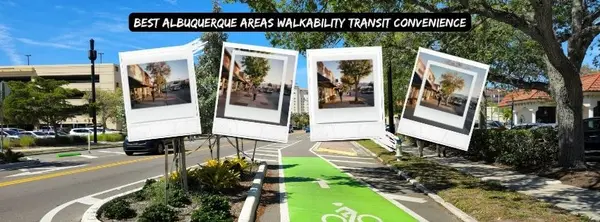
Albuquerque is a post-WWII American city — sprawling, freeway-oriented, designed around the automobile. The citywide Walk Score of 43 confirms that most errands require a car. The specific exceptions (Nob Hill Walk Score 85, University Heights 84, Downtown) are genuine but limited. If you are moving from a dense urban environment where you did not own a car, Albuquerque will require one. The ART bus serves the Central Avenue corridor with reasonable frequency; the ABQ Ride bus covers major arterials. But most residential neighborhoods require a car for grocery shopping, medical appointments, and most daily errands.
The MVD Deadlines
- Vehicle registration: 30 days after establishing residency. You need your out-of-state title, proof of NM insurance, an emissions test certificate (required in Bernalillo County), and a VIN inspection.
- Driver's license: 90 days to transfer your out-of-state license to a NM license. REAL ID compliance requires: passport or birth certificate plus Social Security documentation plus two proofs of NM address.
- Online MVD portal:mvd.newmexico.gov handles many transactions without a physical visit.
The New Mexico Gross Receipts Tax
New Mexico does not have a 'sales tax' in the conventional sense — it has a Gross Receipts Tax (GRT) applied to sellers that is passed to consumers like sales tax. In Albuquerque the GRT rate is approximately 7.875%. It functions identically to sales tax from the consumer's perspective but has specific professional services rules that differ. Practically invisible to most newcomers.
The Albuquerque Real Estate Specifics
- Non-disclosure state: New Mexico does not publish residential sale prices in public records. Zillow's Zestimate is less accurate here than most states. Use MLS-based comparable sales from your agent, not AVMs.
- Swamp coolers: Approximately 30-40% of pre-2000 Albuquerque homes use evaporative cooling rather than conventional air conditioning. These systems work extremely well in the low-humidity desert — less cost to operate, genuinely cool when outside humidity is below 30%. They work poorly during the monsoon when humidity rises. Learn to operate and maintain the seasonal service ($75-$200/year).
- Flat roofs: The Pueblo Revival architectural tradition produces flat roofs that need periodic recoating (every 5-7 years) and annual inspection. Ask about maintenance history for any pre-2000 home.
- NM MFA programs: Housing New Mexico (NM MFA) offers down payment assistance and below-market mortgages for qualifying buyers. These programs do not exist in Texas or California at the same level. Check housingnm.org before finalizing your financing.
Part 4 — The Cultural Orientation
The Three Cultures — The Foundation of Everything
- Pueblo Indigenous culture: The 19 New Mexico Pueblos have been present here for centuries before Spanish contact. The Pueblo cultural tradition is embedded in the architecture (adobe, kiva), food (blue corn, squash, dried chile), art (pottery, weaving, jewelry), and ceremony. The Indian Pueblo Cultural Center at 2401 12th Street NW is the first place every newcomer should visit.
- Spanish colonial culture: Founded in 1706 as a Spanish colonial Villa. The Spanish heritage is in the adobe architecture, the acequia water systems, the Catholic traditions, the New Mexican cuisine blending Spanish and Pueblo ingredients, and the place names (Corrales, Bernalillo, Belen).
- American and contemporary culture: The railroad era, Route 66, the Atomic Age (Manhattan Project, Sandia Labs, Kirtland AFB), the film industry, and the tech economy have layered onto the Indigenous and Spanish colonial foundations. All three layers are simultaneously visible.
The Balloon Fiesta — Nothing Prepares You
Your first Balloon Fiesta will be the October event you did not fully believe was real until you were standing on the Fiesta Park grounds at 6am watching 500+ hot air balloons inflate simultaneously in the dark and rise into a sky that you previously thought could only contain 30-40 balloons safely.
The Fiesta draws 800,000 visitors in 9 days to a city of 560,000. Traffic in October is dramatically different from the other 11 months. Hotels book 6-12 months in advance. For your first Fiesta: go to the Dawn Patrol on the first Saturday — the 6am launch when the balloons glow like lanterns in the pre-dawn dark. This is the moment when newcomers understand that the Balloon Fiesta is not just an event — it is one of the most spectacular recurring visual experiences available anywhere.
Breaking Bad Geography — Real and Everywhere
If you watched Breaking Bad or Better Call Saul, you will spend your first year in Albuquerque having a specific form of deja vu: the places you drove past on the TV screen are the places you drive past on the way to the grocery store. The car wash. The strip malls on Central Avenue. The foothills. The South Valley landscape. The Sandia Mountains at every significant outdoor scene.
"Thanks to New Mexico's film incentives and diverse landscapes, the city has been a go-to filming location for major productions like The Avengers, Breaking Bad, and Better Call Saul. Albuquerque is also part of Netflix's expanding studio footprint in the state and is home to an NBCUniversal production facility, creating steady job opportunities," confirmed Extra Space Storage's 2026 Albuquerque living guide.
The Sports Scene
- Albuquerque Isotopes (Triple-A baseball): Colorado Rockies affiliate, Rio Grande Credit Union Field at Isotopes Park. The green chile cheeseburger at the concessions is the most famous item in minor league baseball history. The Sandia Mountains visible beyond the outfield wall.
- New Mexico United (USL soccer): The most passionately supported team in the city — the supporter section's chants and flags make a United match one of the most atmospheric sports experiences here.
- New Mexico Goatheads (NAHL hockey, 2026 debut): New professional hockey at the Rio Rancho Events Center.
- UNM Lobos basketball at The Pit: University Arena is one of the most acoustically intense college basketball venues in the country — a below-grade arena where crowd noise has nowhere to go.
Part 5 — The Things That Consistently Surprise Newcomers
The Dark Skies
Albuquerque's nighttime sky is dramatically clearer than most American cities. Low light pollution, dry desert air, and elevation produce a sky where the Milky Way is visible from the backyard on the right night. The UNM Campus Observatory is open to the public on Friday nights for free telescope viewing.
The Sandia Mountains at Sunset
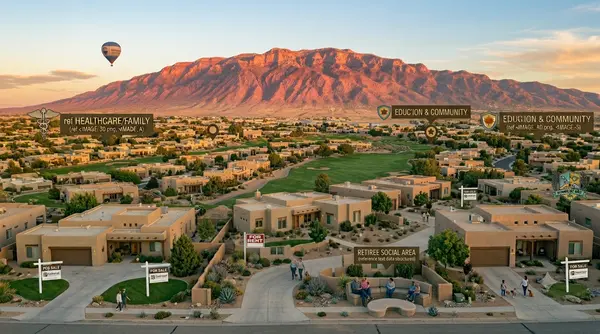
The Sandia Mountains — immediately east of the city, rising from 5,000 feet in the valley to 10,378 feet at the Crest in approximately 15 horizontal miles — turn a specific shade of pink to watermelon red every clear evening as the last direct sunlight catches the limestone face. The Pueblo word 'Sandia' is typically translated as watermelon, and the color the mountains turn at sunset is exactly why. This happens every clear evening. After a few months, you will feel specifically fortunate on evenings when cloud cover prevents it — because you have learned to expect the show.
The Sense of Space
From most Albuquerque residential neighborhoods, you can see a mountain range, an open mesa, or a desert horizon without any intervening structure of significance. The sky is larger. The horizon is farther. The specific psychological effect of living where you can see for 100 miles on a clear day is something that cities built at human density do not produce.
The Pace
Albuquerque moves at a different pace than Texas cities, California cities, or the Pacific Northwest. The mañana tendency — a more relaxed relationship with time — is a real cultural characteristic that manifests in service pace, contractor scheduling, and social gatherings that begin and end later than the invitation specifies. This is not a deficiency. It is a cultural priority of present-moment engagement over schedule adherence. The newcomer who adapts to the pace rather than fighting it consistently reports a happier first year.
Part 6 — By Origin State: What to Specifically Expect
- Coming from Texas: Property taxes will be dramatically lower (0.84% vs. 2.0-2.5%). The humidity difference is immediately and permanently noticeable. The mountains will surprise you — Texas has no equivalent. The food is different from Tex-Mex in ways that take adjustment but quickly feel better. Your Albuquerque home will likely cost significantly less than your sold Texas home.
- Coming from California: Home prices are dramatically lower — your California equity goes significantly further here. The food culture is specifically its own thing, not Mexican food as you knew it. The density is dramatically lower — sprawling and space-rich.
- Coming from the Pacific Northwest: The sunshine will feel overwhelming at first and necessary after six months. The humidity absence affects skin in ways moisturizer addresses. The culture is Latino and Indigenous rather than the PNW's Anglo-outdoor character — a genuinely different community.
- Coming from Colorado: Already adjusted to elevation and outdoor lifestyle. Culturally very different from Denver or Colorado Springs. Property taxes lower. Home prices generally lower.
The Newcomer's Practical First-Month Checklist
- Week 1: Set up PNM electricity, NMGC gas, ABCWUA water accounts. Call 311. Buy sunscreen and a water bottle.
- Week 2: Visit mymvd.mvd.newmexico.gov to understand vehicle registration (30 days) and license transfer (90 days) timelines. Gather your out-of-state title, NM insurance proof, and REAL ID documents.
- Month 1: Register your vehicle (required within 30 days). Attend a Saturday Downtown Growers' Market. Try your first green chile breakfast burrito. Find your nearest trailhead.
- Month 1-3: Transfer your driver's license (required within 90 days). Locate nearest urgent care. Get NM car insurance established.
- First October: Buy Balloon Fiesta tickets early. Attend the Dawn Patrol (6am mass ascension). This is the one experience every newcomer must have in their first year.
For the complete guide to the pros and cons of living in Albuquerque — with the honest assessment of what works and what is genuinely challenging — our post on the pros and cons of living in Albuquerque before you relocate covers the complete living assessment. And for the complete Albuquerque cost-of-living picture — what housing, utilities, groceries, and taxes actually cost in 2026 — our post on the Albuquerque cost of living in 2026 covers the full budget guide.
The Bottom Line — The Learning Curve Is Worth the Arrival
Every newcomer to Albuquerque has a learning curve — the elevation, the food, the swamp cooler, the flat roof, the MVD deadlines, the green chile roasting season that will change your September forever. None of these are problems once you understand them. They are the specific vocabulary of a specific place that has been doing things its own way for 700 years and has not felt the need to explain itself to newcomers.
The people who have moved to Albuquerque and stayed — who arrived for a job or the mountains or affordable housing and found themselves still here a decade later — consistently describe a single moment when the transition from visitor to resident occurred. For many it was the first green chile harvest, standing in a parking lot watching their first sack come out of the drum. For others it was a Balloon Fiesta dawn. For others it was the evening the Sandia Mountains turned pink for the hundredth time and they realized they were still looking.
That moment comes for almost everyone who gives Albuquerque an honest chance. This guide is how you get there faster.
Ready to Make Albuquerque Home?
Jenn & Vinay from The Rodgers Neighborhood Real Estate Group have helped hundreds of out-of-state buyers make Albuquerque their home — from the first conversation about neighborhood options to closing on the specific home that matches the lifestyle they were looking for. We know what buyers from Texas, California, Seattle, and Colorado need to understand about Albuquerque specifically. The conversation about your Albuquerque relocation starts with a buyer consultation.
Jenn & Vinay Rodgers are Albuquerque's trusted real estate professionals with The Rodgers Neighborhood Real Estate Group, brokered by Real Broker, LLC, serving buyers and sellers across Albuquerque, Rio Rancho, Corrales, Los Lunas, Tijeras, Cedar Crest, Sandia Park, the East Mountains, Bernalillo County, Sandoval County, and surrounding New Mexico communities.
The Rodgers Neighborhood Real Estate Group
Jenn & Vinay Rodgers
Real Broker, LLC
Albuquerque, NM
📞 505-417-2733
🏠 Browse Albuquerque homes and start planning your relocationCategories
- All Blogs (266)
- 2026 & Beyond for Real Estate (164)
- Doctors and Nurses looking for homes in NM (4)
- Guide to buying a home in NM (124)
- Health Care Heros (6)
- Home Upgrades (25)
- Jenn & Vinay your Local Real Estate Experts! (86)
- Moving to Albuquerque (102)
- Neighborhoods in Albuquerque NM (74)
- Rent or Own (2)
- Sellers Questions for Selling homes (2)
Recent Posts

GET MORE INFORMATION