

Living Near I-25 or I-40: Is It Worth It for Albuquerque Homebuyers?
DISCLAIMER: Noise levels, air quality, and home values near highways vary significantly by specific property, orientation, setback distance, sound barriers, and local topography. The data in this guide represents general patterns, not predictions for any specific address. Always visit a property at different times of day and under different weather conditions before making a purchase decision.
The I-25 and I-40 freeway network is the circulatory system of Albuquerque — the corridors that make a city of 560,000 people function as a connected metro rather than a collection of disconnected neighborhoods. And like any circulatory system, the areas closest to it have specific characteristics that the areas farther away do not: greater access, more noise, lower residential desirability, and lower prices. Whether living close to these corridors is worth it depends on what you are trying to accomplish with the purchase.
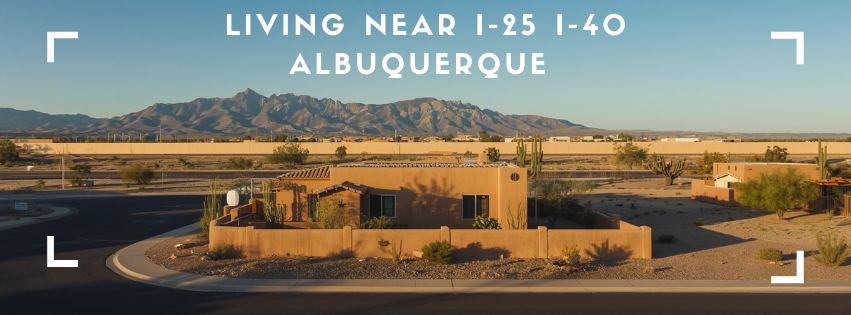
The Two Freeways — What They Are and Where They Run
I-25 in Albuquerque — The North-South Spine
Interstate 25 — also known as the Pan-American Freeway — runs north-south through Albuquerque as the city's primary north-south arterial. From the south, I-25 enters Albuquerque from Los Lunas and Isleta Pueblo, passing through the Southeast Heights and the University area, intersecting with I-40 at the Big I interchange, then continuing north through Downtown, the Northeast Heights corridor, and up toward Bernalillo and Rio Rancho.
- Speed limit: 65 mph through most of Albuquerque; 55 mph in the 1.5-mile section between Gibson Boulevard and Central Avenue through the Downtown core.
- Traffic character: Primarily commuter and light vehicle traffic — the north-south commuter corridor for Northeast Heights residents heading to Downtown, Kirtland AFB, and UNM employment. Higher truck traffic percentage near the Big I interchange.
- Key Albuquerque interchanges: Isleta Boulevard, Rio Bravo, Gibson Boulevard, Central Avenue (Big I with I-40), Lomas Boulevard, Paseo del Norte, Tramway, Bernalillo.
I-40 in Albuquerque — The East-West Freight Corridor
Interstate 40 — the successor to Route 66 through Albuquerque — runs east-west across the city along the Route 66 corridor, intersecting with I-25 at the Big I interchange in the center of the city.
- Speed limit: 65 mph across most of Albuquerque.
- Traffic character: Significantly higher truck traffic percentage than I-25 — I-40 is the primary east-west freight corridor through New Mexico connecting California/Arizona to Texas and Oklahoma. The truck traffic is heavier and the noise frequency profile is different (lower-frequency rumble vs. passenger vehicle white noise).
- Key Albuquerque segments: Western approach (Coors Boulevard area through the Westside), the Central/Downtown segment, the Nob Hill-adjacent segment (Central Ave overpass area), the Eastern approach through Tijeras Canyon toward the East Mountains.
The Big I — The Most Consequential Intersection
The interchange of I-25 and I-40 in central Albuquerque — locally known as the Big I — is one of the busiest intersections in New Mexico. Homes within approximately 1/2 mile of the Big I experience the noise from traffic on both freeways plus the deceleration, acceleration, and rumble of the interchange ramps. The Big I's immediate vicinity is specifically the highest-noise zone in the Albuquerque residential landscape, and it represents the extreme end of the freeway proximity question.
What Highway Proximity Does to Home Values — The National Data Applied to Albuquerque
"Sound carries, especially at night when ambient noise drops and highway traffic becomes more noticeable. Homes within sight of a freeway often face steeper discounts than homes on busy local streets. The perception of pollution and constant noise weighs heavily on many buyers. Setback matters quite a bit — a home sitting 100 feet from the road with a deep front yard experiences less impact than one positioned right at the curb. Homes that back to a busy road rather than face it typically fare better — the house itself acts as a buffer. In competitive markets, the lower price point can actually attract buyers who might otherwise be priced out of a desirable neighborhood," confirmed Opendoor's 2025 research on how busy roads affect home values.
The general price impact formula by proximity:
- Within 300 feet (approximately 1 block) of a highway: Typically 10-20% price discount vs. comparable homes farther away. On Albuquerque's median $356,000 home (Redfin June 2026), this discount is approximately $35,600-$71,200. At the higher end of the discount range, this represents meaningful affordability access.
- 300-1,000 feet from a highway: Typically 3-10% discount. On a $356,000 home: $10,680-$35,600. The discount is real and measurable; the noise is less intrusive.
- Beyond 1,000 feet: Minimal direct highway discount. The buyer at this distance is primarily affected by the highway's indirect effects: traffic from on-ramp and off-ramp streets, commercial development patterns near the freeway, and the character of the transitional zone between residential and highway land uses.
The Albuquerque-Specific Highway Noise Variables
The national highway proximity research applies to Albuquerque — but with specific modifications produced by the high-desert environment:
The Desert Night Silence Amplification
The most specifically Albuquerque variable in the highway proximity calculation: the high desert's low ambient noise environment amplifies highway sound at night far more than in urban environments with constant background noise. In New York, Chicago, or Los Angeles, the constant urban background noise (other traffic, HVAC units, human activity) produces a floor of ambient sound that partially masks highway noise. In Albuquerque's residential neighborhoods — where the ambient noise floor drops dramatically after 10pm — the highway that was masked by daytime activity becomes distinctly audible at night.
Buyers who visit a property adjacent to I-25 at 2pm on a Saturday and find the noise tolerable should specifically revisit at 11pm on a weeknight. The difference in highway noise audibility between those two conditions can be dramatic in the high-desert environment.
The Wind Direction Variable
Albuquerque's prevailing winds blow from the southwest to the northeast — which means that highway noise from I-25 (which runs generally north-south in the eastern portion of the city) is most strongly carried toward the Northeast Heights on the prevalent wind days of spring and early summer. A home on the east side of I-25 in the Northeast Heights is specifically downwind of the freeway during the city's windiest months. A home on the west side of I-25 (relatively fewer residential properties) is upwind and experiences less wind-carried noise.
The wind direction effect is seasonal — strongest in March through May, least impactful in summer and fall. The buyer evaluating a home near I-25 in winter or fall should specifically consider what the noise profile will be in April.
The I-40 Truck Noise Distinction
I-40 carries significantly more commercial truck traffic than I-25 — as the primary east-west freight corridor through New Mexico, I-40's traffic includes a substantial percentage of 18-wheelers moving between California and Texas. The acoustic signature of heavy truck traffic (low-frequency engine rumble, jake brakes on the eastern descent through Tijeras Canyon, the specific pitch of loaded 18-wheelers at highway speed) is different from light vehicle traffic and is more difficult to habituate to than the white noise of passenger vehicle traffic.
Buyers evaluating homes near I-40 — particularly near the eastern segment where the Tijeras Canyon grade produces heavy truck deceleration and jake brake use — should specifically evaluate the truck traffic component of the noise profile, not just the overall traffic volume.
Segment-by-Segment Analysis — The Albuquerque Guide
I-25 South — Rio Bravo to Gibson Interchange
The I-25 southern corridor through the Southeast Heights and toward Kirtland AFB serves the military and government employment communities. Homes within 1/4 to 1/2 mile of this segment:
- Who lives here: Military families, Kirtland AFB civilian employees, Southeast Heights working-class and middle-income residents.
- The commute advantage: The I-25 south segment buyer who works at Kirtland AFB or travels north to Downtown or University can be on the freeway in under 2 minutes from most Southeast Heights addresses near the corridor. This specific commute advantage has real value for the military family on a 2-year Kirtland assignment.
- Price range: Southeast Heights homes near I-25 are among the most affordable in the city — the combination of the older housing stock and the freeway adjacency discount produces entries well below the $356,000 median. For budget-conscious buyers, this corridor offers the most square footage per dollar in accessible Albuquerque neighborhoods.
- The noise assessment: The 55 mph speed limit section between Gibson and Central moderates noise in the immediate area. North of Gibson, the 65 mph section is louder. The eastern descent from I-25 toward the Big I produces concentrated truck noise from deceleration.
I-25 Central — The Big I Vicinity (Central Avenue to Lomas Boulevard)
The most noise-intensive segment: the Big I interchange area where I-25 and I-40 merge and diverge within a half-mile radius. The Downtown and EDo neighborhoods adjacent to this corridor experience the most complex highway noise profile in Albuquerque.
- Who buys here: Urban loft and condo buyers who specifically prioritize the walkable Downtown environment over freeway quiet. The loft conversion buildings along the Downtown/EDo corridor trade highway proximity for building mass that provides some acoustic buffering, plus the urban lifestyle trade that Downtown residents have accepted.
- The investor opportunity: The price discount in the Big I vicinity is the most significant in the Albuquerque metro — and the rental demand from UNM students, hospital staff, and young professionals who accept urban-level highway noise in exchange for walkability and urban access is specifically durable. The investor buyer who is not planning to live in the property can capture the price discount without the noise cost.
I-25 North — Paseo del Norte to Tramway Interchange (Northeast Heights)
The most relevant I-25 segment for the majority of Albuquerque's upper-income residential market: the section from Paseo del Norte through the Northeast Heights toward Tramway Boulevard, where the I-25 corridor runs along the western edge of the premium residential neighborhoods.
- The Northeast Heights setback advantage: Most premium Northeast Heights residential development is 1-3 miles east of I-25 — far enough that the freeway provides the commute access without the noise. The I-25 effect on home values in the inner Northeast Heights (within 1/2 mile) is measurable; the outer Northeast Heights (1+ miles east) is effectively unaffected.
- The price gradient: Buyers in the Northeast Heights can observe a consistent price gradient as properties move east away from I-25: the 1/4-mile band near the freeway is measurably cheaper than the same square footage farther into the neighborhood. This gradient represents the freeway discount that expires at approximately 1 mile.
I-40 West — Coors Boulevard to Rio Grande (Westside)
The I-40 western approach through the Westside serves the large residential communities of Taylor Ranch, Ventana Ranch, and Rio Rancho.
- The Westside I-40 dynamic: Most Westside residential development is set back from I-40 by commercial development corridors — the Coors Boulevard commercial strip acts as a buffer between the freeway and the residential neighborhoods. Many Westside residents are aware of I-40 as a commute tool without experiencing significant freeway noise at their homes.
- Who benefits: Intel employees in Rio Rancho who travel east to Albuquerque on I-40. Westside residents who work on the east side and cross town on I-40 to I-25 through the Big I.
I-40 East — Tijeras Canyon (East Mountains Approach)
The most specific and most severe highway noise situation in the Albuquerque area: the I-40 eastern descent through Tijeras Canyon. The canyon walls concentrate and amplify highway noise in a way that the flat valley does not, and the Tijeras community (directly adjacent to I-40 at the canyon mouth) experiences the full acoustic impact of heavy truck traffic on the grade.
- The Tijeras buyer's situation: Homes immediately adjacent to I-40 in Tijeras are priced to reflect the noise discount — and some buyers specifically accept the trade-off for the mountain canyon setting, the East Mountain character, and the cedar/pinon environment that the canyon location provides. The question is whether the scenery-to-noise ratio works for the specific buyer.
- East Mountains beyond the canyon: Cedar Crest, Sandia Park, and the East Mountain communities beyond the I-40 interchange points in the canyon are generally far enough from the freeway that highway noise is not a significant residential factor. The East Mountain buyer who is 3-5 miles from the I-40 interchange is effectively outside the freeway noise zone.
The Health Consideration — Air Quality Within 300 Meters
Highway proximity research consistently identifies a health consideration beyond noise: particulate matter (PM2.5) from vehicle exhaust is measurably elevated within approximately 300 meters (approximately 1,000 feet) of major highways. The specific health implications — increased respiratory irritation and long-term particulate exposure — are most relevant for households with asthma, young children, elderly residents, or other respiratory sensitivities.
The Albuquerque-specific context: the high-desert wind patterns discussed above apply equally to particulate matter transport. Wind-driven particulate from I-25 moves northeast on spring wind days. Buyers with specific health sensitivities should factor this into the proximity calculation, particularly for I-40 where the higher truck traffic percentage produces proportionally higher diesel particulate emissions.
Who Should Seriously Consider a Freeway-Adjacent Purchase
- The military or government employee on assignment: The Kirtland AFB buyer on a 2-year assignment who commutes on I-25 and is not making a permanent home has a specific calculus: the commute time savings and the price discount are real cash benefits during the assignment period. The resale liquidity question is less relevant because the assignment ends before long-term value erosion matters.
- The investor buying for rental income: The price discount that freeway proximity produces is not equally applied to rental rates — renters accept freeway adjacency for the commute convenience in a way that owner-occupant buyers are less willing to. The investor who buys the I-25-adjacent home at a $30,000 discount can rent it to a tenant who commutes on I-25 daily and finds the freeway access an advantage rather than a cost. The cap rate math specifically improves from this asymmetry.
- The budget-constrained buyer who needs to be in a specific school zone: The Northeast Heights buyer who cannot afford the interior homes in the La Cueva school zone but finds an I-25-adjacent address that is still within the zone boundaries may find that the school zone premium exceeds the freeway discount — making the I-25-adjacent home the path to the school zone access they need at a price they can reach.
- The buyer who genuinely does not hear highway noise: A meaningful percentage of the population habituates to steady-state background noise and genuinely does not experience freeway sound as intrusive. These buyers — often people who have lived near freeways before or who have specific hearing profiles — can capture the price discount without the quality-of-life cost. The honest test: spend a night in the neighborhood before buying, not just a showing.
Who Should Avoid Freeway-Adjacent Purchases
- Families with young children who spend significant time in the backyard: The combination of particulate exposure and constant noise is specifically most relevant for children who play outdoors near the highway.
- Light sleepers and noise-sensitive individuals: The desert night amplification effect discussed above makes the nighttime noise experience of freeway adjacency specifically worse in Albuquerque than in most other cities. Buyers who are noise-sensitive need to experience the property at 11pm on a clear, low-wind night before committing.
- Buyers with respiratory sensitivities: Asthma, allergies, COPD, or other respiratory conditions are specifically aggravated by the elevated particulate matter within 300 meters of major highways.
- Buyers who plan to sell in 5-7 years to owner-occupant buyers: The resale liquidity constraint — the smaller buyer pool willing to accept freeway noise — produces the original price discount and sustains it at resale. Buyers who plan a 5-7 year hold and sell to an owner-occupant face the same price concession at exit that they captured at entry.
The Sound Wall Variable — Does It Help?
Many Albuquerque neighborhoods adjacent to I-25 and I-40 have sound walls (concrete or masonry barriers) between the freeway and residential properties. The effectiveness of sound walls depends on height, material, continuity, and the topographic relationship between the wall, the freeway, and the residential properties behind it.
- What sound walls do: Reduce direct line-of-sight noise transmission. A properly designed sound wall can reduce noise levels for the first row of homes behind it by 5-10 decibels — meaningful but not eliminating the freeway as a factor.
- What sound walls do not do: Block noise that travels over the wall (which happens at increased vehicle heights — trucks and high-profile vehicles), block noise that bounces off structures behind the wall, or address particulate matter exposure.
- The Albuquerque wind variable: A sound wall that works effectively on a calm day provides less protection on a high-wind spring day when the wind carries sound over and around the barrier.
The Practical Due Diligence Checklist for Freeway-Adjacent Properties
- Visit at three times: Weekday morning rush hour (7-9am), weekend afternoon, and weeknight after 10pm. The noise profile is genuinely different at all three times.
- Check wind direction during visits: A calm-day visit does not represent spring wind conditions. Check the weather history for spring wind events in the neighborhood before buying.
- Walk the property perimeter: The noise at the front door is different from the noise at the backyard. If the backyard is where you plan to spend time, evaluate the backyard noise specifically.
- Measure setback distance: Google Maps can measure the straight-line distance from the property to the nearest freeway travel lane. Under 300 feet: high impact. 300-1,000 feet: moderate impact. Over 1,000 feet: low direct impact.
- Check the sound wall height and continuity: Walk the full length of any sound wall adjacent to the property to check for gaps, height variations, and sections where the wall is lower or absent.
- Ask about sleep quality from current neighbors: The most honest noise assessment is a conversation with someone who has lived near the freeway for 2+ years. What did they notice at first? What do they notice now?
For the guide to Albuquerque neighborhoods organized by commute characteristics — where to live relative to Kirtland, Sandia Labs, Downtown, and UNM employment — our post on the best Albuquerque neighborhoods for easy commutes covers the commute-optimized neighborhood guide. And for the hidden costs that highway adjacency adds to homeownership — including the resale impact that is not visible at purchase — our post on the hidden costs of buying a home in Albuquerque covers the full cost picture.
The Verdict — Who Should Say Yes and Who Should Say No
The answer to "is it worth it to live near I-25 or I-40 in Albuquerque?" is not a single verdict — it is a profile match:
- Worth it for: The investor buying for rental income. The short-term assignment buyer. The budget buyer who specifically needs the price discount to access a school zone or neighborhood that would otherwise be out of reach. The buyer who has lived near highways before and genuinely does not find the noise intrusive.
- Not worth it for: Families with young children who use the backyard frequently. Noise-sensitive individuals. People with respiratory conditions. Buyers who plan to sell in 5-7 years to owner-occupant buyers and want the full buyer pool at exit.
The specific Albuquerque modification to the national pattern: the desert night silence amplification makes freeway noise here more noticeable after 10pm than in most comparable cities. The buyer who believes they will adapt to the highway sound should specifically test that belief with a nighttime visit before purchasing — because the desert-quiet nighttime environment does not provide the masking that urban nighttime environments in other cities do. The purchase commitment is a long one; the nighttime test is 30 minutes.
Want Help Evaluating a Specific Albuquerque Property Near a Highway?
Jenn & Vinay from The Rodgers Neighborhood Real Estate Group evaluate every freeway-adjacent property with our buyer clients using the due diligence checklist in this guide — measuring setbacks, checking sound wall continuity, assessing wind direction impacts, and asking the neighbors. When a freeway-adjacent price discount represents an opportunity rather than a problem for a specific buyer's situation, we identify it. When it represents a quality-of-life risk that the buyer should avoid, we say so. The conversation about any specific Albuquerque property's highway proximity impact starts with a buyer consultation.
Jenn & Vinay Rodgers are Albuquerque's trusted real estate professionals with The Rodgers Neighborhood Real Estate Group, brokered by Real Broker, LLC, serving buyers and sellers across Albuquerque, Rio Rancho, Corrales, Los Lunas, Tijeras, Cedar Crest, Sandia Park, the East Mountains, Bernalillo County, Sandoval County, and surrounding New Mexico communities.
The Rodgers Neighborhood Real Estate Group
Jenn & Vinay Rodgers
Real Broker, LLC
Albuquerque, NM
📞 505-417-2733
🏠 Search Albuquerque homes with commute time and noise considerations built inCategories
- All Blogs (266)
- 2026 & Beyond for Real Estate (164)
- Doctors and Nurses looking for homes in NM (4)
- Guide to buying a home in NM (124)
- Health Care Heros (6)
- Home Upgrades (25)
- Jenn & Vinay your Local Real Estate Experts! (86)
- Moving to Albuquerque (102)
- Neighborhoods in Albuquerque NM (74)
- Rent or Own (2)
- Sellers Questions for Selling homes (2)
Recent Posts






GET MORE INFORMATION