
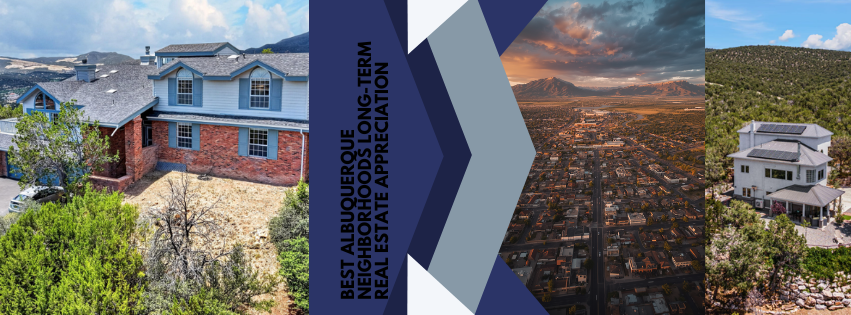
Best Albuquerque Neighborhoods for Long-Term Real Estate Appreciation
The question of which Albuquerque neighborhoods produce the best long-term real estate appreciation has a defensible answer — one grounded in the structural drivers of demand that persist across interest rate cycles, through market corrections, and across different economic conditions. This guide covers those drivers first, because understanding why neighborhoods appreciate is more durable than knowing which neighborhood was hot last year.
Albuquerque's 10-year cumulative appreciation of 94.59% (NeighborhoodScout data, placing the city in the top 50% of markets nationally) reflects a city whose fundamentals — employment anchors, in-migration demand, geographic constraints on supply, and school quality — have sustained appreciation well above what the general market quality would predict. The neighborhoods within Albuquerque that have outperformed even that already-strong average share specific structural characteristics. This guide identifies them and explains the mechanics.
The Citywide Baseline — What Albuquerque's Appreciation Data Shows
Albuquerque's long-term appreciation trajectory is among the most consistent in the Mountain West. "Areas with highly rated schools, such as La Cueva and Eldorado High School districts, rank among the most desirable — these locations often see consistent demand for homes, reflecting in relatively higher property values and shorter time on the market," confirmed Steadily's 2026 Albuquerque real estate market overview (January 2026). Neighborhoods on the cusp of development, such as Sawmill and Wells Park, are catching the attention of investors.
The rate scenario context: "If rates drop to the 5-6% range, we would see increased competition, higher home sales volume, and potentially 4% to 5% annual price appreciation again, especially in desirable areas like Nob Hill and the Northeast Heights," confirmed Norada Real Estate's Albuquerque market forecast (November 2025). The underlying demand structure means that rate relief specifically accelerates appreciation in Albuquerque's most structurally desirable neighborhoods.
The appreciation data points that frame the analysis:
- 10-year cumulative appreciation:59% — nearly doubling home values over the decade at an average 6.88% annually (NeighborhoodScout)
- Latest 12-month appreciation:34% — above the broader national average and above the 2.8% Redfin year-over-year figure for the three-month trailing period
- Latest quarter annualized:04% — the most recent directional signal suggests the pace may be accelerating
- Premium tier outperformance: The 87122 ZIP code ceiling rose from $731,365 to $738,030 in the most recent full-year period — outpacing the overall market and confirming the premium tier is "pulling away from the rest"
- Market Action Index:5 (week of May 15, 2026) — seller's market above 30, indicating continued demand pressure that supports appreciation
The non-disclosure context: New Mexico is a non-disclosure state. ZIP-level appreciation estimates from national platforms are less reliable than in disclosure states. The analysis in this guide draws on MLS-sourced data and published market analysis from credible sources, but buyers should use MLS-based CMA data from their agent for property-specific pricing decisions.
The Five Structural Drivers of Neighborhood Appreciation in Albuquerque
Before the neighborhood list, the framework: the neighborhoods that consistently outperform the city's overall appreciation rate share one or more of these five structural characteristics. The more of these characteristics a neighborhood possesses, the more durable its appreciation trajectory.
- Geographic irreplaceability: Neighborhoods whose specific location cannot be replicated — foothills adjacency, bosque frontage, mountain proximity, protected land adjacency. The 87122 foothills ZIP cannot expand; the buildable land between the residential streets and the Wilderness boundary is finite. Finite supply against sustained demand produces appreciation.
- School zone quality: The La Cueva High School attendance zone is the most consistently documented appreciation driver in the Albuquerque market. The zone produces structural demand from family buyers that persists regardless of mortgage rate environment — families with school-age children have a specific, non-deferrable reason to buy in the zone. This demand does not disappear when rates rise; it compresses but does not dissolve.
- Employment anchor proximity: Neighborhoods within reasonable commute of Sandia National Laboratories, Kirtland Air Force Base, Intel Rio Rancho, UNM Health Sciences, and Presbyterian Healthcare maintain demand from a professional population whose employment is stable and well-compensated. The Sandia/Kirtland employee buying in the Northeast Heights is not rate-sensitive at the margin — they have a job, they have a clearance, they are staying.
- In-migration demand concentration: California, Colorado, Texas, and Arizona equity buyers are concentrated in the Northeast Heights and North Valley. Their cash or near-cash purchasing power supports pricing in those neighborhoods at levels that local buyer pools alone would not sustain. As out-of-state migration continues and accelerates, the neighborhoods those buyers prefer will see continued demand pressure.
- Walkability and cultural scarcity: Nob Hill's Walk Score 85 on Route 66 is geographically specific and cannot be moved or replicated. The market has consistently found that buyers who specifically value walkable urban neighborhoods in Albuquerque have exactly one neighborhood to consider at the top tier — which is why Nob Hill appreciates consistently and why the renovation economics in the neighborhood work.
Tier 1 — The Proven Premium Appreciators
The 87122 ZIP Code — Northeast Heights Foothills (North Albuquerque Acres, High Desert, Foothills-Adjacent)
Price range: $380,000 to $2,000,000+ | Appreciation driver: Geographic irreplaceability + school zone + in-migration demand concentration
The 87122 ZIP code is Albuquerque's single strongest appreciation case because it possesses all five structural appreciation drivers simultaneously. The Sandia Mountain foothills are finite and protected — the Sandia Mountain Wilderness boundary is the neighborhood's eastern edge, and no residential development can occur beyond it. The La Cueva school zone assignment covers most of the ZIP. The Sandia Labs and Kirtland commute is 20-30 minutes. California equity buyers specifically target the Northeast Heights foothills. And the Walk Score 85 of the broader foothills area (though not as high as Nob Hill's) reflects the trail system accessibility that attracts the outdoor lifestyle buyer who is the most motivated purchaser in this tier.
The documented outperformance: the 87122 ceiling rose from $731,365 to $738,030 in the most recent full-year period — gaining $6,665 on a home priced at the ceiling of the ZIP while the overall Albuquerque market was producing modest overall appreciation. The expensive foothills neighborhoods are specifically pulling away from the rest of the Albuquerque market, driven by the scarcity that finite foothills geography produces.
The long-term case: there is no scenario in which new residential development expands into the Sandia Mountain Wilderness. The supply of foothills-adjacent residential properties is permanently capped. Over a 20-year holding period, the combination of capped supply and sustained demand from the La Cueva zone and outdoor lifestyle buyer pools produces the most defensible appreciation trajectory in the city.
Nob Hill — Walk Score 85 on the Route 66 Cultural Corridor
Price range: $230,000 to $500,000+ | Appreciation driver: Walkability scarcity + cultural irreplaceability + consistent in-migration buyer demand
Nob Hill is Albuquerque's most consistently appreciating urban neighborhood for a structural reason: its Walk Score 85 is the highest in the city by a meaningful margin, it is positioned on Route 66's longest continuous urban stretch in America, and there is exactly one Nob Hill in Albuquerque. The buyer who specifically wants to live within walking distance of Albuquerque's best restaurants, galleries, coffee shops, and the First Friday ARTScrawl has one neighborhood to choose from at this quality level.
The renovation economics: Nob Hill's housing stock — primarily 1940s-1960s mid-century construction — provides the renovation value-add opportunity that the appreciation foundation supports. A well-executed renovation of a Nob Hill property adds value that is captured in appreciation rather than lost to oversaturation, because the neighborhood is sought enough that quality improvements command market recognition.
The in-migration buyer profile: California buyers relocating from walkable urban neighborhoods specifically research Nob Hill first. The walkability, the cultural character, and the Route 66 authenticity are the specific Albuquerque attributes that convert the LA or San Francisco buyer's prior life experience into a neighborhood preference. This demand is structural and ongoing as California out-migration continues.
The rate sensitivity scenario: Norada specifically identifies Nob Hill as one of two neighborhoods (alongside the Northeast Heights) that would see 4-5% annual appreciation in a rate-relief scenario. The pent-up buyer demand for walkable Nob Hill properties is documented and quantifiable — the buyers who want to be there but cannot afford the payment at 6.30% are waiting for a rate reduction to transact.
Tier 2 — The Structural Zone Appreciators
Northeast Heights La Cueva Zone (87111, Eastern Portions) — The School Premium That Never Turns Off
Price range: $280,000 to $500,000 | Appreciation driver: School zone quality + Sandia/Kirtland employment proximity + out-of-state family buyer demand
The broader Northeast Heights La Cueva zone — the established residential neighborhoods between Eubank Boulevard and Tramway Boulevard — has been the most consistent single appreciation story in Albuquerque over the decade for a straightforward reason: family buyers with school-age children have a structural, non-deferrable reason to purchase in this zone, and that demand does not change when interest rates rise. Families who need to be in La Cueva for September school enrollment will stretch to qualify at 6.30% in a way that interest-sensitive buyers will not.
The school premium documentation: homes within the La Cueva zone trade at a premium over comparable homes outside the zone — a premium that is self-reinforcing as the zone's reputation attracts higher-income buyers who can sustain higher prices. The zone premium is not inflated; it reflects the specific demand that quality public schools produce and that private school alternative costs confirm. A family paying $30,000/year in private school tuition who moves to the La Cueva zone and pays nothing is making a real estate purchase that is simultaneously a school choice.
The 10-year holding case: the La Cueva school zone's reputation and academic outcomes have been consistent for two decades. The school zone premium is not a trend; it is a durable structural feature of the Albuquerque market that is as unlikely to reverse as the Sandia Mountains' geographic position.
North Valley and Los Ranchos de Albuquerque — Finite Bosque Adjacency
Price range: $300,000 to $700,000+ | Appreciation driver: Geographic irreplaceability (bosque adjacency) + in-migration lifestyle demand + agricultural character preservation
The North Valley and Los Ranchos produce consistent appreciation for the same reason the 87122 foothills tier does: the attribute that buyers specifically pay for — proximity to the Rio Grande bosque, the agricultural character, the cottonwood corridor — is geographically bounded and cannot be replicated. The Paseo del Bosque Trail does not expand; the bosque floodplain does not grow; the cottonwood forest does not migrate east into the Northeast Heights.
The Los Ranchos specific case: the village of Los Ranchos de Albuquerque (incorporated separately, actively managing its agricultural character through zoning) is the most underpriced bosque-adjacent residential option in the metro — priced below comparable Corrales properties while sharing the same bosque access and agricultural character. As Corrales prices rise and out-of-state buyers discover the village, Los Ranchos is positioned to absorb appreciation from the Corrales premium market.
The California buyer overlap: the North Valley/Los Ranchos lifestyle — bosque walks, agricultural remnants, cottonwood in October, the Los Poblanos lavender farm within walking distance — is the specific package that California buyers from the Sonoma or Napa lifestyle context find most familiar and most desirable. Their equity-funded purchase pressure is specifically concentrated here.
Tier 3 — The Growth Trajectory Neighborhoods
Mesa del Sol — The Master-Planned Community Coming Into Its Own
Price range: $290,000 to $420,000 | Appreciation driver: Infrastructure investment + mixed-use development + airport adjacency + Kirtland proximity
Mesa del Sol, the master-planned community on Albuquerque's southeast side near the airport, is in the stage of development where appreciation potential is highest: the foundational infrastructure exists, the city is making specific investments (a new fire station allocation signals long-term commitment), mixed-use development is bringing retail and dining into the community, and the price point is still below the city's established mid-tier.
The Kirtland ABQ adjacency: Mesa del Sol is among the closest residential communities to Kirtland Air Force Base and the associated defense contractor employment. Military and contractor buyers who require proximity to Kirtland specifically find Mesa del Sol's combination of new construction, lower prices, and commute efficiency compelling — producing a specific demand base that is independent of the general buyer population.
The new construction premium recapture: at Mesa del Sol's price points, buyers are purchasing new construction with warranties, energy-efficient systems, and modern layouts at prices that are below the city median in some segments. As the community matures — as the retail fills in, the community identity solidifies, and the school quality documentation accumulates — the price discount relative to comparable established neighborhoods should narrow, producing appreciation for early buyers.
Sawmill Arts District and East Downtown (EDo) — The Transitioning Urban Neighborhoods
Price range: $180,000 to $380,000 | Appreciation driver: Infrastructure investment (Rail Trail, Sawmill Market anchor) + proximity to Downtown employment + current underpricing relative to trajectory
The Sawmill District and East Downtown neighborhoods are the Albuquerque neighborhoods with the most clearly documented appreciation trajectory: city investment in the Rail Trail is bringing pedestrian and cycling infrastructure; the Sawmill Market has become a genuine community destination (not just a one-time visit); and the price points still reflect the neighborhood's transitional status rather than its ultimate destination.
The appreciation mechanics for transitioning neighborhoods: the buyer who enters the Sawmill District before the transition is complete captures the value that the transition creates — the gap between current pricing (reflecting current condition) and future pricing (reflecting completed transition). The risk: transitions are not always completed on the expected timeline. The Sawmill District's transition has a confirmed anchor (the Sawmill Market), confirmed infrastructure investment (the Rail Trail), and confirmed developer interest — the three prerequisites for a transition that moves forward rather than stalling.
The honest risk assessment: these neighborhoods carry more uncertainty than the 87122 foothills or the La Cueva zone. The appreciation potential is higher than the established tier precisely because the risk is higher. Buyers who enter the transitioning tier should have a five-to-ten-year holding horizon and the financial capacity to carry the property through any temporary market disruptions.
Tier 4 — The Volume Growth Appreciators
Rio Rancho — Intel-Powered Volume Appreciation
Price range: $250,000 to $450,000 | Appreciation driver: Intel $3.5B expansion employment demand + population growth (8.1% from 2020-2024) + new construction quality
Rio Rancho's appreciation story is the most straightforwardly employment-driven in the metro. Intel's $3.5 billion Fab 11X expansion is creating professional employment that produces housing demand specifically concentrated in Rio Rancho's residential market. The 8.1% population growth from 2020-2024 — the fastest raw-numbers growth in New Mexico — is the documented evidence of that demand.
The new construction overlay: the active builder market in Rio Rancho (D.R. Horton, Lennar, Pulte in the Cabezon, Loma Colorado, and Mariposa communities) means that appreciation is moderated by new supply that resale markets don't face. New construction competition limits how far resale prices can run above comparable new-build prices in the same community. The appreciation in Rio Rancho is real but not dramatic — steady 3-5% annually for a well-positioned property, supported by the Intel employment foundation.
Westside Albuquerque (Taylor Ranch, Volcano Cliffs, Petroglyph Adjacency) — Protected Land as Appreciation Anchor
Price range: $250,000 to $420,000 | Appreciation driver: Petroglyph National Monument protected land adjacency + new infrastructure + affordability entry at the city's growth edge
The Westside appreciation case rests on a single specific geographic fact: Petroglyph National Monument is federally protected land that can never be developed. Residential properties adjacent to the monument boundary are purchasing permanent open space adjacency — the view to the west stays open permanently, the trail access from the neighborhood to the monument's 20,000+ petroglyphs is permanent, and the sense of space that the monument's undeveloped escarpment provides is a permanent attribute.
Permanent open space adjacency is a documented appreciation driver: properties adjacent to permanently protected land (national parks, wilderness areas, monuments) consistently outperform comparable properties without that adjacency over long holding periods. The Westside Petroglyph-adjacent properties are the most accessible version of this dynamic in the Albuquerque market.
The Investment Timing Framework — When to Buy in Each Tier
The different tiers of Albuquerque appreciation neighborhoods are appropriate for different investment timelines and risk tolerances:
- 87122 Foothills and La Cueva Zone (5-10 year horizon): Buy when correctly priced inventory appears. The appreciation trajectory is structural and confirmed over a decade. These neighborhoods do not require a specific entry timing to work — the long-term case is durable. A buyer who enters at a fair price and holds for 10 years will capture the structural appreciation that the scarcity drivers produce.
- Nob Hill (5-10 year horizon, renovation upside available): The appreciation case is structural but the renovation value-add is the additional leverage. A buyer who purchases a dated Nob Hill property at a discount to finished comps and renovates it well captures both the market appreciation and the renovation premium — both durable in Nob Hill's structural demand environment.
- Sawmill and transitioning neighborhoods (7-15 year horizon): Longer holding required because the transition timeline is uncertain. The entry prices reflect the transition risk; the appreciation potential reflects the completed-transition destination. These are the highest-potential-return neighborhoods in the city at current prices, with correspondingly higher holding requirements and risk tolerance needs.
- Rio Rancho and Westside (5-10 year horizon): Steady appreciation built on confirmed employment and infrastructure investment. Lower ceiling than the premium tier but lower entry price and lower competition. The Intel employment driver specifically is the most significant single appreciation catalyst in these neighborhoods for the 2026-2031 period.
The Non-Disclosure Caveat — Why the Analysis Is Necessarily Directional
Every appreciation analysis of Albuquerque neighborhoods carries the non-disclosure caveat: New Mexico's non-disclosure of sale prices means that neighborhood-level appreciation data from national platforms (Zillow, Redfin, Realtor.com) is less precise than in disclosure states. The appreciation figures cited in this guide draw on the best available published data from credible sources, but property-specific appreciation analysis requires MLS-based CMA data from a locally knowledgeable agent.
The investor practical implication: the directional analysis — which neighborhoods have the structural drivers for long-term appreciation — is reliable and confirmed by multiple independent sources. The specific annual appreciation percentage for a specific property in a specific block of the Northeast Heights is a number that requires MLS access to determine, not a national platform estimate.
For the comprehensive picture of what is driving Albuquerque's overall appreciation and where values are rising fastest in the current market, our post on where Albuquerque home values are rising the fastest in 2026 covers the current market-level data. And for the migration picture that underlies the in-migration demand driving the premium tier's appreciation, our post on why people are moving to Albuquerque in 2026 provides the full demand context.
The Appreciation Quick Reference — Neighborhoods by Structural Driver
- Strongest long-term appreciation case: 87122 Foothills ZIP (all five structural drivers; finite supply; decade-confirmed outperformance)
- Most consistent urban appreciator: Nob Hill (walkability scarcity; renovation value-add; in-migration demand; Route 66 irreplaceability)
- Most durable school zone premium: Northeast Heights La Cueva zone 87111 (family buyer structural demand; Sandia/Kirtland employment)
- Best bosque-adjacency appreciation play: North Valley and Los Ranchos (finite bosque access; agricultural preservation zoning; underpriced vs. Corrales)
- Best growth trajectory / transitioning: Sawmill Arts District and EDo (confirmed infrastructure investment; anchor tenant; Downtown adjacency)
- Best employment-driven volume growth: Rio Rancho (Intel $3.5B expansion; 8.1% population growth 2020-2024)
- Best protected-land adjacency play: Westside Petroglyph-adjacent (permanently protected federal land adjacency; permanent view preservation)
The Bottom Line — Appreciation in Albuquerque Rewards the Patient and the Informed
Albuquerque is not a market for buyers seeking rapid appreciation and quick flips. Steadily.com's 2.5% conservative forecast and Norada's 4-5% rate-relief scenario bracket the realistic expectation: steady, durable, and compounding appreciation that rewards patience more than timing.
The neighborhoods that have outperformed the city's already-strong 10-year average are the ones that possess the structural drivers that outlast any single market cycle — the school zone that families always want, the foothills land that can never be replicated, the walkable urban neighborhood that Albuquerque can only provide in one place. These characteristics are not going to change with the next Federal Reserve decision.
The buyer who understands why a neighborhood appreciates — who is purchasing geographic scarcity rather than current popularity — is in the best position to own through market cycles, capture long-term equity accumulation, and emerge at the 10-year mark with a home that has compounded their financial position rather than simply kept pace with inflation.
That is the Albuquerque appreciation thesis: structural, durable, geographic, and patient.
Want to Buy in Albuquerque's Best Long-Term Appreciation Neighborhoods?
Jenn & Vinay from The Rodgers Neighborhood Real Estate Group have the MLS access, local market knowledge, and neighborhood-level expertise to help buyers identify which specific properties within Albuquerque's strongest appreciation corridors represent the best combination of current value and long-term upside — the specific block in the 87122 foothills tier that is fairly priced relative to comparables, the Nob Hill renovation opportunity that the renovation economics support, and the La Cueva zone home that the school premium will continue to protect. The conversation about long-term appreciation in Albuquerque starts with a call.
Jenn & Vinay Rodgers are Albuquerque's trusted real estate professionals with The Rodgers Neighborhood Real Estate Group, brokered by Real Broker, LLC, serving buyers and sellers across Albuquerque, Rio Rancho, Corrales, Los Lunas, Tijeras, Cedar Crest, Sandia Park, the East Mountains, Bernalillo County, Sandoval County, and surrounding New Mexico communities.
The Rodgers Neighborhood Real Estate Group
Jenn & Vinay Rodgers
Real Broker, LLC
Albuquerque, NM
📞 505-417-2733
🏠 Browse Albuquerque homes in the best long-term appreciation neighborhoodsCategories
- All Blogs (359)
- 2026 & Beyond for Real Estate (253)
- Doctors and Nurses looking for homes in NM (4)
- Guide to buying a home in NM (159)
- Health Care Heros (7)
- Home Upgrades (41)
- Jenn & Vinay your Local Real Estate Experts! (124)
- Moving to Albuquerque (137)
- Neighborhoods in Albuquerque NM (94)
- Rent or Own (2)
- Sellers Questions for Selling homes (2)
Recent Posts




GET MORE INFORMATION